Friday, 12 September 2025

Martha Pray and Joseph Wilkinson (52 Ancestors in 52 Weeks 2025 Week 38 theme: "Animals")

My 7X great grandparents Joseph and Martha (Pray) Wilkinson were born in Providence, Rhode Island in the latter part of the 17th century. They were married in Smithfield, Providence, RI in 1713 and  went on to have a large family of 15 children. 

Joseph Wilkinson had come to the northwest part of Scituate in 1703 and spent 10 years establishing himself there prior to their marriage.  He erected the first barn there to house the first cow brought to town.  His home, on the most northern turnpike, was considered to be a good farm. It was said that Martha had planted apple trees on their farm during the first year of their marriage. Both were doing their parts to establish a good home for their family in the new community.

Locations of Providence and Scituate, R.I. - Google Earth

Joseph was known to have used the hunting lodge that was built for the convenience of sportsmen from Providence and surrounding places. But sometimes the tables were turned and it was the wildlife doing the hunting.  

One often repeated story tells how Joseph and Martha in their early married years had to keep guard on their sheep at night to protect them from bears and wolves.  The sheep were kept in log enclosures near the house.  One night Joseph and Martha were awakened by the sound of a bear rolling the logs away; they had to get up quickly to rescue their sheep.  

Another frequently told animal story relates to Martha being visited by a bear when she was home alone. Martha had an apple tree full of ripe fruit that the bear was shaking from the tree. In desperation, Martha took her husband's loaded gun kept on a peg on the wall for just such emergencies. She took one shot.  This so frightened her that she dropped the gun, ran back into the house and fastened the door.  When her husband returned home and was told what she had done, he went out to investigate and found the bear dead near the apple tree. Not only had Martha saved their apples but also provided some fresh bear meat for the family.

In fairness to the bears, black bears were believed to have been common throughout Rhode Island when the first Europeans arrived. Colonists soon cleared about 2/3 of the forest lands, drastically reducing bear habitat. It isn't surprising that the bears were doing what they could to find food amid depleting resources. Bears had essentially disappeared from the area by the 18th century.

Joseph died at the age of 58 and is buried in the Westcott-Wilkinson Lot (also known as R.I. Historical Cemetery #14); Martha lived to the age of 91 and probably told her bear story many times to her grandchildren and great grandchildren.

Westcott-Wilkinson Lot  burial site for Joseph Wilkinson (and possibly Martha Pray Wilkinson)
photo courtesy Gene Kuechmann of Findagrave.com


Some Resources: 

  • A History of Scituate, R.I., Being an account of its Early Settlement & Events to the Present, Compiled by the American Studies Class, Scituate Jr./Sr. High School, N. Scituate, Rhode Island, Project Heritage 1977
  • Beaman, C.C.,  An Historical Sketch of the Town of Scituate, RIpublished by Order of the Town Council, Delivered in Scituate July 4, 1876 at the Request of the Town Authorities, Phoenix Capron & Campbell, Steam Books and Job Printers 1877
  • Roberts, Gary Boyd, "Genealogies of Rhode Island Families volume 1", New England Historical and Genealogical Society, 1989
  • Kuffner, Alex, Providence Journal 11 June 2019, "Bears, too, Finding R.I. A Good Place to Settle Down" article accessed online 25 August 2025 from The Herald News at https://www.heraldnews.com/story/news/2019/06/11/bears-too-finding-r-i/4938185007/

Labels: , , , ,

Saturday, 2 August 2025

The Andersons at Bawlf, Alberta, Canada (52 Ancestors in 52 Weeks 2025 Week 32 theme: "Wide Open Spaces")

My maternal great great grandfather Israel Anderson (1829-1910) spent a lifetime searching for wide open spaces. Born in 1829  and raised in Laxarby, Västra Götaland, Sweden, 3 miles from the nearest town, he moved to Norway as a young man to work on a farm there. He married farmer's daughter Johanna Gundersdatter Opsahl and moved to America in 1856 with wife and their first child, my great grandfather Anders (Andrew) Anderson. 

Israel and Johanna went on to have the following children: Andrew b 1855, Sophia b. abt. 1856, Ida b. 1858, Gunelius b. 1862, Olava b. 1864, Annetta b. 1868, John b. 1868, Betsy b. abt. 1870 and Carl Gustaf b. 1873. Johanna died in 1900.  

Over the years, the call of its wide open spaces took Israel and family to several newly developing areas on the American frontier. After first settling in Decatur, WI, they moved on to Northwood County, Iowa and then to Grafton, Dakota Territories, traveling by train and covered wagon. In 1901 son Carl Gustaf moved across the border to homestead in Manitoba. In 1902 son Gunelius moved his family to Canada as well, settling in what became the Bawlf area of what was then the North-West Territories.  In 1903 Israel himself emigrated for a third and final time to join Gunelius in the Bawlf area. He was a widower in his mid-70s.

Alberta was not even yet a province when Israel arrived. In 1903 the land was still part of the North-West Territories, and, of course, before that had been part of the truly wide open spaces occupied by the western First Nations peoples. At noon on 1 September 1905 Alberta became a Province of Canada. Israel had been there for a couple of years by this time.

Google Earth view of Bawlf area - showing the present-day checkerboard of fields that were wide open spaces when the Andersons arrived


The Village of Bawlf was established in the vast Canadian prairies in 1905, the same year that Alberta became a province. Named for Nicholas Bawlf, president of the Winnipeg Grain Exchange, the town came into being alongside the new railroad. Farming and shipping grain were its raison d'être.

Son Gunelius "G.I."  had moved there the preceding year with his family. The following is from a letter dated 17 May 1977 from Ernie and Esther Anderson to R.W. "Bob" Anderson, based on their recollections of  comments made by Gunelius's son Lawrence Anderson: 

"G.I. left Edinburg, N.D., where he owned a hotel, in 1902 and moved to Alberta. Andrew and John came up two years later and bought a half section beside the homestead. Lawrence was saved land, proved it up and got it at age 21. The railroad came in 1906. Israel homesteaded near his sons' farms and was required to spend a few months each year on his homestead, so he had a house on skids that he pulled over to the land in summer and then back to the sons in the winter.    Lawrence said they lived in 2 tents when they arrive in Daysland and lived in them until three weeks before Christmas when their house was finally ready for occupancy. It was bitterly cold, he remembers."

The 1906 census of Alberta shows Gunelius at section 8-45-17-W4M, his sons Emil at 10-45-17-W4M and Lawrence at 30-44-16-W4M. Another brother, John Anderson, had homesteaded at Bawlf just east of his father at NE36-44-17 W4M.


Homestead application of Israel Anderson


Sadly, on 7 March 1910, at age 80, Israel died before proving up his homestead application. 

1910 Post Card from Gunelius Anderson advising sister Sophia of Israel's death

Decades ago my uncle Bob Anderson and his son visited the rural Lutheran cemetery near Bawlf  where Israel is buried. A few years after this, while attending a kids' hockey tournament at nearby Daysland, my husband and I also paid Israel's gravesite a visit.

Two of His Male Anderson descendants visit Israel's burial location 

In 1998, in response to my letter to the Village of Bawlf, local resident and historical record-keeper Lil Bohmer sent me a considerable amount of information based on local knowledge of the family. Lil was a member of the same Bawlf Lutheran Church as the Andersons and was the record-keeper for the cemetery. She provided the burial locations for Israel as well as for Gunelius, his wife Sophia, their daughter Gina Reesor (1891-1928), son Emil (1884-1950) and son Alfred (1886-1954).

Lil went on to say: 

I found in the Daysland History book the enclosed information about Kenneth and Aleda Anderson. Also in the book were copies of maps showing land owners in the early 1900s. Another son of Gunelius and Sophia farmed north of Ohaton. He was known as Ike but a gentleman who knew him said he thought his given name was Israel - after his grandfather. The other son Lawrence, who farmed with Alfred later lived in Daysland. I found several people who remembered Gunelius and family but no one is left who would remember Israel. The house that the Andersons built on their farm was considered a beautiful place. Their neighbours and church friends were all there for Open House when it was completed. A few years ago that house was moved into Daysland to be a neat looking place yet. It was a 2 story. The fact that it had a kitchen nook and a dining room had impressed everyone. 

Israel's grandsons Clarence and Ingwald (sons of Andrew) homesteaded in the Lancer area of Saskatchewan, Canada a few years later. The wide open spaces of the Canadian prairies did not suit everyone. Some of the sons or their descendants ended up moving back south of the 49th parallel. The current crop of Andersons inhabiting Canada's wide open spaces primarily descend through the Israel/Andrew/Ingwald line. 

3 of Israel's sons backed by their sons about 1915: lower left my great grandfather Andrew Anderson in front of his son Clarence, lower centre Gunelius in front of his son Emil and lower right John in front of his son Victor. The picture was taken after Victor returned from fighting in World War I


Labels: , , , , , , , , , , , , ,

Friday, 27 November 2020

Martha Grace Edwards (1865-1921) (52 Ancestors 2020 Week 49) Theme: "Oops!"

By all accounts, my great grandaunt Martha Grace Edwards ("Grace") was a much-loved and highly respected member of her extended family. Still, her life contains one or two events that might garner this lovely lady an "oops!". I suppose, in fairness, most of us have had at least an oops! or two in our lives.

Grace Edwards in 1916

To begin at the beginning, it is anything but clear that her mother's husband was Grace's biological father.  Mother Barbara Hoover had married her second husband, Lewis Edwards, on 24 October 1861 in Henry County, Illinois. The American Civil War had already begun and, just a few months into their marriage, on 9 August 1862, Lewis enlisted as a private in Company C, 112 Illinois Infantry and was off to war. 

Serving with the army near Mount Sterling, Kentucky, Lewis contracted a severe cold and cough in early spring of 1863 and was sent to the camp hospital.  After this, he never returned to active duty.  He was sent home to Orion, Henry County, Illinois on a brief sick furlough in February of 1865.  Lewis was formally discharged from the military on 24 July 1865. According to a deposition of his brother-in-law Clark Bleakney, Lewis returned home in August of 1865 from military service, at which time he was suffering so severely from "disease of the lungs" that he "remained sick and suffering from said disease . . . up to the 18th day of February 1866 at which date he died and is buried in Orion cemetery."

No official birth records exist for the time of Grace's birth, and the date shows signs of revision in the family Bible. The revising may have occurred during the time that Grace's mother Barbara was applying for a Civil War orphan's pension on behalf of Martha (Grace) and her twin sister Mary (Minnie) Edwards, trying to establish that they were the legitimate children of deceased veteran Lewis Edwards. The girls were  born on 28 November in either 1865 or 1866, not in Orion, Henry County, Illinois where Lewis lived and died but at the home of Barbara's sister in Jasper County, Iowa. Either birth year makes for interesting speculation, given the tenuous state of Lewis Edwards' health and the timing of his furlough and release from the army which was followed shortly by his death. Oops? Maybe. 

Grace and her twin sister Minnie had an older half-brother Samuel Lester Hoover born 1855 from their mother's first marriage and would go on to have another half-brother Charles Francis Edwards (my great grandfather) born in 1869. After Lewis's death, Barbara and her children lived with her parents in Keokuk, Iowa where they can be found in the extended family in the 1870 U.S. census. Strangely, the twins show up as one individual in that census: M. M. age 4. (The census was taken as of 1 June 1870 and the stated age was to be the age at that date, which would put the twins' birth year at 1865.)

Grace listed as  "M" (for Martha) in the 1870 US census for Keokuk County, Iowa
This is the first record that can be found for Grace


Barbara married an older family friend named George Payton 18 August 1873 in What Cheer, Keokuk, Iowa. Their combined household can be found in Howard, Elk County, Kansas in the 1880 U.S. census. Here we find Grace listed as George's 14 year-old stepdaughter Martha. As in 1870, the census was dated as of 1 June and age was to be given as of that date, giving added credence to a birth year of 1865 for the twins. 

Grace listed as "Martha" at age 14 in the 1880 U.S. Census for Howard, Elk County, Kansas


More information about the extensive activities and business ventures of Grace's mother Barbara and step-father George Payton in Howard can be read in my story from earlier this year. It is clear that the family lived in town and all took an active part in the life of the community. Grace at this time is often known as "Gracie Payton".
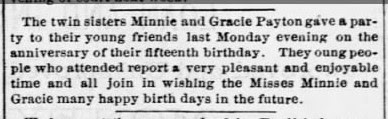
Grace and Minnie celebrate their 15th birthdays
Newspapers.com - The Howard Courant 1 December 1881
(supports a birth year of 1866 for the twins) - apparently Gracie and her friend Minnie Momma paid a visit to the newspaper office, according to an item in the same issue:


By the time of the retroactive Civil War orphans' pension applications begun on their behalf  by their mother in March of 1890, both Minnie and Grace had new married names. Minnie is now Mary Simmers (sometimes given as Simmons) and Grace is Martha Lemon. 

Grace's married surname might foreshadow the biggest "oops!" of her life. 

The marriage record that has been uncovered for Gracie Edwards and John Fillmore Lemon shows that their marriage didn't occur until the following year - 5 January 1891 in Fredonia, Wilson, Kansas. By that time, they had had two children: Winfield Scott Lemon, born 29 July 1886 in Winfield, Kansas and Maud Lemon, born in December of 1887 in Independence, Kansas. 

John Fillmore Lemon was more than ten years Grace's senior. He had been married in Illinois in 1878 to a woman named Mary E. Barber. At least two sons (Albert and William) had been born to them. No record of a divorce has been located. Apparently he worked on the railroad, and this may explain how he was able to meet Grace who was living in Kansas.

John Fillmore Lemon in foreground

A health report appeared in the local paper for John F. Lemon in September of 1890, wherein he is referred to as the son-in-law of Henry Barber (presumably wife Mary Barber's father). 

Independence Daily Reporter, Independence, Kansas for 3 September 1890 in Newspapers.com

Ill or not - and still married to Mary or not - John was definitely in a relationship with Grace. His surname was used in her 1 December 1890 Civil War minor's pension application. 

Portion of Grace's Civil War Orphan's Pension Application Dated 1 December 1890
(Signed by her as Mrs. Martha Lemon - the actual marriage occurred one month later)

Grace and her sister had immediately taken over their own application process after their mother Barbara's death just over a week earlier on 22 November 1890. What difficult times these must have been for the family! 

It would be informative if the 1890 U.S. census were available to show who was living where and with whom; presumably John and Grace would have been living in Kansas with their two young children. The Lemon family does show up living together in Pueblo, Colorado ten years later in the 1900 U.S. census:


John and Grace with children Winn and Maud in the 1900 U.S. Census, living in Pueblo, Colorado 
(the 2/2 beside Grace's name indicate that she has given birth to 2 children, both of whom are still alive and the 16 listed for both John and Grace indicate they had been married 16 years, when their official marriage record would indicate 9 years.)

A family photo from Colorado was provided by one of Winn's descendants.

Grace, John, Maud and Winn Lemon in Pueblo, Colorado

If Grace was in fact the proverbial "other woman", all did not remain wedded bliss between her and John. The 1908 newspaper headline could not resist reporting this Oops!:

The Deseret Evening News, Salt Lake City, Utah, 4 August 1908 from Newspapers.com

(Perhaps the statement that "there are no children" does not mean that they never had any, just that the two children were now adults. In fact both are now married and can be found with their spouses in the 1910 U.S. Census.)

By 1910, John Lemon is single and one of a long list of boarders living in Boulder, Colorado, working in a stone quarry. 

John Lemon in 1910 U.S. Census

This was apparently not the life John wanted for himself. After this, he seems to have ingratiated himself with his first wife Mary and is once again living with her and their two adult sons in Ohio by the time of the 1920 census.

John and Mary Lemon with sons in Ohio, 1920 U.S. Census

Grace seems to have escaped the Oops! factor thereafter. 

Immediately after her divorce from John Lemon, we find her getting married again on 12 August 1908 to Henry Bradshaw ("Brad"),  a man some 15 years her junior. (Like her sister Minnie and mother Barbara, she sometimes fudged her age a bit. All three often seemed to get away with claiming to be younger than their years, especially when in relationships with younger men.) That same year, they relocated to Portland, Oregon, where we find them in the 1920 U.S. census.

Henry and Grace Bradshaw in Portland, Oregon in the 1920 U.S. Census


Brad and Grace (center front) at the Cliff House, San Francisco in 1907


Brad and Grace, Portland, Oregon 1916

The couple seemed to enjoy their lives together until her untimely death in her mid-50s in Tacoma, Washington on 20 September 1921. 


Some Resources:

  • Edwards, Lewis C. (Pvt., Co. M, 112th Ill Vol. Inf.), Civil War widow's pension application no. 394,573, certificate no. 265.106 and minors' pension application no. 418,303, certificate no. 265.106 ; Case files of Approved Pension Applications, 1861-1934, Civil War and Later Pension Files; Department of Veterans Affairs Record Group 15; National Archives, Washington, D.C.
  • Lemon, Winfield Scott, Personal Memoirs "Compiled at the request of his grandson Dick," copy provided to the author by Richard Lemon.


Labels: , ,

Friday, 13 November 2020

George Gardiner (c1650-1724) (52 Ancestors 2020 Week 47) Theme: "Good Deeds"

"Deed" can have a couple of distinct meanings: first, as an act or gesture illustrative of one's character, and secondly, as a legal document signed and delivered regarding ownership of property. Those two meanings intersect in George Gardiner's story.

But for the bold enterprising nature of his mother, my 8X great grandfather George might never have been born. And he certainly would never have shared in the ownership of substantial lands acquired through the good deeds of his mother's generous third partner. 

General area of the Good Deeds - South Kingstown, R.I.
Google Earth

To understand how these good deeds came about, it is necessary to explain a bit of the history of his parents. George was born about 1650 in Newport, Rhode Island to George Gardiner senior and Herodias Long. Both George senior and Herodias had had prior marriages and never officially married each other, instead following the Quaker custom of standing before witnesses and swearing to live together as husband and wife. From all appearances, they lived together happily as husband and wife for a couple of decades and had seven children, the third of whom was the George of our story. 

George's mother Herodias was a fanatic Quaker, at one time willingly walking some 70 miles from Newport to Boston with a young child in her arms to receive a whipping at the post for her religious beliefs.

When their relationship eventually soured, Herodias claimed that George was no longer supporting her and the children. She also claimed to regret having lived with George without going through a proper form of marriage. Thus on 3 May 1665 we find George Gardiner senior brought before the General Assembly court upon the petition of "Hored Long alias Gardner, his reputed wife."

According to Herodias, she had been forced to move in with Gardiner for the support he could provide following her divorce from her first husband, John Hicks. She said she had repeatedly begged  Gardiner to set her up in a separate house and "not to meddle with mee." This must be greeted with a healthy dose of skepticism since she appears to have been a strong-willed woman quite capable of standing up for herself.

The General Assembly found themselves unable to grant her divorce since there was no actual marriage to terminate! They decreed that Gardiner cease to trouble her and that the couple pay a fine for having lived together without being married.  

HOWEVER, the true cause of her wish to free herself from Gardiner can be found in another petition to the same General Assembly. Margaret Porter, wife of John Porter, a wealthy Rhode Island landowner, complained to the court that her husband had deserted her and gone to Pettaquamscut leaving her without means of supporting herself. In her petition, Margaret said that her husband "is destitute of all congugall love towards her, and suitable care for her". She requested that Porter be required to support her from his large estate. Porter was a well-respected member of the community and was expected to behave accordingly. The General Assembly sided with Margaret and ordered Porter to support her, which he arranged to do within the month. 

By this time, Herodias had already moved in with John Porter at Pettaquamscutt. Porter was one of the original purchasers of a huge tract of land called Pettaquamscutt from the Indian sachems of an area around what is now South Kingston, R.I. At first, the pretense was that she was working for him as his housekeeper, but no one really believed this. They were brought to court for living together without being married, but no mention can be found of any penalty or reprimand. 

Porter conveyed large tracts of his lands to her children, supposedly to fulfill a promise he had made to Herodias at the outset of their relationship. No record of a marriage between this couple has been found.


1724 Map of the 1657 Pettaquamscutt Purchase - Public Domain Image
John Porter's Pettaquamscut lands showing transfers to Herodias's sons

Divorce was almost unheard of at the time. One can only imagine how this scandal would have affected the children of the two divorcing couples. George junior would have been in his mid-teens at the time. 

About five years after all this turmoil, George Gardiner junior at about age 23 married Tabitha Bethiah Tefft. This couple would not cause any scandal during their lengthy marriage, during which they had a large family of at least 9 children (the 6th of whom was my 7X great grandmother Hannah Gardiner). 

It was during the early years of George and Tabitha's marriage that his stepfather John Porter performed his own good deed by transferring good title deeds to lands to George and his siblings.

Historical Marker regarding John Porter's acquisition of the lands
subsequently transferred to stepchildren including George
Photo used with permission of trashpaddler.com

George junior appears in the records only for such matters as having taken the oath of allegiance on 19 May 1671. On 16 November 1678 he and wife Tabitha sold Nicholas Gardiner 60 acres. Then on 29 January 1700, he and his wife for the love of their son Nicholas deeded him 60 acres of land.

On 17 November 1705, George and brothers Benoni, Henry, William and Nicholas, along with wives Tabitha, Mary, Joan, Elizabeth and Hannah Gardiner and Rebecca Watson, all of Kingstown, sold 410 acres on Point Judith Pond to John Potter for 150 pounds to be paid to Thomas Hicks of Flushing, Long Island.  (Thomas was a half brother of George, being a son of Herodias and John Hicks.) The good deeds continued.

George lived to about age 74, dying and being buried at Kingston, Rhode Island. Although there is no marker for his grave, he is believed to be buried in the Nathan Gardner Lot at South Kingston, Rhode Island.

Some Resources:

  • Archer, Richard, "Fissures in the Rock: New England in the Seventeenth Century", University of New Hampshire, 2001, pages 73-77
  • "Genealogies of Rhode Island, Volume 2", page 523
  • Moriarty, G Andrews, "Herodias (Long) Hicks-Gardiner-Porter, A Tale of Old Newport" from "Genealogies of Rhode Island, Volume 1", pages 599-607
  • "Some Notes on 18th Century Block Island", NEHGR Register, Volume 105, page 258
  • Wikipedia article for Horodias Long and John Porter accessed online 8 November 2020
  • Robinson, Caroline E, "The Gardiners of Narragansett, Being a Genealogy of the Descendants of George Gardiner the Colonist 1638", Providence Rhode Island 1919

Labels: ,

Friday, 6 November 2020

Norwegian Ancestor Kittel Guttormsen (c1758-1836) (52 Ancestors 2020 Week 46) Theme: "Different Language"

 Having more than 50% Norwegian ancestry, it was clear to me from the beginning that at some point I would be faced with researching in Norwegian.  It turned out to be not only manageable but fairly accessible, even to someone with little knowledge of the language.

Complications with the Norwegian language arose because of Norway's history of being controlled by Denmark for several centuries until 1814. For a long time, Norwegian was much like Danish and then another version developed to move away from Danish and be more distinctly Norwegian. This resulted in a couple of variations of the Norwegian language, which have subsequently moved into a single form. As a result, modern Norwegian usage may be quite different from that found in the old church records. 

Another thing that distinguishes Norwegian is that is has 29 letters to its alphabet rather than the 26 we have in English. The additional three letters are all vowels (æ, ø and å) and occur after "z" - something to always keep in mind when searching an index for a word in alphabetical order! Although these additional Norwegian vowels do not appear on most keyboards, there are codes for getting these letters to type in computer programs.

To add additional challenge, the old style Gothic writing in the kirkebøker (church books) varies considerably in legibility and, even with the best penmanship, can be difficult to decipher.  See some examples further below.

Notwithstanding these challenges, it is important to recognize that you don't need to be fluent in a language to be able to read basic records. You can quickly pick up the basic words relating to gender, number, birth and baptism (døpte), marriage (viede, copulerede), death (døde), burial (begravede), censuses (folketellinger). Often, there is some similarity of the Norwegian word to its English counterpart.

In addition to using an online translator such as Google Translate, a Norwegian-English Dictionary can come in handy. Remember that you might find a Danish-English Dictionary of more use in some cases. For most basic research, a list of the usual Norwegian words used in genealogy is sufficient, such as the one at the Family Search wiki (see Resources below). 

English-Norwegian-Danish Dictionary compiled by Haldor Hanson, Chicago:
John Anderson Publishing Co., Publishers Skandinaven, 1912

Because the state Lutheran Church was mandated to keep all the vital records for Norway, excellent records are available well back into the 1600s. When I first started researching my Norwegian ancestors, it was necessary to scroll patiently through microfilms, sometimes several for each parish, by ordering them from Salt Lake City. Subsequently, most church records and several censuses have been freely obtainable online from the National Archives of Norway (Arkivverket). 

I have conducted research on dozens of my Norwegian ancestors with the very basic Norwegian language skills I have picked up. As an example, this week's story will focus on one of my mother's Norwegian paternal ancestors. 

Kittel Guttormsen is my 4X great grandfather. Norwegian naming practices also vary from what we are used to in the English/American world where we tend to have a given first name, sometimes a middle name and always a surname, usually passed down from the father. In Norway, there was a given name and a patronymic name based on adding the suffix "sen" or "datter" to the father's first name.  Just from his name, we know that Kittel Guttormsen's father's first name was Guttorm. To get away from the problem of so many names being essentially the same, individuals could be differentiated by adding their (farm) location as an identifier. Hence, Kittel is sometimes known as Kittel Guttormson Opsahl. To add to the confusion, however, if a person moved during his lifetime, that part of the name changed accordingly!

Kittel was the second child born to Guttorm Bjørnsen Nareim and his wife Siri Kittelsdatter Mjøseng. (We can see that Kittel was named for his maternal grandfather, a common practice.)  At the time of his birth in about 1758, his father was farming Nareim farm in Sigdal parish, Buskerud. Kittel was baptized there on 15 July 1759.

Døpte (Baptism) record for Kittel Guttormsen from the Sigdal Kirkebok

In 1778, Kittel's father bought half of the Nedre Opsal farm in Lier parish some 30 miles distance from Nareim farm in Sigdal parish. After the father's death in 1784, widowed mother Siri transferred half this land to Kittel and the other half to his brother Gullik. The farm book describes a lot of financial transactions, including mortgage loans and payments made, values for the property and earnings. Apparently there was a mill on the property valued at 500 dlr. 

On 24 July 1792, Kittel married Johanne Nilsdatter.

Copulerede (marriage) record for Kittel and Johanne from the Lier Kirkebok

The land transactions  remained convoluted and continued over the years. Complex descriptions in Norwegian are definitely beyond my current skill level with the language. The Farm Book describes the following according to Google Translate:

In 1792, Kittel sold in 1796 from a fehage, 1 lp.m which lay on the north side of the garden. In 1801, along with a part of Klemmetsdal, Gullik sold a small piece of wood, "located at the top of Opsalfjellet", to Asle Nilsen from Strømso. The owners of this piece of wood should answer 6 divorces. Annually, "all-time owners of Garden Opsal." In 1804, Kittel digged on Gullik's part of the garden for 600 dlr, and then took the mortgage for the entire purchase price. In the beginning of the 1800s he entered into contact with the other users at Nedre Opsal regarding the dragon horse . Kittel took a mortgage loan of 100 spd. In 1819. The following year, debt grew by 170 spd. In 1823 he issued a joint for 800 spd. and the livestock of the son Gunder Kittelsen. . .

You can see Google Translate does not provide a nice comprehensible translation. Norwegian friend Ragnild assures me that Norway does not have dragon horses and this should have probably been translated as a draw horse for pulling loads. Goodness knows what answering 6 divorces really should have said!

Aside from all these property transactions, Kittel and Johanne also raised their family. They had sons Gunder (my 3X great grandfather) and Nils and daughters Ingebor, Siri, and Anne. 

Gunder and  Johanne and their first three children show up in the 1801 Norwegian census living at Opsahl farm in Lier, Buskerud.


Folketellinger (census) from 1801 for Lier, Buskerud


Kittel died 25 February 1836 and was buried at Tranbye on 10 March. 


Døde og begravede (death and burial) Lier Kirkebok 1836
accessed from the Norwegian Digital Archives

Understanding just a few basic words in Norwegian took us all the way from Kittel's baptism to his burial. Now I must expand my language skills to figure out what that translation about the 6 divorces really meant!


Some Resources:

  • FamilySearch.org research wiki for aids to researching in Norway, accessible online at https://www.familysearch.org/wiki/en/Norway_Genealogy and for a list of the more common Norwegian words used in genealogy at https://www.familysearch.org/wiki/en/Norwegian_Genealogical_Word_List
  • Thomsen, Finn A., Genealogical Maps & Guide to Norwegian Parish Registers, Thomsen's Genealogical Center P.O. Box 588, Bountiful Utah 84010, 1988
  • Norwegian Digital Archives accessible online at https://www.digitalarkivet.no/en/
  • Bjerkås, Ola, Liers Historie Bind III Gårdhistorie, Utgitt av Lier Bygdeboknemnd (Farm Book for Lier, Buskerud)

Labels: ,

Thursday, 29 October 2020

Carl Johan Nelson (1839-1911) (52 Ancestors 2020 Week 45) Theme: "Bearded"

When I sit to spend time on my family history, my Dad's two sets of grandparents watch over my shoulder, as if trying to ensure that I tell their stories fairly. They gaze at me rather sternly, seemingly rebuking me for some failure on my part. How I would love to have a nice chat with them to get more detailed stories in their own words so that I could truly do them justice!


My Dad, Ken Bardahl, really appreciated family history. When he found these two pictures at the Bardahl homestead farm, abandoned  and unframed, he scoured the antique and collectibles shops until he found the two domed-glass frames. After Dad passed away, my siblings graciously agreed that I should take possession of these treasures, and that's how they come to watch over my shoulder, admonishing me to get their stories right.
 
Although both of Dad's grandfathers are bearded in their photographs (as was the fashion in the late 1800s), this time it's Carl Nelson's turn to be featured. Dad never met this maternal grandfather who appears in the top picture on the left. In fact, he only ever met one grandparent, namely Anna Elton Bardahl, and that just during one visit when Dad was 4. The stories about his other grandparents can be found here: 

Carl Johan Nelson c.1890
(No picture has been located for Carl without his beard)

Carl was born 26 August 1839 in Norderhov, Ringerike, Buskerud, Norway to Nils Olsen and Guri Larsdatter. His parents never married, and his baptism was unusually delayed, for almost a year, until 8 June 1840.

Baptism and birth record for Carl Nelson from the Norwegian kirkebok for Norderhov, Buskerud

As was traditional, he was confirmed into the state Lutheran church when in his mid-teens. On 25 June 1854, his confirmation appears in the Kirkebok for Norderhov.

1854 Confirmation record for Carl Nelson from the Norwegian Kirkebok for Norderhov, Buskerud


The next time we find Carl in an official record is in the 31 December 1865 folketelling (census) for Norway. He is unmarried, 27 years old and working as a hired man on the farm of Anders Engebretsen in Norderhov. Living conveniently nearby, listed on the same page in the census, is a 24 year-old woman named Marie Nilsdatter. 

Carl married Karen Marie Nilsdatter on 3 July 1866 at Norderhov. Their daughter Gunhild (Julia) was born the following month. They were only married a few months when Carl, Karen and Gunhild joined thousands of their countrymen in emigrating to America. Bundling up their possessions and leaving all they knew to sail across the Atlantic in the dead of winter must have been challenging and at least a bit scary. 

Uttflyted record from the Norderhov Kirkebok
showing the family leaving the parish for America

At first, they settled in Salem Wisconsin but soon moved to Douglas County, Minnesota where they remained for 9 years.  While there, Carl became a naturalized American citizen on 3 October 1872.

1872 Carl Nelson American Naturalization

(It is interesting to note that in making this application, Carl had to renounce all allegiance to the King of Sweden and Norway. Norway at that time was under the reign of the King of Sweden in a rather complex relationship between the countries.)

Carl and his family made one final move in 1876 to the area of Erdahl, Grant, Minnesota where they lived out their lives.

Carl Nelson's land just southeast of Erdahl, MN
Erdahl Plat 1900


Carl and Karen had a family of 8 children, 7 daughters and one son. Most of the children were born during their time in Douglas County, MN, but the two youngest, Josephine and my grandmother Louise, were born after the move to Grant County.

Carl and Karen's Family c.1890 with identification of some of his daughters in Carl's fine handwriting
(Note the daughters' surnames are all given as Carlsdatter in the Norwegian patronymic tradition)


The following photograph is from 1898 at Carl's farm at Erdahl where he appears in his trademark beard working the land with son Nels.


1898 image of Carl (right) with son Nels, farming at Erdahl


One final photograph shows an apparently older Carl on his own, once again in his signature full beard.

Carl Nelson c.1910

Carl died at the age of 72 at 2:00 a.m. on 4 December 1911, after an illness of more than a year. From his obituary, we learn that "Mr. Nelson was an old member of the Pomme de Terre lake congregation of the Synod Lutheran Church, and took an active part in its work. His death is a distinct loss not alone to the congregation but also the community of which he was a part." His funeral was on Friday, 8 December and interment in the Synod Cemetery.

1992 - Carl's grandson Ken Bardahl and his wife Elinor visit Carl's grave


Some Resources:

  • BBC History Magazine article on the History of Beards accessed 18 October 2020 at https://www.historyextra.com/period/victorian/a-brief-history-of-beards/
  • Norwegian digital archive records for Norderhov, Buskerud Kirkebøker (church books) accessed online at https://media.digitalarkivet.no/en/kb/browse


Labels: , ,

Friday, 23 October 2020

Ichabod Crane's Neighbor: Henry Christian Vought (1760-1842) (52 Ancestors 2020 Week 44) Theme: "Scary Stuff"

The Headless Horseman chasing Ichabod Crane through Sleepy Hollow is scary stuff indeed!

"The Headless Horseman Pursuing Ichabod Crane"
John Quidor, oil painting 1858, Smithsonian American Art Museum
Public Domain image https://commons.wikimedia.org/wiki/Template:PD-US

In the story, superstitious school-teacher Ichabod Crane is vying for the hand of Katrina Van Tassel, but rival Brom Bones has his own agenda. After a night of ghost stories (many told by Brom), Ichabod is chased home through the spooky countryside and disappears after the "head" is tossed at him. All that is to be found the next day is his trampled saddle and a shattered pumpkin.  

Ichabod Crane was a fictional creation by Washington Irving in his 1820 gothic tale "The Legend of Sleepy Hollow".  My 5X great grandfather Henry Christian Vought was a flesh and blood man who lived in the place and time of Ichabod's scary ride. 

Irving's Headless Horseman was believed to have been based upon a real Hessian soldier who was decapitated by a canonball during the Battle of White Plains in the American Revolution around the time of Hallowe'en in 1776. Sleepy Hollow was inspired by North Tarrytown (now renamed "Sleepy Hollow"), a Dutch settlement where Irving had fled as a teenager to escape a yellow fever outbreak in nearby New York City. 

About a dozen miles from Sleepy Hollow is another Dutch settlement where my 5X great grandfather Henry Christian Vought was born, lived his life, fought in the American Revolution, died and was buried. This is the area around Peekskill and Courtlandt. If there is something homogeneous in the nature of the Dutch settlers and of the brutality of American Revolutionary War battles in Westchester County, Henry Vought is notionally Ichabod's neighbor.

Google Earth - Henry Christian Vought and Sleepy Hollow locations Westchester, N.Y.


Although Ichabod is an almost unknown name today, it comes from the Hebrew meaning "without glory" and appears in the first Book of Samuel in the Bible.  Certainly Ichabod Crane was aptly named for his ignominious disappearance from Sleepy Hollow.

Henry Christian Vought, on the other hand, did achieve glory for one particular event during the Revolutionary War.

 According to an Affidavit sworn by Henry in his application for a pension for his Revolutionary War service: 

I was born in the year 1760 according to the best information I have on the subject, in the village of Peeks Kill Town of Courtlandt County of West Chester and State of New York. My age is recorded in the Church Books of the Dutch Reformed Church in the town of Courtlandt to which Church my parents belonged.

The full US Revolutionary War Pension and Bounty - Land Warrant Application Files, 1800-1900 is available for Henry C Vought of New York, West Chester. From it we learn that Henry was a private in the Company of Captain Slows commanded by Colonel Van Duyck for 2 years. He was paid his pension at the rate of $80 per year commencing 4 March 1831. His pension application was made when he was 72 years old (actually indicated he would be 72 on 16 February 1833). In his affidavit, he described his service as follows: 

I first entered the service of the United States by enlisting in the service for the period of one year under Capt Slow in Col. Hughes Regiment in the regular line of the State troops of New York and served out the period of my enlistment at Kings Ferry in the County of West Chester and Rockland being constantly employed in ferrying across back and forth, the Army Cattle and Provisions for the army and such like services. This enlistment was in the year 1778. - I again enlisted in the year 1780 in the same service for 12 months (twelve months) in the Company of Capt. Bond in the same Regiment and served out the time at Kings Ferry aforesaid in the same services as before detailed. - My next enlistment was in the same year Cornwallis was taken into a Company of Rangers commanded by Capt. Jacket in the Regiment of Col Van Duyck in the State troops of New York for the period of nine months during this enlistment some part of my time I was stationed with the standing Army at Pines Bridge in the County of West Chester; at other times we ranged from the North to the East River in different parts of the County of West Chester. - During this enlistment I was in the skirmish at Mile Square near the town of Bedford in the County of West Chester where Col Holmes with a Party of Tories surrounded us and we cut our way thro' killing one man and wounding fourteen. - I served my time out and was regularly discharged with the rest of my company. - Besides these services while regularly enlisted I was frequently called out in the Militia in Alarms and Scouting Parties. 

His service would seem to range from the mundane ferrying of provisions to taking part in what must have been a very scary skirmish. In addition to the possibility of death or serious injury, if taken prisoner of war, a soldier's fate would have been possible death by starvation or disease aboard the notorious prisoner of war ships anchored in New York Harbor. The skirmish is described further in his October 1842 obituary in the Peekskill Highland Democrat newspaper.

Highland Democrat October 1842

Unfortunately (as can be seen in the above image) some crucial wording cannot be read in this version of the obituary. However, piecing this together with another transcription located in the Wadsworth history leads to the following description: 

Mr. Vought belonged to a corps of men sent out on a scouting party, commanded by one Lieut. Mosher, with a heart of oak. While the Lieut. was at breakfast with his men somewhere in the vicinity of  Whiteplains, he heard the alarm of the approach of a Squadron of British dragoons. In haste he formed his little band of about twenty men, into a hollow square, the soldiers dropping down with one knee on the ground, elevating their pieces with fixed bayonets to a angle of forty five degrees. The Tory Col. Holmes commanded the Squadron, determined with his horsemen to surround and take these wanderers with him to the British. He offered Lieut. Mosher the most honourable terms of capitulation, which were cordially reciprocated by the Americans, but promptly declined on both sides. Col. Holmes, sure of success, made a violent assault upon this more than spartan band, but the phalanx after repeated assaults still remained unbroken. The assaulters were at last drawn back with disgrace and loss, while the brave Lieut. brought off his men in safety and in triumph.

Gen. Washington gave an account of this gallant and unparalleled affair in his communication and Congress passed a voice of thanks to this distinguished Corps for their valorous achievement.

Henry Christian Vought married Rebecca Nelson in about 1781. They had several children, including daughter Margaret Vought, my 4X great grandmother (whose quilts feature in another story).

He lived out his life in the same vicinity as shown on the map above, dying in Cortlandt 7 October 1842. His obituary in the Highland Democrat begins:

DIED At Annsville, Cortlandt Town, on the morning of Friday the 7th inst., Mr. Henry Christian Vought, aged about 84 years. Mr. Vought belonged to a Revolutionary - Whig family! He was himself a soldier in the Revolution, throughout the war; and lived long and respectably for better than half a century in the full possession and enjoyment of the peace and prosperity won by his valour and that of his companions in arms, and died at last full of years and full of honour. Mr. Vought bore a most conspicuous part in one of the remarkable skirmishes that tried American skill and bravery in the whole war.

He was buried at the Old Episcopal Church of St. Peter's at Cortland. Certainly his was a  much happier and dignified ending than that met by his "neighbor" Ichabod Crane!

Photo Courtesy Gene Baumwoll CSW on www.findagrave.com
Plaque indicates that 44 known Soldiers of the American Revolution are buried here -
Henry is in good company


Some Resources:

  • Borkow, Richard, Westchester County, New York's Role in the Revolutionary War, Westchester Magazine 2013, accessed online 12 October 2020 at https://westchestermagazine.com/uncategorized/westchester-county-new-yorks-role-in-the-revolutionary-war/
  • History.com website accessed 6 October 2020 at https://www.history.com/news/legend-sleepy-hollow-headless-horseman
  • Lee, Francis Bazley, Genealogical and Memorial History of the State of New Jersey, New York: Lewis Historical Publishing Company, 1910.
  • Wadsworth, John Ogden, Walcott, New York, Old and New, photocopy of pages 510-511 in possession of the author.

Labels: ,

Friday, 16 October 2020

Kenelm Winslow (1599-1672) (52 Ancestors 2020 Week 43) Theme: "Quite the Character"

Does the name make the man? Call a  man John or Edward and he may grow into the upstanding conventional sort of man those names seem to evince. Call a man Kenelm and it's quite possible he will be just a wee bit eccentric. At least that's my theory about why he among his Winslow brothers is the one who grew up to be quite the character!

Kenelm (my 8X great grandfather), born 30 April 1599, was  the fourth child born to Edward Winslow and Malgdalene Ollyver of Droitwich, England.  The names of his seven siblings were: Edward, John, Eleanor, Gilbert, Elizabeth, Magdalene and Josiah. Kenelm was named for his paternal grandfather, though we don't know whether the grandfather also had proven to be a bit of a character.

The Winslow family was quite well-to-do with father Edward owning a salt production business. The family home called Kerswell is still a magnificent home. My husband had made prior arrangements with the owners who graciously allowed us to have a tour inside the home on our 2004 visit to England. 

The old Winslow family home - Kerswell, photo taken 1998


It felt like such a tangible connection to be able to touch the ancient exposed beams that would have been touched centuries ago by Kenelm and his family. 


Lovely old beams from the time Kenelm grew up here at Kerswell, photos 2004


Of the five Winslow brothers, oldest brother Edward is the best known. He and younger brother Gilbert were both passengers on the Mayflower that arrived in America 400 years ago. (Gilbert returned to England within a few years and little is known of him.) Edward apprenticed as a printer and joined the Separatist religious group in Leiden, Holland, where he was involved in the underground printing activities of the dissident congregation. Once in America, Edward was one of the first signers of the Mayflower Compact, was a well-respected leader in the colony and is renowned for his report about that well-known first Thanksgiving at Plymouth Colony. 

Brother John Winslow (my 10X great grandfather) followed on the ship Fortune in 1621. He was a ship owner and respected businessman and took an active role in civic affairs like his older brother Edward. 

Another brother, Josiah, also arrived in Plymouth Colony in its early years, but he is sadly remembered for making a total shambles of trying to straighten out the financial affairs of the Colony. 

And then there was Kenelm.

He would have been about 30 when he arrived, unmarried, in Plymouth Colony. Unlike older brother Edward, his was not primarily a move for religious reasons. In fact, he sometimes found himself at odds with the church in his new home community, as we shall see. 

In 1634, he married the widowed Ellen (Newton) Adams. At the time of this marriage, Kenelm Winslow put up security to pay James Adams, Ellen's son from her first marriage, 5 pounds when he came of age. Kenelm was a man of his word: this was done and recorded on 26 December 1651. He and Ellen would have four children of their own, the oldest of whom was another Kenelm Winslow, my 7X great grandfather. 

In many ways, Kenelm was, like his brothers, an upstanding man and a major contributor to his new community. Having completed his seven year apprenticeship to Abraham Worthington prior to leaving England, he had been admitted to the Joiners' Company of London, England in about 1624. As a joiner, he would have designed and built much of the furniture needed by the colonists.  Kenelm was also known as the colony's coffin-maker.

Langdon (pp. 28 and 32) describes the significance of joiners to the community:  

The early settlers also made chests for themselves. They had joiners or cabinetmakers as they called them rather than carpenters, who did any work with wood for them that required skill in the mortise and tenon construction from building a house to making a chest or stool.  John Alden and Kenelm Winslow were the "joyners" of Plymouth.  They made chests and chairs and other furniture no doubt for the Pilgrims. . . .  From Plymouth Colony mostly there has come a type of chair, or two similar types of chair which are indeed instinct with dignity and certain formality but not so repellent in their magnificence.  These are the Carver Chair and the Brewster Chair.  It seems reasonable to believe that  John Alden  and Kenelm Winslow made quite a number of these, especially for the older leaders of the Colony.  There are chairs of these types extant ascribed to the ownership of Governor Carver, Elder Brewster, Captain Miles Standish and Edward Winslow.

Examples of Plymouth Colony furniture of the period can be found at the Plymouth Hall Museum website. 

In addition to his contributions to making the necessary furniture and coffins for the colony, Kenelm also took an active role in civic life. In 1635 he was one of the men chosen to assist the governor and council to set rates on goods and wages. In 1638 John and Kenelm Winslow were witnesses against Stephen Hopkins for selling wine at excessive prices. One might assume that they were just doing their rate-setting jobs, but it may equally have presaged Kenelm's propensity to take matters to court.

He was elected the town's highway surveyor where we get an early glimpse of him marching to the beat of his own drum. On 1 December 1640, he was fined 10 shillings for neglecting those surveying duties.

The following year, the Winslow brothers moved their families to Marshfield where Kenelm was living in 1646 when he was jailed for four weeks for for  using "approbrious words" against the church of Marshfield, calling them all a bunch of liars.

Memorial to the Early Settlers of Marshfield
Kenelm Winslow and wife Ellen listed between brothers Edward and Josiah and their wives


While resident in Marshfield, Kenelm was Deputy to the General Court 1642 - 44 and 1649 - 53. On 1 June 1647 he was chosen constable for Marshfield.   He served on juries and committees, but one sometimes gets the sense that he might have been granted these respected positions based in large part on the success and reputation of his older brothers. 

Stratton describes the many instances of Kenelm's litigious nature (pp. 376-77):  

On 4 June 1645 a committee examined his complaint of injustice and found it to be untrue.  He had said that he could not be heard in a case between himself and John Maynard, but the committee found the judge and jury without fault and ordered Kenelm imprisoned and fined 10 pounds.  On his petition the same day in which he acknowledged his offence and sorrow for same, he was released from imprisonment, and his fine was suspended for one year, and then if he showed good behavior, it would be remitted.  

On 5 May 1646 Kenelm was sued by Roger Chandler for detaining his daughter's clothes on pretense that she owed him further service, and the court ordered Kenelm to return her clothes immediately.

On the same day the court ordered Kenelm to find sureties for his good behavior for uttering those approbrious words against the Marshfield Church, having called them all liars. When he refused to do so, he was sentenced to prison, where he remained until the next month's court. 

Perhaps his month in jail taught him a valuable lesson for he seems to have gone quiet for awhile after these episodes. Still, one can imagine him in his workshop laboring over the next piece of furniture while fuming over some perceived slight, but he held things in check, at least for awhile.

Old habits die hard. On 7 March  1653/54 Kenelm complained against John Soule for speaking falsely of his daughter Eleanor by scandalizing her in carrying reports of her and Josias Standish. John Soule's father George requested that the matter be referred to another court to be tried by a jury of twelve of his equals, but  there is no further mention of the matter so perhaps the complaint was simply dropped. And that seemed to mark the end of Kenelm's public complaints.

Kenelm may have been a character who got himself embroiled in controversy, but he was not alone. People then were much like people now, notwithstanding their Puritan reputation. Cullity (p.9) recounted a couple of lawsuits involving my 7X great granduncles Joseph and Nathaniel Turner in nearby Scituate (spelling in the following as in the original): 

Consider the language and behavior reported in the suit brought by Charles Stockbridge and his wife, Abigail against Joseph Turner of Scituate in 1669. The two charged Turner with slander and defamation for reportedly saying that "the said Charles Stockbridge is a coocally rogue, and that Abigail, his wife, is as very strumpet as an in New England, and that the said Abigaill is a brasen faced whore, and that her husband is a coocally raskall, and he would prove him soe." Turner was fined 100 pounds. Another case in the same year involved the same Charles Stockbridge, but on the other end of the stick: "Mr. Joseph Tilden (1657-1712) complained against Charles Stockbridge, of Scituate, in an action of slander and defamation, to the damage of 1000 pound, for saying and reporting that Nathaniel Turner and Joseph Turner could kisse Elizabeth, the wife of the said Tilden, as ofte as they listed, and doe something else too, and that the said Nathaniel Turner knew her, the said Elizabeth Tilden, as well as her owne husband knew her.

Yes, this is of more than prurient interest in connection to today's story. Kenelm's great granddaughter Sarah Winslow would in the course of time marry James Whitcomb, the granddaughter of Nathaniel and Joseph Turner's sister Mary Turner. 

In any event, Kenelm lived another couple of decades, apparently in greater harmony with those around him. His eldest brother Edward died in Jamaica in 1655 while on colony business. Brother John had moved his family to Boston by then. No longer having his more successful brothers in  Marshfield may have put an end to much of his community involvement. 

Kenelm signed his will dated 8 August 1672. He must have had a premonition of his impending death which occurred 12 September while he was visiting his daughter at Salem; he was buried there the following day. His wife Ellen was named sole executrix of his estate which included real estate, money, goods and movables including a Bible and 7 other books. 

Some Resources:

  • Anderson, Robert C., The Great Migration Begins: Immigrants to New England 1620–1633, 3 Volumes (Boston: New England Genealogical Society, 1995–1996), Vol.3  pp. 2033-2036.
  • Cullity, Brian (Chief Curator), A Cubberd, Four Joyne Stools & Other Smalle Thinges: the Material Culture of Plymouth Colony, Printed for the Loan Exhibition May 8 - October 23, 1994, Heritage Plantation of Sandwich.
  • Follansbee, Peter, Connecting a London-Trained Joiner to 1630s Plymouth Colony article accessed online 15 October 2020 at https://www.incollect.com/articles/connecting-a-london-trained-joiner-to-1630s-plymouth-colony
  • Langdon, William Chauncy, Everyday Things in American Life 1607-1776, MacMillan Publishing Co., 1981.
  • Roberts Gary Boyd, Mayflower Source Records: Deaths and Burials from the Early Records of Marshfield, accessed 9 October 2020 on ancestry.com, Baltimore: Genealogical Publishing Co., Inc., 1986.
  • Stratton,  Plymouth Colony: Its History and People 1620-1691, Ancestry Publishing 1986.
  • Williston, George, Saints and Strangers, New York: Reynal and Hitchcock 1945.


Labels: , , , , ,