Thursday, 3 September 2020

Teaching in One-Room Country Schools: Idella Edwards (1897-1976) and Elinor Anderson (1926-2016) (52 Ancestors 2020 Week 37) Theme: "Back to School"

First Generation: Idella 

Education was of utmost importance to my Grandma. Next to "eat your greens!", her favourite precepts included "get an education!" and (perhaps only aimed at her equally serious granddaughter) "for the love of Mike, smile!" She had lots of other passions and great values to instill, but this week the focus is on school.

Idella ("Della") Edwards was born in Great Falls, Montana on 28 July 1897, the first-born child of Charles F. Edwards and Mary Jane ("Mayme") Wescott. Three sisters and two brothers would come along to complete the Edwards family.


From Grandma Della's Album - with her comment (the same thing she often said to me!)

When Della started school (September 1903) she could simply walk across the street to Longfellow School in Great Falls. However, when she was 12, the family moved to a small fruit farm near Lake Blaine, N.W. of Kalispell and about 30 miles from the western entrance to Glacier Park. Della and her siblings attended Cayuse Prairie School, 3 miles away.


From Grandma Della's Album


Because freight rates were so high, Della's father found he couldn't afford to ship his fruit, so returned to his previous career working on the railroad.  He had always worked for the Great Northern Railroad, but when they had a strike in 1914, he went to Canada to work on the CPR.  This introduced him to the Saskatchewan prairie where he saw a new opportunity. He took up a homestead (N18-20-21-W3M) seven miles south of Lancer, Saskatchewan.  That winter, Charles moved his family to a home in Kalispell until he could get a house built on the half section in Saskatchewan.

When Charles brought the family by train to Lancer in the spring of 1915, Della remained in Kalispell until the summer of 1916 so that she could finish high school. 

Flathead County High School, Kalispell, MT from Grandma Della's Album

From Grandma's High School Yearbook 1916


Charles and some of the other men applied to the Saskatchewan Department of Education for advice in setting up a local school district in the newly developing farming community. A variation on one of the proposed names was approved by the Department; Hill School would be located on the Northeast corner of SE17-20-21 W3M. My Uncle Bob Anderson wrote about these times in "A Partial History of Hill School (District #3624)": 

It was recorded that there were 13 school age children in the proposed district. Five of this group were members of the Edwards family (Everett 15, Marion 13, Ora 11, Grace 9, Merton 6). 

As was true of nearly all Prairie rural schools, a loan (debenture) was asked for and received, to finance construction. But in Hill's  case, approval came later than expected, so the target date of fall, 1915 could not be met. Since approval was not given until late 1915, construction of the 24'X30' school, an 8 horse barn and 2 outhouses was not completed until Nov., 1915. The fall term was held in the Ed Howey farm home, with teacher John Cairns at $70 per month. Hill School was officially opened on Apr. 3, 1916. The first school officials were chairman J. B. O'Connor, Sec.-Treas. Chas. Edwards and Trustees Bert White and A.E. Cavanagh.

The first teacher at the new school was Grace Leggott. She resigned at the end of the spring term because of illness, and the local Board was faced with the task of finding another teacher for the fall. There were more openings than teachers in those early years and qualified people were hard to find. At the local Board meeting, Sec.-Treas. Chas. Edwards mentioned that his oldest daughter Idella had just finished high school in Kalispell, Montana, and was planning to join the family on their homestead. Could she fill in as teacher until someone qualified could be found? The Trustees agreed with his suggestion, and Idella Edwards took charge of Hill School early that fall, just after her 19th birthday. With no teacher training and no background in Canadian or Saskatchewan schooling, she was somewhat apprehensive, and with good reason.

School Inspector G.D. Ralston arrived on the scene late that fall, discovered who was teaching there, and reported to the Dept.of Education.

 A copy of the letter sent to Miss Edwards from the Department of Education on 30 November 1916 indicated that, "although this is not altogether satisfactory it has been decided to allow you to remain in charge until December 31, 1916. Your provisional certificate is enclosed herewith. . . .  If you wish to continue teaching in this province it will be necessary for you to qualify in the usual way. If you will have forwarded to the Department an official statement to the effect that the Flathead County High School, from which institution you obtained your diploma, is an accredited High School, you will be entitled to admission to the Third Class Session of the Normal School."


From Grandma's Album - Central School, Swift Current, Saskatchewan
Location of her Normal School 1917

Della did as suggested and headed "back to school". She attended Normal School for a three month course in public school teaching in Swift Current, Saskatchewan in January, February and March of 1917.  The usual location for learning to be a teacher was the Normal School in Moose Jaw, Saskatchewan, but it was filled to capacity at this time with the First World War in full swing. Swift Current was certainly the more convenient location for her; Della's class may have been the only one to receive their teaching diplomas at this location.

From Grandma's Album - she is second from left


From Grandma's Album - she is second from right, back row
 

Until the end of the school term, she taught at Oroyo School near Beverly, Saskatchewan.  She then applied for and was accepted as teacher at Wayne Valley School District (SW3-22-20-W3M).  She began teaching there in the Fall of 1917, boarding with a local family by the name of Morice.  

Miss Della Edwards standing in doorway to her school:
Wayne Valley School

The location meant that she was fairly close to her family; the Charles Edwards' were farming south of Lancer. It also meant that she was in the immediate vicinity of the homestead of Ingvald Anderson, whom she met shortly and married on December 29, 1919.  Idella taught until the end of the term in June 1920.  At this time, she and Ingvald were living at his brother Clarence's homestead (23-21-20-W3M) four miles southeast of her school.  She mentioned driving by horse and buggy the four miles to school, leaning over the side with morning sickness, being pregnant with their first child.

In those days, this meant the end of her teaching career as she adapted to the challenging role of wife and, over the years, mother of six on a small prairie farm. 

She was called upon to go "back to school" from time to time to fill in when a local teacher was ill. The remuneration was not great - she was able to treat herself to the luxury of some beautiful handkerchiefs that she obviously treasured and handed down to her daughter Elinor who handed them down to her daughter Joanne. 


Next Generation: Elinor

My mother Elinor Georgina Anderson, Ingvald and Della's fourth child (born 11 March 1926 in Cabri, Saskatchewan) would grow up to follow in her mother's footsteps. Like her mother's, her teaching career was cut short when she chose to marry a local farmer in the district where she was teaching.  

Elinor's path to school was never a particularly easy one. She and her siblings did a lot of walking to school over the dry prairie, swinging the jam pails full of their lunches, but the stories they told of this time were ones of great enjoyment rather than hardship. 


Music at Ararat Springs School - Elinor 2nd from left; brother Jack third from right

School days for Elinor early 1940s at Ararat School - Elinor back row right


High school was not taught in her local one-room school. Elinor completed Grades 9 and 10 by completing correspondence classes at Ararat Springs. Grade 11 proved more problematic.  She worked for her room and board at the home of John and Anna Perry so she could attend high school in Lancer, returning home in April to finish the year there. She was no sooner home than a desperate neighbour, Alf Seip, needed help with his one year-old daughter when his wife was hospitalized with complications of her second pregnancy. Elinor took the job so that Mr. Seip could seed his crop.  In June her principal at the Lancer High School, Mr. Harvey Wallace, stepped in and invited her to stay with him and his wife so that she could catch up on her studies and write the final examinations for Grade 11.  Elinor kept the receipt for the examination fees, which it seems students were expected to pay. (Seven dollars was no doubt a lot of money to her at the time; I wonder if the Wallaces assisted her again or if she used her wages from the Seip job to pay this? For her to have kept this receipt for the rest of her life is indicative of its significance.)


Still determined to complete high school, Elinor put an ad in the Swift Current Sun, seeking room and board in exchange for housework. Bill Dawson, who worked for the Sun, snapped up the opportunity. He and his wife Dorothy had a new baby boy (whose twin brother had died) as well as a two year-old son and needed some help. Elinor had her new home for her Grade 12 year.  Elinor's recollection of her final year of high school:

Working for your room and board meant rising at dawn and making breakfast before school. Wash days were worse as that was also done before you left. After school there was supper, dishes and children to help with. At this time only a portion of Swift Current had running water so water was delivered when you needed it, which was often with a new baby in the house. The outdoor privy had chemical pails which were emptied weekly when the "honey wagon" came around. This all added to "time" - with the only dryer being an outside clothesline. Homework was usually done after 9:00 p.m. in the evening. 

Nevertheless, she graduated from the Swift Current Collegiate Institute in 1944. Her high school yearbook says of her:

ELINORE ANDERSON that smiling one

always has her homework done

But if she hasn't as a rule

She will get it done in school. 


Elinor Anderson Graduation - banquet and dance held Tuesday 2 May 1944

Like her mother, Elinor headed "back to school" to attend Normal School for teacher training. Like her mother, she was doing so during war years. 

Elinor borrowed the money from her older brother Bob to enable her to attend the Normal School in Moose Jaw, Saskatchewan for the term commencing in September 1944. (She always said that she finally had Bob paid back just before her teaching career ended.) 

She made many friends there that year and one gets a sense it was a very special year in her life. (One of her fellow classmates was Alvina Olsen Kantrud who would become a neighbour and lifelong good friend. Alvina was also my first Sunday School teacher, as it turned out.) She has numerous photographs showing a very happy 18 year-old enjoying the freedom of attending classes and socializing without also having to work long hours to pay her room and board. 

Elinor (2nd from right) with Normal School friends Audrey Erjen, Zena Dutton, and Vi Bolley 1945


She was a member of Class "Q".  The class photo has a notable shortage of young men, no doubt a sign of the times.

Elinor's Class at Moose Jaw Normal School 16 February 1945

Their graduation ceremony was held on 14 June 1945 and then it was time to find a teaching position. Fortunately for her descendants, she landed at Jorgenson School in the Leinan/Stewart Valley area north of Swift Current, Saskatchewan. She boarded across the road with the (unrelated) Anderson family, one of whom provided me with the following photograph of Elinor as a young teacher there.

Miss Elinor Anderson, teacher, June 1946


Elinor's students at Jorgenson School May 1946
(apparently they were about to play ball - something she would likely have encouraged)


Elinor enjoyed teaching. She had many stories she liked to tell from those days; I believe her students sometimes pulled the wool over her eyes (by manipulating the clock so that recess was never-ending, for example), but my mother was no fool and soon caught on to their antics. Then, like her mother, she fell in love with a local young farmer. She married my Dad Ken Bardahl in December of 1947, ending her  2 1/2 year teaching career. Dad had also attended Jorgenson School for a part of his education.

Ken Bardahl as a student at Jorgenson School c.1940-41, in the white shirt, middle front row


In a strange twist of fate, my mother would go "back to school" one more time. In 1959 we moved from the Bardahl homestead to the old Jorgenson School where my mother had taught more than a decade earlier. Because it was abandoned, my Dad was able to buy it and its two acre property very reasonably and convert it into a comfortable home. I never heard my mother say how she felt about this move "back to school" but it must have elicited an abundance of memories for her. 

Jorgenson School under renovation 1959


Some Resources:

  • Anderson, Robert W., "A Partial History of Hill School (District #3624)", Handwritten original copy in possession of the author, undated but probably about 1989
  • Anderson, Robert W., "Normal School at Central in early years as city", The Southwest Booster, Swift Current, Saskatchewan, May 29, 1989, section 1, page 13
  • Bardahl, Elinor, personal memories included in Roots and Branches: The Ingwald Anderson and Idella Edwards Family Tree by Robert W. Anderson and Joanne L. Barnard, Chokecherry Press 2000, page 66


Labels: , , , ,

Thursday, 20 August 2020

Inez Bardahl (1918-2004) (52 Ancestors 2020 Week 35) Theme: "Unforgettable"

My aunt Inez Louise Bardahl ("Inee") was born on her mother's 37th birthday and was given her mother's name as her middle name. For the remainder of her mother's 103 years, the two often celebrated their birthdays together. Inee's birthday was unforgettable and all who knew Inee will attest to her being a delightfully unforgettable person! 

Inee and her mother Louise celebrating a birthday probably 1980s


Inee was the youngest of the six daughters born to John and Louise Bardahl. Two brothers would follow over the next few years. The family of 8 children grew up on the Bardahl homestead farm north of Swift Current, Saskatchewan. I spent the first 10 years of my own life in that little two-bedroom home and always have a difficult time figuring out how 10 of them managed to fit inside. 


John and Louise Bardahl family 1946 (colorized)
Inez seated beside her mother, front right

Inee was the only petite dark-haired brunette in a family of fairer-haired lanky Norwegians and one gets the sense that she sometimes felt she didn't belong. There are even a couple of family photos where she's taken scissors to cut herself right out of the picture! (It was often said that I resembled my aunt Inee; also being the shortest and the only brunette among my taller fair-haired siblings, I can likewise attest to sometimes wondering if I belonged!)

An example of Inee having removed herself from a family photo


Inee's Confirmation Photograph

On the 20th of September 1941, Inee married Robert ("Bob") McMurdo in Edmonton, Alberta. The couple, sadly, never had any children of their own, but were widely adored by nieces and nephews - and children in general.  

Inee and Bob

Inee and Bob were usually just a lot of fun and were always playing good-natured tricks and enjoying a good laugh, but never in a mean way or at anyone else's expense. Hamming it up in photographs was a common theme over the years.


My cousin Roger remembers Inee well from the time of the Second World War in Regina, Saskatchewan. The men were away serving in the war effort and Inee would come to help his mother care for her five young kids. Inee would always bring cookies or other treats and enjoyed spending time with the children. 

After the War, Inee and Bob moved to Edmonton, Alberta where he was a driver for Woodwards' Department Store and Inee worked as a meat cutter with the neighbourhood butcher. (This was news to me!)

Cousin Roger tells how Inee was the only family member who ever came to watch him play football. She made a point of showing up whenever he was playing in Edmonton for the Calgary Junior Broncs in 1954 and 1955. She really loved a lot of sports and in her later years had a huge-screen television set for watching the games. 

Inee worked as a Comptometer operator for Palm Dairies Ltd. in Vancouver in the early 1960s. (The Comptometer was an early version of a calculator; according to a glowing letter of reference from her employer in 1963, her work related to the computation of ice cream drivers' sheets and receipts of sales.) She continued in a similar occupation for many years with Simpsons Sears; I recall her working in the office at its North Hill Store on 16th Avenue N.W. in Calgary, Alberta in the later 1960s. 

Inee with brother Jim and mother Louise 
on Stephen Avenue, Calgary c1951

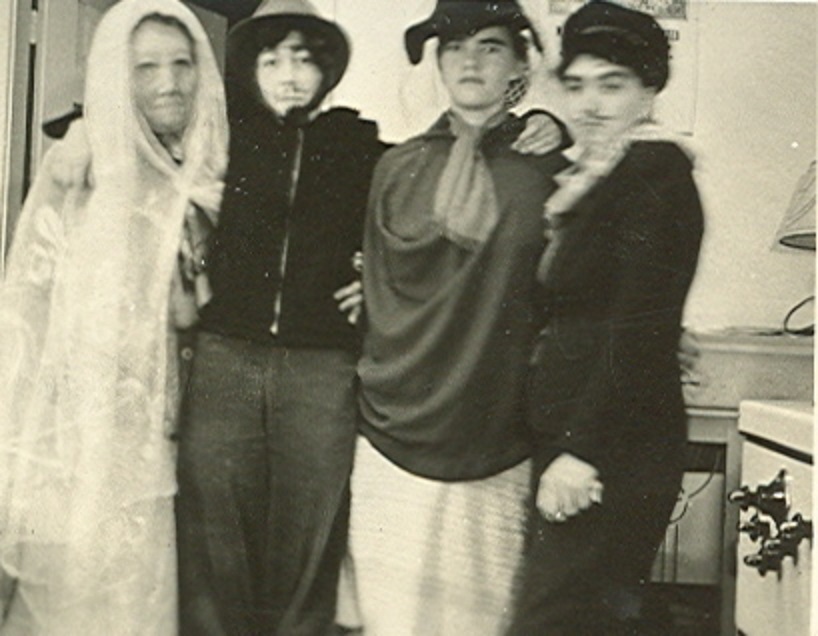
Although generally very well turned out, Inee enjoyed dressing up in costumes as well.

Inee on the right with her sisters

Her sense of humour was often in evidence. She was an excellent joke-teller and loved a good laugh. She would often dress as a clown or pull a trick on someone, catching them completely unaware.

Inee with her siblings (except for oldest sister Joetta) 1992 Family Reunion
She is decked out in hat and oversize orange sunglasses, pink shorts set, 
and orange striped socks offset by the contrasting shoes! (And what is she holding behind her back???)


Aunt Inee was very artistic and excelled at a variety of crafts. She taught me to make tiny intricate flowers using a clay made from McGavin's bread, of all things. I remember this because we NEVER had store-bought bread at our house and it seemed impossible to locate a loaf of the stuff! 

Inee was a cake decorator of renown. My recollection is that one of the families that she did many cakes for over the years was the musical Carter family (Johnny Cash and June Carter). 

All of these things made Inee who she was, but it fails to give a true sense of her playfulness. Cousin Roger recalls how she delighted in Christmas and, along with husband Bob, put on spectacular displays in her home that always attracted a lot of attention. She made many of the ornaments herself and added to her collection each year. An electric train went around the tree, and over the years she would add more and more track until it went around the room. She would start to decorate her entire home very early; over the years, her Christmas Season was extended to last from October 15 to March 15! 


She gave me one of her giant glass ornaments which I treasure and remember her by each Christmas when it takes a special place in our tree, although, unlike Inee's,  our tree always comes down the first week of January. 


Bob predeceased her in 1995. She continued to live in Turner Valley where they had made a big circle of friends of all ages. Inee died in 2004 at the age of 86. A celebration of Inee and Bob was held on 10 July 2004 in Okotoks, Alberta, the card for which indicated that  "As Inee had wished, because of their renowned love of Christmas, their ashes shall be scattered together beneath two Christmas trees, west of Turner Valley."

Inee won't be forgotten by anyone whose life she enhanced. That certainly includes her nieces and nephews, several of whom were happy to share their memories of her with me - thank you, Sandy, Louise and Roger. Three cheers for Aunt Inee!


Labels: , ,

Wednesday, 29 April 2020

Grace Edwards (1904-1993) (52 Ancestors 2020 Week 19) Theme: "Service"

Grace (Edwards) and Floyd McBride in their Service Station Coffee Shop
Moses Lake, Washington, 1940
A service station featured prominently in the life of one family member and her husband. Grace was my Grandma Della's youngest sister, born to Charles F. Edwards and Mary Jane "Mayme" (Wescott) Edwards on 19 November 1904 in Great Falls, Montana.

It is so disappointing that we cannot see additional views of the cafe in the above picture since there was apparently one feature that was at one time the talk of the town in Moses Lake. Here is Grace's nephew John Edwards' description, transcribed from his audio recording (see Resources below to find a link to listen to John tell it in his own voice):

"That little coffee shop and restaurant that my Aunt Grace and Uncle Floyd had in Moses Lake was an interesting place. . . .
When Grace and Floyd built that restaurant there, the state told her they had to have two bathrooms, they couldn’t have one. They had to have a men’s and a women’s. So what she had was two doors a ways apart, one was women’s and one was men’s. They both went into the same bathroom! It was the talk of the town! The state never caught on. They were pioneers in their day. That was true grit, if there ever was. 
I loved my Aunt Grace. She was my favorite aunt." 

Before returning to more of John's memories, we will visit Grace's life story that led to that service station in Moses Lake.

Grace's older sister Marion recalled in her memoirs that the family had quite a comfortable life in Great Falls, Montana, where Grace was born. Father Charles had good employment with the railroad and they had a nice home right across from Longfellow School. The merry-go-round that Charles built them in their back yard was well used by all the school children. Railway passes enabled regular visits to Mayme's family back in Wisconsin. Mayme, an excellent seamstress, ensured that they were always well dressed.

Grace Edwards 1906

Despite this comfort, when Grace was about 4 years old Charles decided to move his family to a  fruit farm 12 miles from Kalispell near Lake Blaine. Charles seemed to be forever on the move, looking for yet another opportunity, but never quite finding that pot of gold at the end of the rainbow. The 1910 American census finds young Grace, age 5 living with her family at Jocko, Flathead, Montana. Cayuse Prairie School was 3 miles away. By the time Grace started school, it was no longer a matter of simply crossing the street!

When freight rates made the fruit farm uneconomic, Charles went back to work for the Great Northern Railroad. A strike in 1914 left him unemployed, so he went to Canada to work for the CPR and then took out a homestead on some rather poor farmland. The 1921 Canadian census for the family at Miry Creek, Maple Creek, Saskatchewan includes 15 year-old Grace, a student. This was NOT a particularly luxurious life for the family.

Christmas 1921 at the Charles Edwards Saskatchewan Homestead
Grace is on the right, next to her mother Mayme
Within a few months of the above picture, their farm house burned to the ground, including paintings and sketches by Charles Russell, the Montana artist who had been a friend back in Great Falls. Charles gave up on his Saskatchewan homestead and moved back to work on the railroad in the United States.

Grace first married Clark Robbins and settled in Birmingham, Oakland, Michigan, where a 1925 City Directory has them listed at 616 Ann. This marriage was not destined to last; after her divorce from Clark, she married Floyd Marshall McBride on 8 June 1931 in Ferndale, Michigan. Floyd was listed as an insurance agent at the time of the 1930 U.S. census.

Grace was always beautifully turned out!

Grace's mother Mayme had died suddenly in 1926, leaving the family bereft. Her father Charles had received a railroad pension after losing a leg in a switching accident, enabling him to buy property in the area of Castle Rock, Washington. By the early 1930s, hearing of plans to build Grand Coulee Dam on the Columbia River in Washington, Charles had sold the Castle Rock property and built a service station near the dam site.

Charles and his son Everett operated that service station at the dam site until he sold that in about 1939 to help Grace and Floyd get established in Moses Lake, Washington with their own service station (pictured at the top of this story).

Grace and Floyd raised a family of two; Grace gave up the cafe to stay at home with her children. Their son says that when Floyd first opened his service station, he drove his car to Spokane and sold it to generate enough funds for an air compressor and other equipment for the new service station - and a bus ticket back to Moses Lake!

January 1947 - Family Gathering with Floyd and Grace standing center 


Grace's nephew John Edwards (smiling in the center of the above photo, seated at the table on his father's knee) recounts the events that occurred at the service station restaurant one very memorable December during his childhood. The following is a transcription from an audio recording made by John in  2019:

"I think it was the winter of ‘45, I’m not sure. All the winters - that area was extreme in its climate at that time. It was triple digits in the summer and it was below zero in the winter and blizzards and it was just a miserable place to live. It’s amazing that a jackrabbit could survive out there. But Grace and Floyd ran that little café. He had a little bulk plant back in behind there. . . .
It was winter and they were all gathered there celebrating, I guess, the upcoming Christmas and singing songs. My uncle Everett there, my Dad’s brother, he was D.O.A. That doesn’t mean dead on arrival; it means drunk on arrival. Which was not unusual for Everett or anybody else in those days, I guess. Every deal was done on a handshake and a drink. It was kind of interesting. As a little kid I didn’t realize that that was inappropriate. I would have been 5 years old.
I think it was the winter of ‘45. This blizzard had been blowing all night. There was hardly anybody coming through town at all. The snow was so deep everybody had chains on and then this one car had come over from Seattle all the way through the Snoqualmie Pass, in those days nothing like it is today, a little two-lane road that was paved in places only. Most of it was gravel. It was a horrible time getting through. We had this car that came through and stopped there at Grace’s café. It was a 1940 Plymouth business coupe. And a very polite young man got out of that and he was just beat and bedraggled. It had been a heck of a trip! His fenders were all beat up in the back from those chains. He came in just frozen. He had run out of money - and everything else. . . .
They were all gathered around in there. Everett had a collection of harmonicas; I think he probably had those the day he died, all colors, all different kinds of harmonicas. He was a genius on a harmonica. Oh, he could play good! Dad had his guitar. They were in there singing Christmas songs.
This gentleman came in all bedraggled and broke and didn’t know what he was going to do. They invited him in and Grace made him a sandwich of some kind and they all kept singing and Dad was playing his guitar and Everett the harmonica.
This little fellow said “I have a little tenor guitar out in my car. Let me go get it.” Dad said sure we’ll wait and he went out and came in with this little tenor guitar. . . . They struck up again and started singing.
And this gentleman started singing with them and, all of a sudden, they just all stopped singing. And it was Bing Crosby! They’d all heard him on the radio but they had never seen him before. They were just thrilled to death!
He was the guest of the evening. He was fed and I think they sang songs all night down there. I fell asleep over in a corner there somewhere, as a kid. . . .
In the morning Bing wanted to know if there was anyplace in town where he could maybe hawk his little 4 string guitar to get enough money to get on into Spokane - that’s where he lived. Chris the barber had a place down there on East Broadway. . . . He was the one who had the pawn business. And so Bing got on down there; they gave him a couple of bucks to get down there. They’d had a road grader come through and knocked some of the worst snow back where you could get going again.
Chris was so excited when he found out who he was! He wrote him a pawn ticket for it but he had one of the - Parker had just come out with the roller pens  to write with instead of  the regular fountain pen and it went down a lot nicer - and he had Bing sign his guitar and put the date on it and everything and he said this will always be here. He said, "If you can’t pick up your pawn ticket that’s fine. But I will have this guitar until the day I die. I’m not going to sell your guitar." . . .
I think he loaned Bing $20 which in those days was one heck of a lot of money, and that’s what he paid for the little 4 string guitar.
 Bing made it, I guess, on in to Spokane.  . . . But I think Chris had that guitar still when he died."


Grace (Edwards) McBride c1964

Grace's son recalls that the family lived for awhile at the service station in the part that had been the cafe. The McBrides built a new service station on the same location in the mid-1950s and eventually sold out to retire in 1973.

Grace and Floyd at the time of their 50th wedding anniversary party

Floyd died in Moses Lake, Washington in 1992 and Grace joined him the following year.

End note: 

In fairness, but not wanting to ruin the hilarious story of the deceptive bathroom doors recalled above by John Edwards, it should be reported that Grace's son recalls there actually being two bathrooms at one point but with the dividing wall not providing much privacy! Perhaps the authorities did catch Grace out in the end?

Resources:

  • Edwards, John; Audio recording made in 2019 detailing some of his memories of his Aunt Grace's service station cafe, can be listened to in its entirety in the Memories section for Grace Edwards on the Familysearch.org website at: https://www.familysearch.org/tree/person/memories/LCRN-S58
  • Miller, Marion Frances Edwards; My Memories, personal memoir written for her family in January 1978 from her home at 5405 Union Street, Lexington, Michigan

Labels: , , , ,

Saturday, 18 April 2020

Ingvald Theodore Anderson (1893-1958) (52 Ancestors 2020 Week 17) Theme: "Land"

Ingvald (sometimes spelled "Ingwald" as it was pronounced) was my maternal grandfather. He was born 3 January 1893 on the family farm west of Grafton, North Dakota to Andrew and Jorgena (Torkelson) Anderson and baptized at the South Trinity Lutheran Church at Grafton on 31 March of that year. The new state of North Dakota had just been established in 1889 but no civil birth records can reliably be found until 1899; thankfully, the Lutheran church in America had a strong tradition of maintaining its own records, a practice that had long been established in Norway.


Birth/baptism record for Ingvald - first entry at the top of the page
He had five older siblings, plus a sixth who had died at the age of 3 in 1885. Another brother Arnold was born the year after Ingvald; tragically, this younger brother also died very young. Some time after the birth of his youngest sister Gladys in 1903, his mother Jorgena's mental health declined to the point where she was admitted into an institution in Yankton, South Dakota. Shortly thereafter, Ingvald's father moved his family to a ranch in South Dakota, perhaps to be closer. With the family story being that she had died, it isn't clear that the children ever actually visited her.  His mother basically disappeared from his life when Ingvald was about 12.

Andrew and Jorgina Anderson family c.1904; Ingvald is they young boy on the far right


The only incident we know from Ingvald's youth is described by his son Bob Anderson:
In 1905, Ingvald met with a near-fatal accident when a friend's shotgun accidentally discharged, the full blast catching him in the left shoulder just above the lung.  He almost bled to death before a doctor reached him, and lay close to death for many days following.  The left arm and hand were  to remain permanently stunted, though not of too great a hindrance to work.  Fifty years later, suffering from neck and shoulder pains, he thought it might be the old wound.  X-rays revealed many shotgun pellets lodged in bone, muscle and skin in the shoulder and neck.

Ingvald in back row centre (see arrow) at Business College, 1909


A few years after the move to South Dakota, Andrew sold out the ranch and bought a hardware and implement business in Haynes, North Dakota.  Ingvald clerked there as a youth. It seemed for awhile as if Ingvald planned to join his father with a career in business but the land seemed to call out to him.

Canada had been encouraging farmers to take up land in its western prairies. For a $10 registration fee, qualified individuals could file at a Dominion Land Office for a selected  "homestead" of 160 acres (1/4 section) of land. Certain requirements to build and reside on the land and to cultivate it had to be met in order to have the land title transferred into the name of the homesteader; this was called "proving up" the land. One of the requirements for obtaining title was that the homesteader be a British subject. A second adjacent quarter-section could be obtained by a process called "pre-emption". Uncle Bob describes Ingvald's reaction to this opportunity:

By the time Ingvald and brother Clarence were of age, arable land in the American West had just about all been settled and a large part of the most accessible acreage of the Saskatchewan prairies had also been settled.  Areas such as the Lancer-Abbey region -- still with no rail service closer than Swift Current -- were still available.  To this area in 1909 came Clarence (age 19) and Ingvald (age 17) and their friend Hans Berg (age 22).  They filed on homesteads on the "flat" between Abbey and the South Saskatchewan River.  Ingvald's homestead quarter was SE6-22-20-W3M.  He had to stretch his age to get it, 18 being minimum age to qualify for a homestead.  They came with horse teams and wagons which held their few belongings all the way from Park River, North Dakota. They journeyed through eastern Montana and north into Western Saskatchewan -- a treeless stretch of prairie.  They mentioned having to pull ranchers' fence posts for fuel to cook with and for heat at their night camps. Clarence and Ingvald both felt extremely fortunate in getting a homestead with a creek running through it (Spring Creek).
Ingvald (right) probably about 1906

On 9 March 1911, Ingvald made application for his homestead; he had proved up his land and received title on 23 July 1914. To fulfill the requirement that he be a British subject, Ingvald became a naturalized Canadian citizen in June of 1914.


Although his original homestead application was for the SE quarter, he eventually built his home on the SW quarter of Section 6.

Ingvald's Homestead Grant (top line) in the Dominion Lands Records


When World War I broke out in the Fall of 1914.  Ingvald went to enlist, but was turned down when the medical examiner told him he looked as though he had already been through the war.  (This was no doubt because of the shotgun accident he had had as a boy.)


Ingvald as a young homesteader
.


It was likely in the Fall of 1917 that Ingvald first met Idella Edwards when she started teaching at nearby Wayne Valley School. The two were married in Swift Current, Saskatchewan in late 1919. Children started arriving a year later with the birth of my Uncle Bob, followed by his sisters Kathryn, Eunice, Elinor (my mother), then John "Jack", and finally Helen.

Ingvald back row, second from left
Front row: daughters Elinor, Eunice, Kathryn, probably about 1929
With Della pregnant as winter approached in 1927, the family moved to be near Della's father Charles Edwards in Everett, Washington. This is where younger son Jack was born in December of  1927. While there, Ingvald worked in the lumber industry. But when spring arrived, he made his way back to his Saskatchewan land.

Ingvald on the left, in Washington State about 1927


The Anderson family lived in an unpainted shack made up of a main part that was 12 X 16 feet with a north lean-to 10 X 16 and an east lean-to 6 X 12 feet, the latter containing bunk beds.  There was a plank cribbed cellar under the north lean-to for vegetable storage and cooling milk.  In the winter, snow was melted in a wooden barrel for household use.

The land that Ingvald had homesteaded was to prove challenging over the years, no more so than during the "Dirty Thirties" of the depression and drought. This was the time that my mother and her siblings were growing up; the children seemed to have taken things in stride and had a happy childhood. However, for Ingvald and Della, things must have been very difficult. Trying to feed and clothe this growing family with the economic hardships of the time must have been a challenge.

Uncle Bob described the situation in a story he wrote in 1986 about how local governments tried to help reduce pest problems by declaring a bounty on gophers and rabbits:

In those desperate Prairie years of the early 1930s many things came together to drive farm families into deep poverty. Grain and livestock prices sagged to all-time lows and continued drought resulted in crop failures and reduced herds and flocks. Weeds, grasshoppers and cutworms further thinned the stands of grain. Gophers ate their way in from field edges, gathering and storing grain. Jack rabbits roamed field and pasture, eating at feed stacks in winter.

Horsing Around with Family and Neighbours c1938


Dust was everywhere in the summers and the winters were bitterly cold. Uncle Bob described how the wood fires often burned down by midnight, leaving water in the tea kettle frozen atop the stove by morning. There was no coal to heat their small homestead shack. The prairies were not generally a good source for wood, but Ingvald and elder son Bob would make an annual trip to scavenge what they could, quite often for poplar, willow and black birch in the nearby Sandhills. The following is an account written by Uncle Bob in 1986:

I was down cleaning out the barn that late fall afternoon when the stranger in his shiny new car drove into our yard. Dad was at our wood pile. He had just started, with bucksaw and axe, to convert the huge pile of poles into stove-length pieces to use in the coming winter. 
The stranger stopped his car by the wood pile and got out. In moments I heard Dad's voice, loud and angry-sounding. I couldn't hear what was said, but it upset me just the same. I had never before heard Dad speak to a caller in this way. 
I watched as the stranger paced out the length and width of the pile of uncut poles. I thought I saw Dad hand him some money. The stranger wrote on a piece of paper, handed it to Dad, jumped into his car and left. I thought I'd better finish my job and let Dad cool down a little before I went to the wood pile to ask him who the stranger was.
Later, when Bob could see that Ingvald had calmed down, he learned that the stranger was a government man who had fined them for taking the wood. Bob still had  the receipt in 1986 when he wrote the story.

Received: the sum of six dollars. From I. Anderson. On account of: Dues for six cords fuel wood cut in trespass. Signed (officer's name) Department of Natural Resources. 
Ingvald was diagnosed with diabetes and suffered complications such as poor circulation in his legs and removal of a kidney. Daughter Helen reported that it aged him tremendously.

Della never loved the land the way Ingvald did. By the mid 1940s the family moved to Swift Current where she operated a boarding house. In the summers, Ingvald would return to farm his land in the Lancer area, eventually joined by son Bob. My memories of my grandfather are of a quiet gentle introverted man with a warm sense of humour.


Ingvald about 1955


My brother John and sister Sandy and I were staying with our grandparents at their farm in the summer of 1958 when Ingvald died very suddenly of a heart attack at the age of  65. Sandy had gone with him to deliver a load of grain to the local elevator when he collapsed in his seat. He died, not on his own land, but nevertheless while conducting his farming operations.

Some Resources:


Labels: , , ,

Friday, 20 March 2020

Steve Bardahl (1868-1947) (52 Ancestors 2020 Week 13) Theme: "Nearly Forgotten"

Birth/baptism of Osten (Ostensen) item #10
Steve Bardahl was my paternal grandfather's half brother. Leaving no descendants, he has been mostly forgotten or assigned to the perimeter of the Bardahl family history. No picture of Steve has ever been found amid the family photographs.

Hans and Anna Bardahl Family c.1890 (colorized image)
Steve is notable for his absence here and in any other family photos


A clue for his distance from the family can be found in his birth record. His original name was not Steve Bardahl. Born 8 September 1868, his baptism record in the Holden Lutheran Church of Goodhue, MN shows his given name as Osten, with parents Osten Ostensen and Anne Eriksdtr. Holien.

After his mother married Hans Bardahl in 1873, Osten is sometimes found in records as "Erstine" or "Astein" with the surname Bardahl. He didn't seem to adopt the name Steve until he reached adulthood.

1875 census for Hawk Creek, Renville, MN, Astein Bardahl age 6


1880 U/S. census, Granite Falls, Chippewa, MN, Erstine Bardahl age 11
My grandfather John Bardahl is 1 year old at this time

On 5 March 1894 he married Laura Nelson, daughter of Carl and Karen Nelson (and older sister to Louise Nelson who would become my paternal grandmother).

Wedding of Steve Bardahl and Laura Nelson, first entry for 1894
Pomme de Terre Lutheran Church

One might imagine that all was bliss for the couple since their example was followed by Steve's half brother John who would go on to wed Laura's sister Louise a few years later. However, Steve and Laura were not destined to live happily ever after.

 
Laura Nelson back row right
with brother Nels, young sister Louise (my grandmother) and their mother Karen Nelson c.1890 (colorized image)

Steve and Laura moved to Milton, North Dakota to farm shortly after their wedding. According to The Milton Globe newspaper of 18 February 1897 "Steve Bardahl has opened up a collection agency. Office at residence, three doors west of post office." In the 22 July 1897 edition of the same paper: "Mr. and Mrs. S. Bardahl have moved into the building recently vacated by Mrs. Hanson."

The Milton Globe also gives us details about Steve's career. It reported on 13 October 1898: "Steve Bardahl of this city was last Monday appointed and sworn in as deputy sheriff. Deputy Gunder Nelson's business is of such nature that it necessitates his absence from the county at this busy time, when the services of a deputy sheriff are daily required."

Steve and Laura appear in the 1900 census at Milton, N.D. where they are renting their home and Steve is listed as a police constable.

The Milton Globe of 8 June 1906 reported: "At a meeting of the village council Tuesday evening Steve Bardahl was appointed marshal to succeed Jonas Christenson, resigned."

This must have been an interesting time and place to be involved in law enforcement; it was in many ways still  "the wild west". Records for Sheriffs serving in Cavalier County indicate that as a result of the prohibition enactment when North Dakota became a state in 1889, an additional deputy was needed at Langdon and Allan Pinkerton, a former city policeman, was hired for the job. Pinkerton broke up a large gang of outlaws terrorizing residents of several counties. Several murders and property line disputes required investigation between 1894 and 1898. From 1900 to 1904 several controversial trials were held and there was an investigation involving blind pigs. (A blind pig isn't what you might think. Apparently it referred to a low-class establishment that would thwart the prohibition laws by charging patrons to see an animal, such as a pig, and then offer them a free drink as part of the viewing. More information can be found at this site.)

Steve would have been in the thick of all this law enforcement action. But the jail did not hold only hardened criminals. My grandmother Louise once told me how Steve had locked her in jail in Milton and refused to release her for some time. He was playing a joke on her, but she was NOT amused, finding the whole experience quite terrifying.

While his law enforcement career was being established, the couple had difficulty starting a family. Again from The Milton Globe newspaper, 22 November 1900: "BORN - to Mr. and Mrs. Steve Bardahl, on the 17th inst., a son. The infant died within twenty-four hours after its birth, and the bereaved parents have the sympathy of many friends, especially as this is their second misfortune of this nature within the last few years."

The Bardahls were again on the move to a different rented house, as reported by The Milton Globe of 12 April 1906: "Mr. and Mrs. Steve Bardahl this week moved into the Wakeford house on West Oakland ." One gets the feeling that the Bardahls were rather unsettled.

The 1910 census finds Steve and Laura in Milton Village, Montrose Twp., N.D.  The record indicates that Steve was 41, Laura 36; that they had been married 16 years; that Laura had given birth to two children, neither of whom survived; that his occupation was laborer and that they were renting a house. It appears that Steve's law enforcement career had ended by this time.

During the 1910s, Steve and Laura joined other family members homesteading in the Leinan area of Saskatchewan (north of Swift Current).  Homestead records indicate that he made application for three different quarter sections: SW20-19-14-W3M, SW18-18-14-W3 and NW18-18-14-W3 but apparently did not ever prove up any of them. Many family members today might be surprised to learn that Steve and Laura had homesteaded in the area at all. The couple did not arrive in Canada until too late in 1911 to be counted in the Canadian census taken that summer. They do not appear in any of the group family pictures taken from the early homesteading days. Once again, Steve has been nearly forgotten. It seems they were in Canada for about 5-7 years before moving back to the United States, but did not seem to have left much of a mark.

It isn't clear just when the Bardahls separated or if they ever actually divorced. However, they lived apart for the rest of their lives.

Laura (Nelson) Bardahl, unknown year
Laura spent a number of years in Canada where she supported herself as a maid at the Banff Springs Hotel and was able from time to time to find work there for some of her nieces.

By the time of the 1930 US census, Steve was living with his mother in Barrett Village, Lien Twp., Grant Co., MN; at this time, he was 61 - white, male, single (note that something else had been written in the space for marriage condition and then erased and replaced), unemployed farm laborer, and not a veteran.

In the late 1930's (probably following his mother's death in 1938) he moved to Langdon, N.D. and was custodian at the City Hall there. As his health failed, he moved to a nursing home in Arthur, N.D. and died there 24 July 1947. Steve is buried at Lebanon (Milton) Memorial Cemetery. Reunited in the end, Laura was buried here too when she died in 1954.


Stone for Laura Bardahl at Lebanon (Milton, Cavalier County, N.D.)
Photo courtesy HL49 of Find a Grave website

There is no stone for Steve - once again nearly forgotten!

01 August 2020 Addition:

Many thanks to my cousin Roger for his fine detective skills in finding a photograph that almost certainly includes Steve. The 1930 U.S. Census had told us that Steve was living with his mother Anna in Barrett, MN. Photographs taken at the time of a 1930 visit by John and Louise to visit his mother include this one of Anna with her sons John and Ole and their wives; the man on the right is undoubtedly Steve. Not completely forgotten, after all!


Some Resources:

  • Saskatchewan Archives Board for Homestead Records located online at https://www.saskarchives.com/collections/land-records/homestead-files-saskatchewan-archives/pre-1930-homestead-file-series-s-42
  • Evangelical Lutheran Church in America 1781-1969,  birth records for Holden Church MN for 1868 located online through Ancestry.com 
  • Pomme de Terre MN. Evangelical Lutheran Church in America marriage records for 1894
  • Sheriffs Serving North Dakota 100 Years photocopy of page for Langdon, Cavalier County provided by Ross and Barbara Dohlen from their visit to the area
  • A Century of Area History 1882-1982 Milton, North Dakota local history book, photocopied pages provided by the Dohlens from their visit there
  • The Milton Globe : Milton, Cavalier County, N.D., published weekly from 1888-1937

Labels: , , ,