Friday, 15 August 2025

Douglas Paul Barnard, Master Brainteaser (52 Ancestors in 52 Weeks 2025 Week 34 theme: "Playtime")

Douglas Barnard from his obituary in the London Daily Telegraph 18 May 1994 p.25 accessed on Newsapapers.com 

Douglas Paul Barnard (aka Douglas St. Paul Barnard) was my husband's first cousin once removed. Born 27 January 1924 in Pakefield, Suffolk, England to Arthur and Laura (Parry) Barnard, his idea of playtime might not be everyone's idea of fun. As a cruciverbalist, his work was his play. (To save you the trouble since I had to look it up anyway -- a cruciverbalist is a compiler or aficionado of crossword-puzzles. And -- full disclosure: I have been a lifelong cryptic crossword puzzle junkie, a hobby shared with my mother and her brother Bob. I am in awe of the work of Douglas Barnard.)

Douglas Barnard's father Arthur was the younger brother to my husband's grandfather John Mathias Barnard. (Whereas John Mathias was a large man standing over 6 feet tall, brother Arthur's service records from when he signed up for the army at age 18 show him to be less than 5 feet 5 inches tall and weighing just 124 pounds. Perhaps he was still growing?) After serving with the British army during the Boer War and in India from 1896-1908, Arthur committed to service in the Christian ministry. To this end, Arthur moved his family to Australia in the 1920s. 

Young Douglas grew up in Australia and obtained his education at the Brisbane Boys'  College. He compiled his first crossword at age 15.

He started work as a bank clerk, but soon enlisted in the Australian army at Launceston, Tasmania on 10 March 1942 shortly after turning 18. His capabilities were soon recognized and he was sent on a Junior Leaders Course followed by selection for the Royal Military College. Records indicate he was a Bombardier. His casualty forms list frequent illnesses and problems with his eyes and with his right ear after a gun blast near it. It is difficult to follow his military records with any real idea of what he was doing; there is a very mysterious reference to his having "m/in from Queensland LofC area  GDD" and embarked from Cairns for "Mexico" (yes, with the quotation marks) on 19-02-45 and then having disembarked at Aitape (surely this is in New Guinea?) on 3-1-45.  He was promoted to Sergeant on 8 November 1945 before his discharge from service in 1946. 

Perhaps he was actually an intelligence officer during the War as reported by a couple of sources (see Gilbert article and Best for Puzzles website in Resources below). If his talents were not taken advantage of in this way, a great opportunity was missed. No official source has been found, but his was exactly the sort of mind required at Bletchley Park or its Australian counterpart Central Bureau. 

At the end of the War, Douglas transferred to the Army Psychology Corps. Then in 1946 he entered Tasmania University to study political science. He was expelled for publishing a pamphlet calling one of his professors a Communist. Later vindicated when that professor was discharged, it nevertheless cost Douglas the Rhodes Scholarship he had won to study at Oxford. 

When paralyzed from polio at age 25, he was told he would never walk again. With characteristic determination and ability, he designed his own leg clamp and got himself back on his feet.  

In 1954, Douglas moved his wife and children to England where he found free-lance work, including as an occasional crossword compiler for the London Daily Telegraph. By the time his obituary was published in that newspaper on 18 May 1994, they reported that he had compiled 2,956 puzzles for them over a course of 40 years. They added that "recently his crosswords had appeared on Mondays because their clarity and cryptic elegance were considered a refreshing challenge after a relaxed weekend."

His book Anatomy of The Crossword is a classic for demystifying the cryptic crossword (which is unlike the more straight-forward encyclopedic version more common in North America). Having figured out on my own how the cryptic clues can follow a number of different formats, it delighted me to read this book and learn that the patterns all had names and explanations. He expounds on the use of puns (based on homonyms and homophones), drollery, allusion, dialectic clues, dilemmatic clues, paragrams, anagrams, disjunctive clues, parabolic clues, and finally the all-encompassing cryptic licence that may be taken by the cruciverbalist. Oh, my! 

Barnard's Anatomy of the Crossword, 1963

According to his obituary:

A true polymath, he quickly grasped the arcane details of any discipline. Science, mathematics, computers, religion and philosophy were of particular interest to him, but he was also a talented handyman who rewired, replumbed and restored his large Georgian house almost single-handed. 

He designed and built a large Adam-style mantelpiece, restored a Bechstein grand piano and collected and restored Oriental antiques.  

His interest in politics led him to run as a Conservative candidate in the 1964 election; he did not win a seat. 

Over the years, he set many other brain-teaser puzzles and wrote many articles as a freelance journalist, often under various pseudonyms. It takes a special mind to turn mathematics into playtime.


The Rochdale Observer 24 April 1965 accessed on Newspapers.com

In addition to his Adventures in Mathematics (1967), he also wrote The Puffin Book of Car Games (1977), It's All Done by Numbers (1968), 50 Daily Telegraph Brain-Twisters (1985), Figure it Out (1973), One Hundred Brain Twisters (1966), A Book of Mathematical and Reasoning Puzzles (1962) and 50 Observer Brain-Twisters (1963). So much playtime created by him for so many puzzle enthusiasts!

Here is an example of one of his regular Brain-twisters (and, no, I haven't tried to solve it, before you ask!):

The Observer 10 January 1965 p.39 from Newspapers.com

As to why he added the "St." to change his name from Douglas Paul Barnard to Douglas St. Paul Barnard or D. St. P. Barnard, no explanation has been found. Probably there is some sort of cryptic or mathematical clue. Perhaps the "s" and "t" are needed to create an anagram: absurd lapdogs rant? about grandads plural? Sorry, Douglas, some of us need a more fulsome clue to solve this one!

Some Resources:

  • Australia, World War II Military Service Records, 1939-1945 for Douglas Paul Barnard, accessed on Fold3
  • Barnard, D. St. P., Anatomy of the Crossword, London: G. Bell and Sons, Ltd. 1963
  • Barnard, D. St. P., 50 Daily Telegraph Brain-Twisters: a book of mathematical puzzles and reasoning problems, Javelin, 1985, accessed on 25 July 2025 on Internet Archive at https://archive.org/details/50dailytelegraph0000doug/page/12/mode/2up
  • Best for Puzzles Website, Crossword Who's Who for Douglas Barnard accessed online 25 July 2025 at https://bestforpuzzles.com/people/b.html
  • Gilbert, Val, "The Telegraph Crossword is 80 and Still Going Strong", 30 July 2005 from the Narkive Newsgroup Archive  accessed online 25 July 2025 at https://rec.puzzles.crosswords.narkive.com/5ALuWsOd/the-telegraph-crossword-is-80-down-and-still-going-strong
  • Obituary for Douglas Barnard, The Daily Telegraph, London, England, 18 May 1994, p.25.


Labels: , , , , , , ,

Saturday, 2 August 2025

The Andersons at Bawlf, Alberta, Canada (52 Ancestors in 52 Weeks 2025 Week 32 theme: "Wide Open Spaces")

My maternal great great grandfather Israel Anderson (1829-1910) spent a lifetime searching for wide open spaces. Born in 1829  and raised in Laxarby, Västra Götaland, Sweden, 3 miles from the nearest town, he moved to Norway as a young man to work on a farm there. He married farmer's daughter Johanna Gundersdatter Opsahl and moved to America in 1856 with wife and their first child, my great grandfather Anders (Andrew) Anderson. 

Israel and Johanna went on to have the following children: Andrew b 1855, Sophia b. abt. 1856, Ida b. 1858, Gunelius b. 1862, Olava b. 1864, Annetta b. 1868, John b. 1868, Betsy b. abt. 1870 and Carl Gustaf b. 1873. Johanna died in 1900.  

Over the years, the call of its wide open spaces took Israel and family to several newly developing areas on the American frontier. After first settling in Decatur, WI, they moved on to Northwood County, Iowa and then to Grafton, Dakota Territories, traveling by train and covered wagon. In 1901 son Carl Gustaf moved across the border to homestead in Manitoba. In 1902 son Gunelius moved his family to Canada as well, settling in what became the Bawlf area of what was then the North-West Territories.  In 1903 Israel himself emigrated for a third and final time to join Gunelius in the Bawlf area. He was a widower in his mid-70s.

Alberta was not even yet a province when Israel arrived. In 1903 the land was still part of the North-West Territories, and, of course, before that had been part of the truly wide open spaces occupied by the western First Nations peoples. At noon on 1 September 1905 Alberta became a Province of Canada. Israel had been there for a couple of years by this time.

Google Earth view of Bawlf area - showing the present-day checkerboard of fields that were wide open spaces when the Andersons arrived


The Village of Bawlf was established in the vast Canadian prairies in 1905, the same year that Alberta became a province. Named for Nicholas Bawlf, president of the Winnipeg Grain Exchange, the town came into being alongside the new railroad. Farming and shipping grain were its raison d'être.

Son Gunelius "G.I."  had moved there the preceding year with his family. The following is from a letter dated 17 May 1977 from Ernie and Esther Anderson to R.W. "Bob" Anderson, based on their recollections of  comments made by Gunelius's son Lawrence Anderson: 

"G.I. left Edinburg, N.D., where he owned a hotel, in 1902 and moved to Alberta. Andrew and John came up two years later and bought a half section beside the homestead. Lawrence was saved land, proved it up and got it at age 21. The railroad came in 1906. Israel homesteaded near his sons' farms and was required to spend a few months each year on his homestead, so he had a house on skids that he pulled over to the land in summer and then back to the sons in the winter.    Lawrence said they lived in 2 tents when they arrive in Daysland and lived in them until three weeks before Christmas when their house was finally ready for occupancy. It was bitterly cold, he remembers."

The 1906 census of Alberta shows Gunelius at section 8-45-17-W4M, his sons Emil at 10-45-17-W4M and Lawrence at 30-44-16-W4M. Another brother, John Anderson, had homesteaded at Bawlf just east of his father at NE36-44-17 W4M.


Homestead application of Israel Anderson


Sadly, on 7 March 1910, at age 80, Israel died before proving up his homestead application. 

1910 Post Card from Gunelius Anderson advising sister Sophia of Israel's death

Decades ago my uncle Bob Anderson and his son visited the rural Lutheran cemetery near Bawlf  where Israel is buried. A few years after this, while attending a kids' hockey tournament at nearby Daysland, my husband and I also paid Israel's gravesite a visit.

Two of His Male Anderson descendants visit Israel's burial location 

In 1998, in response to my letter to the Village of Bawlf, local resident and historical record-keeper Lil Bohmer sent me a considerable amount of information based on local knowledge of the family. Lil was a member of the same Bawlf Lutheran Church as the Andersons and was the record-keeper for the cemetery. She provided the burial locations for Israel as well as for Gunelius, his wife Sophia, their daughter Gina Reesor (1891-1928), son Emil (1884-1950) and son Alfred (1886-1954).

Lil went on to say: 

I found in the Daysland History book the enclosed information about Kenneth and Aleda Anderson. Also in the book were copies of maps showing land owners in the early 1900s. Another son of Gunelius and Sophia farmed north of Ohaton. He was known as Ike but a gentleman who knew him said he thought his given name was Israel - after his grandfather. The other son Lawrence, who farmed with Alfred later lived in Daysland. I found several people who remembered Gunelius and family but no one is left who would remember Israel. The house that the Andersons built on their farm was considered a beautiful place. Their neighbours and church friends were all there for Open House when it was completed. A few years ago that house was moved into Daysland to be a neat looking place yet. It was a 2 story. The fact that it had a kitchen nook and a dining room had impressed everyone. 

Israel's grandsons Clarence and Ingwald (sons of Andrew) homesteaded in the Lancer area of Saskatchewan, Canada a few years later. The wide open spaces of the Canadian prairies did not suit everyone. Some of the sons or their descendants ended up moving back south of the 49th parallel. The current crop of Andersons inhabiting Canada's wide open spaces primarily descend through the Israel/Andrew/Ingwald line. 

3 of Israel's sons backed by their sons about 1915: lower left my great grandfather Andrew Anderson in front of his son Clarence, lower centre Gunelius in front of his son Emil and lower right John in front of his son Victor. The picture was taken after Victor returned from fighting in World War I


Labels: , , , , , , , , , , , , ,

Friday, 18 July 2025

Confirmation: A Lutheran Rite of Passage (52 Ancestors in 52 Weeks 2025 Week 30 theme: "Religious Traditions" )


1940 Confirmation at Bethel Lutheran Church near Leinan, Saskatchewan - author's father Ken Bardahl back row centre

The Evangelical Lutheran Church was the state church in Norway from 1537 until 2012. It was mandated to keep the official state records including births/baptisms, marriages and deaths/burials. All of these entailed church matters as well as vital statistics. The church records are mostly available online through the Norwegian national archives, albeit only in a browsable format in challenging Gothic script in old Norwegian.

One other church record that is often available is the list of  those confirmed into the Lutheran Church as an affirmation of the baptism done in infancy. From 1736 on, it was a requirement that young people be instructed in the catechism and pass a test before taking their first communion. Confirmation traditionally occurred at around 14-15 years of age and can often be found by searching the church records 14-16 years following a person's baptism record; sometimes confirmands were as old as 20 so scrolling through a few years' records might be required. Confirmations are fairly easy to spot even in chronological church records as lists of young people of about the same specified age. Sometimes it lists the father and, occasionally, the mother. It does not often provide much in the way of new information but is another piece of the genealogical puzzle to map out a person's life in a given location. 

For example, after finding the birth record for my paternal immigrant ancestor Hans Olai Johnson Bardahl in 1841, it was fairly easy to find his Confirmation record from 1857.

1857 Confirmation Record for Hans Olai Johnson (blue underlining) from Nesna, Nordland, Norway church book

Hans's Confirmation record is unusual in containing a generous amount of genealogical information including his name, date and place of birth, father's and mother's names, his religious knowledge and diligence (which I wish I could decipher) and finally the date on which he had been vaccinated for smallpox. Smallpox vaccine was mandated in Norway from 1810 and often shows up in the church records alongside births/baptisms, confirmations or marriages. Hans had been vaccinated 18 September 1845 at age 4.

Both paternal grandparents were Confirmed as Lutherans in the United States; much of the same record-keeping persisted in the Church although not mandated in America. My favourite record is the certificate in Norwegian for my paternal grandmother Louise Nelson, confirmed in 1897 in Erdahl, MN.


My paternal grandfather John Bardahl was confirmed in Elbow Lake, Minnesota in 1893.


1893 Confirmation of John Bardahl from the Evangelical Lutheran Church in America Records for Elbow Lake, MN

John was 14 when he was confirmed; his parents were Hans and Anna Barda(h)l , his birthplace was Chippewa, Minnesota and his religious knowledge was good. 

My maternal grandfather Ingwald Anderson (1893-1958) should have been confirmed in about 1907; no record can be found. This could be because his mother had been experiencing mental health issues following the still birth of a baby in 1900; family life was very disrupted by this and religious practice and guidance may have fallen by the wayside.

My brother's copy of our first year Confirmation book containing much of the Catechism that was to be learned by memory


My Dad's sister Inez Bardahl's Confirmation Photo c.1932
Conformation was a major milestone deserving of a new dress or suit and a professional photograph.

My Dad Ken Bardahl was the son of John and Louise (Nelson) Bardahl and was confirmed in 1940 at age 14. At that time, confirmands were tested orally in front of the congregation on their memorization of the Catechism. Following my Dad, my brother and I took the two years of religious training and had our Confirmation at the same church. By that time, we were all grateful to learn there would no longer be public testing of one's ability to memorize the Catechism and no record kept of one's religious knowledge as had been the case for our ancestors.

One of the last Confirmations at Bethel Prairie Lutheran Church, June 1964, Leinan area of Saskatchewan; author's brother back row left; author front row right; author's younger sister's Confirmation was also held here a few years later (no photo available as so often happens with younger siblings!)

Some Resources:

  • Research Outline Norway, The Church of Jesus Christ of Latter Day Saints Family History Library, Salt Lake City, Utah (a precursor to materials now available on the familysearch.org website Research WIKI), pages 14-16


Labels: , ,

Friday, 27 June 2025

Homage to Homemakers (52 Ancestors in 52 Weeks 2025 Week 27 theme: "Family Business")

More of my ancestors were homemakers than any other occupation. Even when they had other employment outside the home, census records often cite something like "keeping house" or "housewife" or, most often, "homemaker". What occupation could relate more to family business than that of the person tasked with keeping the home and family functioning?

Women over the generations have been the unsung heroines. Their unpaid work is often undervalued (not part of the calculation of GDP in any country, for example) and often seen as unskilled and of low status--probably because it has been a "pink" job. Most often girls learned the necessary skills from their mothers. Although more men are taking on responsibilities for home and family, studies consistently show household duties are not equally shared and very few men would be identified on a census as "homemaker". Some women are not really cut out for the role either, but fully half my ancestors were de facto homemakers. Without their tireless efforts we simply would not have survived.

It would be impossible to name all my homemaker ancestors and identify their specific accomplishments. The occupation comes with a challenging job description requiring a vast number of skills (as I well know from my own personal experience in the occupation!) Requisite skills have varied with the times but may include:  infant and child care, home nursing, gardening, cooking and preserving food, soap and candle making, spinning and weaving fabric, knitting and sewing the family wardrobe, quilt-making, cleaning and organizing the home, providing chauffeur services, maintaining the family calendar of events, and most importantly, providing love and comfort for the other family members. Homemakers often received little of that love and comfort themselves. They were frequently involved in the family business as well, whether that meant assisting in planting and harvesting crops, bookkeeping, or working in a family shop or cottage industry.

My father Ken Bardahl acknowledged in his memoir written in 1991 some of the  challenges faced by the women when his parents homesteaded in Saskatchewan circa 1910: 

On talking of homesteaders, I must give full marks to the wife, who undoubtedly ran into many problems of her own.  To me, I would think that perhaps it was harder for her than her mate.  Many died at childbirth and of course visiting doctors for pre-natal was an unheard of thing.  They usually all had large families and to try and diagnose problems must have been very worrisome.  When we remember that there was no phone, no cars and perhaps miles from help, it must have been a terrible thing when someone became sick or hurt.  Then too, all the clothes had to be washed by hand, perhaps hauling the water first.  I can recall mother telling of when the telephone came to this area in 1917.  The crew needed a place for meals and they offered to build her a clothesline if she would oblige.  This they did and a very good line was built for her.  At that time she would have had 5 youngsters, as if that wasn’t a job unto itself.  

Here are just a few of the homemakers from my own family tree:

  • My Dad's mother, my grandma Louise (Nelson) Bardahl (1881-1985) homesteaded with her husband, first in North Dakota, then in Saskatchewan. She and husband John had 8 children: first came 6 daughters and finally 2 sons. She gave birth to my Dad when she was almost 45. 
When the couple arrived in the Leinan area of Saskatchewan in 1910, they had to build everything from scratch - house, wash shanty, barn, shop, pig and chicken houses, granaries. Trees were planted to surround the buildings. The virgin prairie sod needed to be broken to enable planting crops. Grandma took an active part and was in charge of the home; she was an excellent cook and homemaker. The Ladies Aid group (of which she was a founding member) fund-raised to enable the construction of the local Lutheran church. Her children and grandchildren adored her. 

And yet the 1921 Canadian census indicated she had no occupation at all!  

                
But that was improved by the 1931 census recognizing her true occupation: 


John and Louise (seated) surrounded by their 8 children; my Dad Ken about 8 years old standing centre (colorized)

  • My maternal grandmother Idella "Della"  (Edwards) Anderson (1897-1976) was an intelligent, capable and fabulously creative woman who ran a well-ordered home and was a very good mother. She was also a school teacher, boarding house operator,  motel owner/operator and floral arranger during her life. Not a single census could be located where she was listed as anything other than "homemaker". Perhaps when more recent ones become available they will identify other of her occupations but, in the end, being a homemaker was by far  her most important role.
Della and neighbour with children on the Saskatchewan homestead c.1926 (colorized)


  • My 3rd great grandmother Mary (Green) Hoover (1812-1907) in the 1870 US census is listed as "keeping house".  The Kansas Board of Health Annual Reports for various times between 1868-1898 indicate that she was a midwife who was listed in their records as a "physician". Although she was registered as having delivered nearly two dozen babies, she certainly would have expended even more efforts in her homemaking role raising 9 children as she and husband Christian Hoover migrated from one place to another (Pennsylvania, Illinois, Iowa, Kansas). She took on an extra load when Christian signed up for the Union army during the American Civil War; sadly, he returned an invalid and eventually died by suicide leaving her almost blind and destitute after all her years of hard work.

Mary (Green) Hoover

  • Mary's daughter, my 2nd great grandmother Barbara (Hoover) Edwards Payton (c1834-1890) was "keeping house" in the 1880 US census. As the mother of 4 of her own children (3 still living with them) plus stepmother to 3 of her husband George's, she would have had her hands full.
1880 US census, Howard, Elk County, Kansas

Still, once again, the census categorization does not do justice to the full extent of Barbara's actual occupations. She was very much an active partner with third husband George Payton in many hotel and restaurant business dealings in Howard, KS. At first, only George was listed although, given the nature of the hospitality business, she would have been very involved indeed; over time, "Mrs. Payton" was listed and in the end "Mrs. B.E. Payton" was duly recognized by her initials as being the business person in charge. This can be evidenced from a couple  of the numerous newspaper advertisements and stories for businesses in which she was involved.  

The Howard Courant Thursday 2 June 1881


The Citizen, Friday 1 December 1882, p.3

The Howard Courant 16 September 1887


Barbara (Hoover) Payton c.1890 (colorized)

When she died of a tumor (cancer) in late 1890, one of her obituaries indicated that "she was a good hearted and very ambitious woman".  (No mention is made of her mothering or homemaking skills!)

Their accomplishments often overlooked, forgotten or minimized, the homemakers in my family were doubtless like those in most others. They did what was expected of them to keep their homes functioning and their families thriving without expecting much in the way of acknowledgement or appreciation in return. Many went far above that to achieve satisfying and useful lives in their communities as well. Their efforts are worthy of far more recognition than they have generally received.


Labels: , , ,

Thursday, 20 August 2020

Inez Bardahl (1918-2004) (52 Ancestors 2020 Week 35) Theme: "Unforgettable"

My aunt Inez Louise Bardahl ("Inee") was born on her mother's 37th birthday and was given her mother's name as her middle name. For the remainder of her mother's 103 years, the two often celebrated their birthdays together. Inee's birthday was unforgettable and all who knew Inee will attest to her being a delightfully unforgettable person! 

Inee and her mother Louise celebrating a birthday probably 1980s


Inee was the youngest of the six daughters born to John and Louise Bardahl. Two brothers would follow over the next few years. The family of 8 children grew up on the Bardahl homestead farm north of Swift Current, Saskatchewan. I spent the first 10 years of my own life in that little two-bedroom home and always have a difficult time figuring out how 10 of them managed to fit inside. 


John and Louise Bardahl family 1946 (colorized)
Inez seated beside her mother, front right

Inee was the only petite dark-haired brunette in a family of fairer-haired lanky Norwegians and one gets the sense that she sometimes felt she didn't belong. There are even a couple of family photos where she's taken scissors to cut herself right out of the picture! (It was often said that I resembled my aunt Inee; also being the shortest and the only brunette among my taller fair-haired siblings, I can likewise attest to sometimes wondering if I belonged!)

An example of Inee having removed herself from a family photo


Inee's Confirmation Photograph

On the 20th of September 1941, Inee married Robert ("Bob") McMurdo in Edmonton, Alberta. The couple, sadly, never had any children of their own, but were widely adored by nieces and nephews - and children in general.  

Inee and Bob

Inee and Bob were usually just a lot of fun and were always playing good-natured tricks and enjoying a good laugh, but never in a mean way or at anyone else's expense. Hamming it up in photographs was a common theme over the years.


My cousin Roger remembers Inee well from the time of the Second World War in Regina, Saskatchewan. The men were away serving in the war effort and Inee would come to help his mother care for her five young kids. Inee would always bring cookies or other treats and enjoyed spending time with the children. 

After the War, Inee and Bob moved to Edmonton, Alberta where he was a driver for Woodwards' Department Store and Inee worked as a meat cutter with the neighbourhood butcher. (This was news to me!)

Cousin Roger tells how Inee was the only family member who ever came to watch him play football. She made a point of showing up whenever he was playing in Edmonton for the Calgary Junior Broncs in 1954 and 1955. She really loved a lot of sports and in her later years had a huge-screen television set for watching the games. 

Inee worked as a Comptometer operator for Palm Dairies Ltd. in Vancouver in the early 1960s. (The Comptometer was an early version of a calculator; according to a glowing letter of reference from her employer in 1963, her work related to the computation of ice cream drivers' sheets and receipts of sales.) She continued in a similar occupation for many years with Simpsons Sears; I recall her working in the office at its North Hill Store on 16th Avenue N.W. in Calgary, Alberta in the later 1960s. 

Inee with brother Jim and mother Louise 
on Stephen Avenue, Calgary c1951

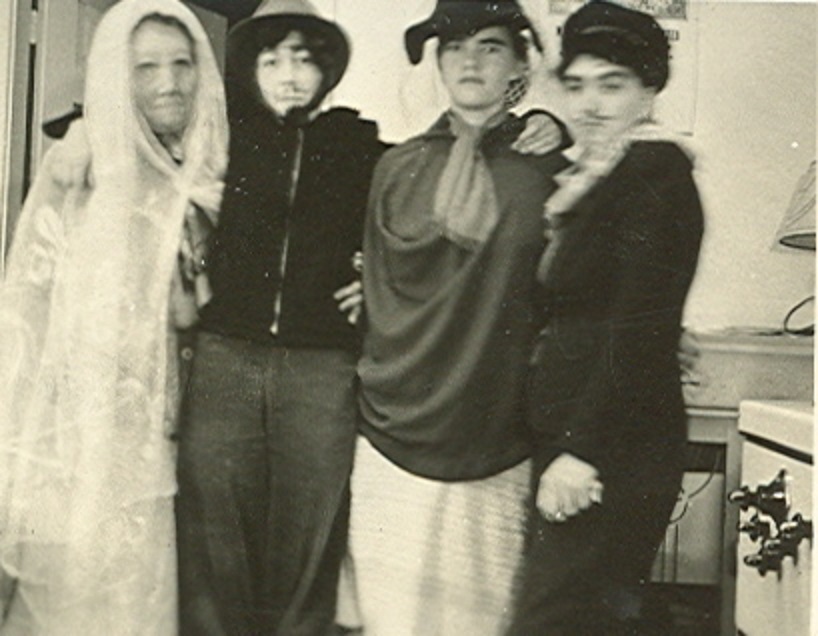
Although generally very well turned out, Inee enjoyed dressing up in costumes as well.

Inee on the right with her sisters

Her sense of humour was often in evidence. She was an excellent joke-teller and loved a good laugh. She would often dress as a clown or pull a trick on someone, catching them completely unaware.

Inee with her siblings (except for oldest sister Joetta) 1992 Family Reunion
She is decked out in hat and oversize orange sunglasses, pink shorts set, 
and orange striped socks offset by the contrasting shoes! (And what is she holding behind her back???)


Aunt Inee was very artistic and excelled at a variety of crafts. She taught me to make tiny intricate flowers using a clay made from McGavin's bread, of all things. I remember this because we NEVER had store-bought bread at our house and it seemed impossible to locate a loaf of the stuff! 

Inee was a cake decorator of renown. My recollection is that one of the families that she did many cakes for over the years was the musical Carter family (Johnny Cash and June Carter). 

All of these things made Inee who she was, but it fails to give a true sense of her playfulness. Cousin Roger recalls how she delighted in Christmas and, along with husband Bob, put on spectacular displays in her home that always attracted a lot of attention. She made many of the ornaments herself and added to her collection each year. An electric train went around the tree, and over the years she would add more and more track until it went around the room. She would start to decorate her entire home very early; over the years, her Christmas Season was extended to last from October 15 to March 15! 


She gave me one of her giant glass ornaments which I treasure and remember her by each Christmas when it takes a special place in our tree, although, unlike Inee's,  our tree always comes down the first week of January. 


Bob predeceased her in 1995. She continued to live in Turner Valley where they had made a big circle of friends of all ages. Inee died in 2004 at the age of 86. A celebration of Inee and Bob was held on 10 July 2004 in Okotoks, Alberta, the card for which indicated that  "As Inee had wished, because of their renowned love of Christmas, their ashes shall be scattered together beneath two Christmas trees, west of Turner Valley."

Inee won't be forgotten by anyone whose life she enhanced. That certainly includes her nieces and nephews, several of whom were happy to share their memories of her with me - thank you, Sandy, Louise and Roger. Three cheers for Aunt Inee!


Labels: , ,

Saturday, 6 June 2020

Elinor (Anderson) Bardahl and Love of Sewing (52 Ancestors 2020 Week 24) Theme: "Handed Down"

My mother Elinor (Anderson) Bardahl was a woman of many creative talents. Although not what this story is going to be about, she was perhaps best known for her Norwegian rosemaling folk art pieces sold widely and treasured by family members.

Elinor at one of her numerous art shows of paintings and Norwegian rosemaling


Elinor's Rosemaling

She was also accomplished with needle and thread and sewing machine - and that will form the focus of this week's story. Elinor no doubt got her sewing talent from her mother Idella (Edwards) Anderson. And Grandma Della got it from her mother Mary Jane "Mayme" (Wescott) Edwards. Even Elinor's 3X great grandmother Margaret Vought Barton was a quilter whose estate inventory listed several of her hand-made quilts by pattern name. From one set of hands to another, this skill has quite literally been handed down the line. It is sure to pop up somewhere in each generation in a growing web of women connected by blood and by a shared love of sewing.

"Sewing is in My Genes" mixed media fibre art wall hanging by the author 2016
includes photographs of her female line ancestors printed on organza
 and layered over double helix DNA fabric, painted wheat pasted tablecloth and old sewing notions


Wedding Photo for Mayme Wescott and Charles Edwards - colorized
Mayme made her pale green taffeta wedding gown

Stories about Elinor's grandmother Mayme highlighted her excellent dressmaking skills. Mayme's daughter Marion (Edwards) Miller said of the wedding dress, "I have no memory of her telling us about their wedding, but the lovely clothes were kept in a trunk for many years. Her wedding dress was a pale mint green, soft taffeta which she made so beautifully. I remember it well, because I wore it to a masquerade dance when I was 17 or 18. She had quite a time getting me into it as I was more buxom than she had been." 

Marion went on to say, "She loved to sew, made all of our clothes, even coats when we were young, and when she had all of us fitted out, she made clothes for poor children."  Mayme would outfit them to take the train from Montana to Wisconsin to visit her folks, as described by Marion: "She would have us all dressed up so nice.  I can remember the trip when I was seven.  She had made white coats for Ora and me and we had white embroidered hats."


Mayme (back left) with daughters including Della (back right)
Mayme and daughters likely made all their clothing

Sewing was a necessary skill at a time when most clothing was made at home; some women obviously would have enjoyed this more than others. Mayme was clearly one of those who loved to sew. (These days, it costs far more to make one's own clothing than to purchase ready-made disposable outfits. People who sew today do it primarily for expressing their creativity in unique and higher-quality items.)

Wool log cabin wedding quilt made by Mayme Wescott Edwards
for marriage of her daughter Della to Ingvald Anderson 1919


When Mayme and her husband Charles Edwards tried homesteading in Saskatchewan, their eldest child Idella remained in Great Falls, Montana, to complete her high school before joining her family in Canada. Once there, she taught school and fell in love with a young homesteading farmer named Ingvald Anderson. When the rest of the Edwards family moved back to the United States, Della remained to get married. Apparently her parents were NOT pleased with this, yet Mayme created a beautiful log cabin quilt for the young couple's wedding gift.

My mother, the third of Ingvald and Della's daughters, learned to sew from her mother. I recall Mum telling me how her mother required that she and her sisters practice hemming handkerchiefs by hand until they could do it perfectly before she would permit them to sew on her Singer treadle sewing machine.

Grandma Della's thimbles - one decorative, the other well-used
(there was a third one but it had been completely worn through!)


Sewing Head from my Grandma Della's old Singer
that she handed down to my mother Elinor

Elinor came to the Leinan/Stewart Valley community as a school teacher in a one-room country school north of Swift Current, Saskatchewan, and, like her mother, fell in love with a local farmer and remained to raise her family there. 

She taught me to sew on that same old treadle Singer sewing machine that had been handed down to her by her mother Della. I was probably no more than 5 or 6, but I loved being able to design and create clothes for my dolls using the well-stocked remnants bin that she kept in her closet. It was a big round wooden cheese tub with lid. She always rolled all the leftover bits of fabric and tied them into neat bundles. I wonder if her mother and grandmother did the same with theirs?


Elinor on left c 1955 wearing  one of her dresses; with friend Eileen and Eileen's daughter Colleen


Shopping for fabric and patterns was one of my favourite shopping experiences as a child. When we went to the Co-Op Store on Central Avenue in Swift Current, Saskatchewan, we would generally aim up the stairs to the mezzanine floor circling the perimeter but open to the main floor below. Being children, we would of course need to use the washrooms in the corner (featuring photographs of Princesses Elizabeth and Margaret, as I recall) before moving on to the nearby fabric section. Oh, what delight! The pattern books were on one side and the fabric bolts all stacked in rows along the wall. Everything was neat and tidy and very appealing to my aesthetic senses. 

3 of Elinor's children - Sandy on left, John center and Joanne right
Girls are wearing their 1958 Christmas dresses made by Elinor
(they were green with black flocking)

My mother instilled in me a love of sewing, though we also had a 4-H Homecraft Club where we learned a lot of specific skills. I made much of my own wardrobe during my high school years (and well beyond for my own growing family). When I was in Grade 12, my Grandma Della asked me to sew her a couple of dresses, giving me free rein on fabric selection "so long as it isn't some dull old-lady stuff!" How she loved colour!

My sister and I both recall how we would get an idea midweek for some new outfit for a Friday night dance and barely start it ourselves before calling on Mum to finish it for us while we were in school. And she always did. We always had new outfits for Christmas even if it meant she had to make over an old dress of her own or one of her sister's. And we almost always won the Hallowe'en costume contests with her creations; no idea that we came up with ever stumped her.

Others in the community often had her do special sewing projects for them, including at least one bridal trousseau. She particularly enjoyed sewing her daughter Sandy's wedding dress in 1973.


Sandy walking down the aisle with her Dad Ken Bardahl 1973
Wearing the dress made by Elinor

She always took part in community and church activities where she could share her creativity. One of my earliest recollections is of her doing some kind of crazy patchwork stitched onto full sheets of newspaper (removed before quilting) for a charitable project for the church.

Elinor (second from right) in local ladies' group with their charity quilts

Elinor was always full of ideas for creating events. For our family reunion at Waterton Lakes in 2000, she instigated the wearing of historic costumes - and sewed many of them for her somewhat reluctant kinfolk.

Elinor (centre in black and white) with sister Kathryn, brother Bob,
daughters Sandy and Joanne (holding Morgan), Graham

Sandy and Brett with young Morgan


Elinor was a generous grandmother who would willingly share her treasured (and often expensive!) painting supplies to teach her grandchildren how to paint. She was always  there to lend a hand when it came to any craft or sewing projects that were proposed by her grandchildren, several of whom also became sewers.


Elinor keeping granddaughter Angie company - and probably sharing some advice! - 
while sewing on the deck


Angie  teaching a class in Tanzania, Africa 2019

And the web expands. Granddaughter Angie was able to visit Tanzania to share her love of sewing in February of 2019 and commented: "It was the most thankful and grateful moment in my life. We taught them how to make reusable sanitary napkins."

The next generation finds Elinor's great granddaughter Sasha at the sewing machine. When the pandemic hit, Sasha immediately started sewing masks for family. Where will this web expand next?

Sasha designing and  sewing her first quilt 2012


Some Resources:

Miller, Marion Frances Edwards, My Memories, Lexington, Michigan 1978, copy in possession of the author addressed "To Elinor with love from Aunt Marion, Jan. 7, 1986.

Labels: , , , ,