Saturday, 9 August 2025

John Wickes (52 Ancestors in 52 Weeks 2025 Week 33 theme: "Legal Troubles")

My 9th great grandfather John Wickes (1609-1676) came from Staines, England, to New England aboard the Hopewell in 1635. Like many of my English ancestors, John had come to New England for religious freedom, but his nonconforming religious beliefs landed him in trouble wherever he went. It seemed it was acceptable among nonconformists to be nonconforming -- provided you conformed to the predominant nonconformist dogma. Religious freedom always had its limits.

John was a tanner by trade. He, his wife Mary Rhodes and their baby daughter Hannah (my 8th great grandmother) settled first in Plymouth Colony. John and Mary went on to have two more daughters and a son. 

Within a few years, John had become a "Gortonist", following the beliefs of the radical  Samuel Gorton. The group was progressive in many admirable ways, believing in such things as abolition of slavery, religious freedom for all, and women's right to speak and to be listened to. Outrageous! Blasphemy! Heresy!

Gorton was willing to accede to the authority of the King of England but denied being subject to local civil authority and its magistrates when he was taken before them. John Wickes was among those banished from Plymouth. Thinking to find acceptance in the more liberal-minded colony of Rhode Island, they moved first to Aquidneck (later known as Portsmouth), but they were soon expelled from there too, and finally even from Providence, where Roger Williams and his Baptists had moved to escape from Puritan rule. In fairness, the civil authorities at Providence were probably more problematic for the Gortonists than were the Baptist religious leaders.

Heading into the wilderness outside Providence, the group intended to settle at Pawtuxet but a handful of English settlers already there were not happy to accept them, so they moved on yet again.

In 1642 John Wickes was one of the original purchasers of Shawomet (later known as Warwick, RI) from Miantonomi, the Narragansett sachem. The Gortonists felt more welcome among the Narragansetts than among their fellow English settlers. 

By 1643, Massachusetts was demanding that the settlers of Shawomet appear before their court; the Gortonists sent a lengthy letter denying that Massachusetts had any jurisdiction over them. This angered the Massachusetts authorities who responded by saying armed guards would be sent to force their compliance. And thus began a "little war" with the 11 Gortonist men badly outnumbered. No one was killed and not a single shot was fired by the Gortonists who ended up taken away as prisoners to Boston with no idea what would become of their families. 

On 17 October 1643 the prisoners were brought before the court on charges of heresy and sedition. The wording of the charge from page 20 of the History of Warwick Rhode Island is given for Gorton (but was very similar for all the men charged, including John Wickes):

Upon much examination and serious consideration of your writings, with your answers about them, wee do charge you to bee a blasphemous enemy of the true religion of our Lord Jesus Christ and His Holy ordinances, and also of all civil authority among the people of God, and particularly in this jurisdiction.

Gorton was condemned to death but the majority of the court refused to sanction this sentence. In the end, he and  six others were sentenced "to be confined to irons during the pleasure of the court and, should they break jail, preach their heresies or speak against the church or state, on conviction they should die." The seven men were separated and sent in chains to different towns. John Wickes was sent to Ipswich.

The pleasure of the court did not last very long. By April 1644, the men were welcomed back by their families and the Narragansett sachems; a new council was formed in which all agreed to submit themselves and their lands to the government of England. Samuel Gorton, John Wickes and two other men were appointed as commissioners. 

On 15 May 1646, the first meeting of the General Assembly of Rhode Island and Providence Plantations was held in Portsmouth. On 19 March 1647, a formal charter was adopted including the towns of Providence, Newport and Portsmouth; Warwick was added to the group. Six men were to represent each town and a council (including John Wickes) was elected. In a somewhat ironic twist of fate, John also served as Town Magistrate. He was Assistant on the Governor's Council in 1659, 1665 and 1666. In all, John Wickes represented Warwick in the General Assembly for 19 years. 

John's wife Mary died in 1661. All four children grew up, married and had lives of their own. 

At the time of King Philip's War (1675-1678), Wickes was not persuaded that he needed protection from the Native Americans; he felt sure that his lifelong good relations with the Narragansetts would hold. It is said that when the attack came, it was not by the Narragansetts but by Pequots and Mohegans, strangers to him  from Connecticut.  In any event, after the town was burned, he ventured out to try to find his cattle and did not return. His severed head was found placed on a pole outside the burned remnants of his home. In the end, it was not his legal troubles that proved to be his greatest danger. 

John Wickes Memorial photo by Garrett Green on Findagrave.com - This is a two-sided memorial with this side containing the harrowing description of his death


Some Resources:

  • Chapin, Howard M., Documentary History of Rhode Island, Providence: Preston & Pounds Co, 1912 accessed 21 July 2025 on Internet Archive at https://archive.org/details/cu31924028851711/mode/2up?view=theater
  • Dae Powell, "Ancestral Glimpses", database, Genealogy Online (https://www.genealogieonline.nl/ancestral-glimpses/I5923.php : accessed 17 July 2025), "John Wickes (1609-1675)".
  • Fuller, Oliver P., History of Warwick Rhode Island, Providence: Angell, Burlingame & Co., 1875 accessed 18 July 2025 on Internet Archive at https://archive.org/details/historyofwarwick00fullrich 
  • Warwick Rhode Island Digital History Project accessed 19 July 2025 at  https://www.warwickhistory.com/index.php?option=com_content&view=article&id=476:samuel-gorton-15931677&Itemid=130

Labels:

Saturday, 2 August 2025

The Andersons at Bawlf, Alberta, Canada (52 Ancestors in 52 Weeks 2025 Week 32 theme: "Wide Open Spaces")

My maternal great great grandfather Israel Anderson (1829-1910) spent a lifetime searching for wide open spaces. Born in 1829  and raised in Laxarby, Västra Götaland, Sweden, 3 miles from the nearest town, he moved to Norway as a young man to work on a farm there. He married farmer's daughter Johanna Gundersdatter Opsahl and moved to America in 1856 with wife and their first child, my great grandfather Anders (Andrew) Anderson. 

Israel and Johanna went on to have the following children: Andrew b 1855, Sophia b. abt. 1856, Ida b. 1858, Gunelius b. 1862, Olava b. 1864, Annetta b. 1868, John b. 1868, Betsy b. abt. 1870 and Carl Gustaf b. 1873. Johanna died in 1900.  

Over the years, the call of its wide open spaces took Israel and family to several newly developing areas on the American frontier. After first settling in Decatur, WI, they moved on to Northwood County, Iowa and then to Grafton, Dakota Territories, traveling by train and covered wagon. In 1901 son Carl Gustaf moved across the border to homestead in Manitoba. In 1902 son Gunelius moved his family to Canada as well, settling in what became the Bawlf area of what was then the North-West Territories.  In 1903 Israel himself emigrated for a third and final time to join Gunelius in the Bawlf area. He was a widower in his mid-70s.

Alberta was not even yet a province when Israel arrived. In 1903 the land was still part of the North-West Territories, and, of course, before that had been part of the truly wide open spaces occupied by the western First Nations peoples. At noon on 1 September 1905 Alberta became a Province of Canada. Israel had been there for a couple of years by this time.

Google Earth view of Bawlf area - showing the present-day checkerboard of fields that were wide open spaces when the Andersons arrived


The Village of Bawlf was established in the vast Canadian prairies in 1905, the same year that Alberta became a province. Named for Nicholas Bawlf, president of the Winnipeg Grain Exchange, the town came into being alongside the new railroad. Farming and shipping grain were its raison d'être.

Son Gunelius "G.I."  had moved there the preceding year with his family. The following is from a letter dated 17 May 1977 from Ernie and Esther Anderson to R.W. "Bob" Anderson, based on their recollections of  comments made by Gunelius's son Lawrence Anderson: 

"G.I. left Edinburg, N.D., where he owned a hotel, in 1902 and moved to Alberta. Andrew and John came up two years later and bought a half section beside the homestead. Lawrence was saved land, proved it up and got it at age 21. The railroad came in 1906. Israel homesteaded near his sons' farms and was required to spend a few months each year on his homestead, so he had a house on skids that he pulled over to the land in summer and then back to the sons in the winter.    Lawrence said they lived in 2 tents when they arrive in Daysland and lived in them until three weeks before Christmas when their house was finally ready for occupancy. It was bitterly cold, he remembers."

The 1906 census of Alberta shows Gunelius at section 8-45-17-W4M, his sons Emil at 10-45-17-W4M and Lawrence at 30-44-16-W4M. Another brother, John Anderson, had homesteaded at Bawlf just east of his father at NE36-44-17 W4M.


Homestead application of Israel Anderson


Sadly, on 7 March 1910, at age 80, Israel died before proving up his homestead application. 

1910 Post Card from Gunelius Anderson advising sister Sophia of Israel's death

Decades ago my uncle Bob Anderson and his son visited the rural Lutheran cemetery near Bawlf  where Israel is buried. A few years after this, while attending a kids' hockey tournament at nearby Daysland, my husband and I also paid Israel's gravesite a visit.

Two of His Male Anderson descendants visit Israel's burial location 

In 1998, in response to my letter to the Village of Bawlf, local resident and historical record-keeper Lil Bohmer sent me a considerable amount of information based on local knowledge of the family. Lil was a member of the same Bawlf Lutheran Church as the Andersons and was the record-keeper for the cemetery. She provided the burial locations for Israel as well as for Gunelius, his wife Sophia, their daughter Gina Reesor (1891-1928), son Emil (1884-1950) and son Alfred (1886-1954).

Lil went on to say: 

I found in the Daysland History book the enclosed information about Kenneth and Aleda Anderson. Also in the book were copies of maps showing land owners in the early 1900s. Another son of Gunelius and Sophia farmed north of Ohaton. He was known as Ike but a gentleman who knew him said he thought his given name was Israel - after his grandfather. The other son Lawrence, who farmed with Alfred later lived in Daysland. I found several people who remembered Gunelius and family but no one is left who would remember Israel. The house that the Andersons built on their farm was considered a beautiful place. Their neighbours and church friends were all there for Open House when it was completed. A few years ago that house was moved into Daysland to be a neat looking place yet. It was a 2 story. The fact that it had a kitchen nook and a dining room had impressed everyone. 

Israel's grandsons Clarence and Ingwald (sons of Andrew) homesteaded in the Lancer area of Saskatchewan, Canada a few years later. The wide open spaces of the Canadian prairies did not suit everyone. Some of the sons or their descendants ended up moving back south of the 49th parallel. The current crop of Andersons inhabiting Canada's wide open spaces primarily descend through the Israel/Andrew/Ingwald line. 

3 of Israel's sons backed by their sons about 1915: lower left my great grandfather Andrew Anderson in front of his son Clarence, lower centre Gunelius in front of his son Emil and lower right John in front of his son Victor. The picture was taken after Victor returned from fighting in World War I


Labels: , , , , , , , , , , , , ,

Friday, 18 July 2025

Confirmation: A Lutheran Rite of Passage (52 Ancestors in 52 Weeks 2025 Week 30 theme: "Religious Traditions" )


1940 Confirmation at Bethel Lutheran Church near Leinan, Saskatchewan - author's father Ken Bardahl back row centre

The Evangelical Lutheran Church was the state church in Norway from 1537 until 2012. It was mandated to keep the official state records including births/baptisms, marriages and deaths/burials. All of these entailed church matters as well as vital statistics. The church records are mostly available online through the Norwegian national archives, albeit only in a browsable format in challenging Gothic script in old Norwegian.

One other church record that is often available is the list of  those confirmed into the Lutheran Church as an affirmation of the baptism done in infancy. From 1736 on, it was a requirement that young people be instructed in the catechism and pass a test before taking their first communion. Confirmation traditionally occurred at around 14-15 years of age and can often be found by searching the church records 14-16 years following a person's baptism record; sometimes confirmands were as old as 20 so scrolling through a few years' records might be required. Confirmations are fairly easy to spot even in chronological church records as lists of young people of about the same specified age. Sometimes it lists the father and, occasionally, the mother. It does not often provide much in the way of new information but is another piece of the genealogical puzzle to map out a person's life in a given location. 

For example, after finding the birth record for my paternal immigrant ancestor Hans Olai Johnson Bardahl in 1841, it was fairly easy to find his Confirmation record from 1857.

1857 Confirmation Record for Hans Olai Johnson (blue underlining) from Nesna, Nordland, Norway church book

Hans's Confirmation record is unusual in containing a generous amount of genealogical information including his name, date and place of birth, father's and mother's names, his religious knowledge and diligence (which I wish I could decipher) and finally the date on which he had been vaccinated for smallpox. Smallpox vaccine was mandated in Norway from 1810 and often shows up in the church records alongside births/baptisms, confirmations or marriages. Hans had been vaccinated 18 September 1845 at age 4.

Both paternal grandparents were Confirmed as Lutherans in the United States; much of the same record-keeping persisted in the Church although not mandated in America. My favourite record is the certificate in Norwegian for my paternal grandmother Louise Nelson, confirmed in 1897 in Erdahl, MN.


My paternal grandfather John Bardahl was confirmed in Elbow Lake, Minnesota in 1893.


1893 Confirmation of John Bardahl from the Evangelical Lutheran Church in America Records for Elbow Lake, MN

John was 14 when he was confirmed; his parents were Hans and Anna Barda(h)l , his birthplace was Chippewa, Minnesota and his religious knowledge was good. 

My maternal grandfather Ingwald Anderson (1893-1958) should have been confirmed in about 1907; no record can be found. This could be because his mother had been experiencing mental health issues following the still birth of a baby in 1900; family life was very disrupted by this and religious practice and guidance may have fallen by the wayside.

My brother's copy of our first year Confirmation book containing much of the Catechism that was to be learned by memory


My Dad's sister Inez Bardahl's Confirmation Photo c.1932
Conformation was a major milestone deserving of a new dress or suit and a professional photograph.

My Dad Ken Bardahl was the son of John and Louise (Nelson) Bardahl and was confirmed in 1940 at age 14. At that time, confirmands were tested orally in front of the congregation on their memorization of the Catechism. Following my Dad, my brother and I took the two years of religious training and had our Confirmation at the same church. By that time, we were all grateful to learn there would no longer be public testing of one's ability to memorize the Catechism and no record kept of one's religious knowledge as had been the case for our ancestors.

One of the last Confirmations at Bethel Prairie Lutheran Church, June 1964, Leinan area of Saskatchewan; author's brother back row left; author front row right; author's younger sister's Confirmation was also held here a few years later (no photo available as so often happens with younger siblings!)

Some Resources:

  • Research Outline Norway, The Church of Jesus Christ of Latter Day Saints Family History Library, Salt Lake City, Utah (a precursor to materials now available on the familysearch.org website Research WIKI), pages 14-16


Labels: , ,

Saturday, 12 July 2025

Wescott and Bullen Cousins (52 Ancestors in 52 Weeks 2025 Week 29 theme: "Cousins")


Wescott - Bullen Cousins photo abt.1893-1894

This photograph shows two sets of sisters who were first cousins, their common grandparents being David Bullen Sr. and  Jane Murdie. The Bullen sisters (on the left) were daughters of David Bullen Jr. (1832-1911) and the Wescott sisters (on the right) were daughters of David's sister Sarah Catherine Bullen (1838-1933). The Bullens were living in Poynette, WI and the Wescotts in Colby, WI., a distance of over 200 miles as the crow flies. 

Pictured are: 

Maude Bullen (married name Branton) upper left

Eva Bullen (married name Wescott) lower left

Idella Wescott (married name Wicker) upper right

Mayme Wescott (married name Edwards) lower right - my maternal great grandmother

The photographer is identified on the back as M. Danks of Colby, Wisconsin. He was registered in business there from 1893-1906 (but had died on 11 February 1905). That limits the timing of this photograph, as does the apparent ages of the young women when compared to other photographs of them.  

I often wonder about the reason for the cousins being together and dressing up with corsages. Perhaps a family wedding? Of the two ring fingers visible in the image, Eva appears to be wearing a wedding ring while Mayme does not; Eva had married her first cousin Harvey Wescott (brother to Idella and Mayme) 14 October 1890 but this would have been prior to Mr. Danks having his photography business in Colby. Mayme married Charles Edwards 1 October 1896 in Great Falls, Montana. There were a couple of family weddings in Colby that occurred in 1894 when Idella Wescott married Frank Wicker and when Idella and Mayme's brother Fred married Josephine Nikodeme. Perhaps the family had gathered for one of those events, but Idella is not dressed in traditional bridal garb if this was at the time of her own wedding. In any event, the gathering of the four of them in Colby was considered worthy of this group photo.

Maude Martha Bullen (1869-1964) was born in Arlington, WI. She married Charles Branton on 16 March 1897. The following is from an undated and unsourced newspaper clipping in the possession of Mrs. A. H. Nelson at the time she and Ruth Dunlop compiled their family history in the 1930s: 

At the Mr. E. Parsonage on Wednesday evening, Nov. 28th, Miss Maude M. Bullen, daughter of Mrs. Hannah Bullen of this city, and Mr. C. H. Branton, also of this place, were joined in holy bonds of matrimony. Following the ceremony the newlyweds started on an auto trip northward to Unity, to spend a few days with the family of the bride's sister, Mrs. Eva Wescott. 

Miss Bullen has spent the major portion of her life in Poynette and was for a number of years a faithful employee of the Poynette Telephone Co. She is held in the highest esteem by her friends. For the past year she has been employed in a hospital in Madison.

Mr. Branton is foreman of a crew of county men, whose business he has successfully conducted for the past eight years; he has been a neighbor to the editor and family for about twenty years, and our associations with each other have been gilt edge. We join in extending congratulations--may they be blessed with health, happiness and prosperity.

This is where the story gets confusing. The good wishes from their wedding announcement did not result in a "happily ever after" story for Maude and Charles. In the 1900 census, just 3 years later, she was a teacher living with her parents under the name Maude Bullen, single. Charles was listed in the same town having been married 3 years to someone named Eliza with two very young children. There is no record of Maude and Charles having any children nor of their marriage having been annulled or ended by divorce. No additional marriage record has been located for Charles and Eliza. Maude is listed as single and a "call girl" with the telephone company in 1920, living with her widowed mother.  From time to time over the years, she used the name Branton. When Charles died in 1959, his obituary lists her as his surviving wife along with the implication that the children, grandchildren and great grandchildren listed were also hers. In fact Eliza had predeceased him but there is no reference to her in his obituary.  

Maude died in 1969 and is buried with her parents in the Bullen section of Hillside Cemetery in Poynette, Wisconsin.

Maude Bullen stone - photo courtesy Findagrave.com member EAK II


Eva Lee Bullen (1868-1939) was the first-born child of David Bullen Jr. and Hannah Hodgson in Arlington, WI.  According to her obituary, she received her education in the public schools of Arlngton, and graduated from the Poynette High School.  She went to Marathon County, WI as a teacher, then on 14 October 1890 married her cousin Harvey Wescott and had a family of  3 sons (Harry, Ross and Glenn) with him. 

At the Wescott Homestead in Wisconsin 1895 (colorized). Harvey Wescott is back row, 2nd from left and his wife Eva is on the far right of the picture with young sons Harry and Ross, standing next to her mother-in-law Sarah Catherine (Bullen) Wescott. (Seated front row are Harvey's sisters Idella and Mayme)

Eva was very active in community and church affairs. She died on 8 March 1939 at Marshfield, WI.

Eva Lee (Bullen) Wescott


Idella Louise Wescott (1869-1963)  was the first of two daughters born to George Garner Wescott and Sarah Catherine Bullen. There were 6 brothers. Idella was in the first high school graduating class of Colby, Wisconsin. Like her cousin Eva, she was a school teacher in her early years. At the age of 24, she married Frank Wicker and went on to have a family of 7 children with him. 

Frank and Idella, unknown year - photo courtesy Dawn Wicker


Frank and Idella's Family Celebrate their 50th wedding anniversary
photo courtesy Dawn Wicker 


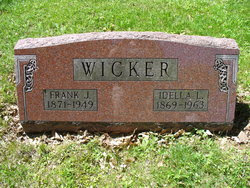
Frank died in 1949 and Idella survived him until 1963. They are buried beside each other at Colby, WI.
Headstone for Frank and Idella in Colby Cemetery, photo courtesy kclem of findagrave.com

Mary Jane "Mayme" Wescott (1871-1926) was the second daughter born to George and Sarah (Bullen) Wescott. 

Daughter Marion (Edwards) Miller describes Mayme as follows: 

My mother, a small quiet spoken lady, blue eyes, dark auburn hair that turned grey when she was in her thirties or forties, always going around the house singing softly, a very particular housekeeper, with hands that were never idle.  She loved to sew, made all of our clothes, even coats when we were young, and when she had all of us fitted out, she made clothes for poor children. . . . When she was a young woman she went on a trip to Montana, probably around 1895, to visit a cousin in Great Falls.  The cousin had a young man boarding with her, 6 ft. tall and handsome, a railroad man who had headquarters there.  His name was Charles Francis Edwards.

For their wedding in Great Falls, Mayme made her own wedding dress, a pale mint green, soft taffeta.

Mayme and Charles Wedding Photo 1896

My grandmother Idella Edwards was the oldest of their 6 children. The family moved around a bit with Charles working on the railroad and trying his hand at mining and farming. It was during their short attempt at homesteading in Saskatchewan that my grandmother started to teach in the Lancer area, fell in love with my young homesteading grandfather and stayed behind to marry when the rest of the family moved back to the United States. Mayme was not happy about leaving her daughter behind but nevertheless hand-stitched this beautiful wool log cabin quilt for the newlyweds.

Portion of the quilt made by Mayme for daughter's wedding - now in possession of the author

Mayme died in 1926 at the age of 54 years after having had a number of teeth extracted in an apparent attempt to improve an unknown long-standing health issue. She was hospitalized in Kelso, WA on a Sunday, died on Tuesday and the funeral was held on Thursday morning in Castle Rock, WA. Her remains were cremated and the ashes are in the Portland Memorial Mausoleum.  Charles lived until 1941; his ashes are beside hers. 

The four young sisters/cousins gazing out with so much promise (and a bit of trepidation perhaps) in that early group photo were women of their time who led somewhat conventional lives that were certainly stamped with their own individuality. 

Some Resources: 

  • Miller, Marion Frances Edwards; My Memories, personal memoir written for her family in January 1978 from her home at 5405 Union Street, Lexington, Michigan, p2
  • Nelson, M. and Dunlop, R., Compilers,  Source Book for the Bullen Family; Privately printed in the 1930s
  • Train, May Phillips, Samuel Bullen and Some of His Descendants, Privately printed 1941
  • Wicker, Frank and Judith, The Wicker-Wescott Heritage, privately printed Milwaukee, Wisconsin. 1998

Labels: , ,

Friday, 27 June 2025

Homage to Homemakers (52 Ancestors in 52 Weeks 2025 Week 27 theme: "Family Business")

More of my ancestors were homemakers than any other occupation. Even when they had other employment outside the home, census records often cite something like "keeping house" or "housewife" or, most often, "homemaker". What occupation could relate more to family business than that of the person tasked with keeping the home and family functioning?

Women over the generations have been the unsung heroines. Their unpaid work is often undervalued (not part of the calculation of GDP in any country, for example) and often seen as unskilled and of low status--probably because it has been a "pink" job. Most often girls learned the necessary skills from their mothers. Although more men are taking on responsibilities for home and family, studies consistently show household duties are not equally shared and very few men would be identified on a census as "homemaker". Some women are not really cut out for the role either, but fully half my ancestors were de facto homemakers. Without their tireless efforts we simply would not have survived.

It would be impossible to name all my homemaker ancestors and identify their specific accomplishments. The occupation comes with a challenging job description requiring a vast number of skills (as I well know from my own personal experience in the occupation!) Requisite skills have varied with the times but may include:  infant and child care, home nursing, gardening, cooking and preserving food, soap and candle making, spinning and weaving fabric, knitting and sewing the family wardrobe, quilt-making, cleaning and organizing the home, providing chauffeur services, maintaining the family calendar of events, and most importantly, providing love and comfort for the other family members. Homemakers often received little of that love and comfort themselves. They were frequently involved in the family business as well, whether that meant assisting in planting and harvesting crops, bookkeeping, or working in a family shop or cottage industry.

My father Ken Bardahl acknowledged in his memoir written in 1991 some of the  challenges faced by the women when his parents homesteaded in Saskatchewan circa 1910: 

On talking of homesteaders, I must give full marks to the wife, who undoubtedly ran into many problems of her own.  To me, I would think that perhaps it was harder for her than her mate.  Many died at childbirth and of course visiting doctors for pre-natal was an unheard of thing.  They usually all had large families and to try and diagnose problems must have been very worrisome.  When we remember that there was no phone, no cars and perhaps miles from help, it must have been a terrible thing when someone became sick or hurt.  Then too, all the clothes had to be washed by hand, perhaps hauling the water first.  I can recall mother telling of when the telephone came to this area in 1917.  The crew needed a place for meals and they offered to build her a clothesline if she would oblige.  This they did and a very good line was built for her.  At that time she would have had 5 youngsters, as if that wasn’t a job unto itself.  

Here are just a few of the homemakers from my own family tree:

  • My Dad's mother, my grandma Louise (Nelson) Bardahl (1881-1985) homesteaded with her husband, first in North Dakota, then in Saskatchewan. She and husband John had 8 children: first came 6 daughters and finally 2 sons. She gave birth to my Dad when she was almost 45. 
When the couple arrived in the Leinan area of Saskatchewan in 1910, they had to build everything from scratch - house, wash shanty, barn, shop, pig and chicken houses, granaries. Trees were planted to surround the buildings. The virgin prairie sod needed to be broken to enable planting crops. Grandma took an active part and was in charge of the home; she was an excellent cook and homemaker. The Ladies Aid group (of which she was a founding member) fund-raised to enable the construction of the local Lutheran church. Her children and grandchildren adored her. 

And yet the 1921 Canadian census indicated she had no occupation at all!  

                
But that was improved by the 1931 census recognizing her true occupation: 


John and Louise (seated) surrounded by their 8 children; my Dad Ken about 8 years old standing centre (colorized)

  • My maternal grandmother Idella "Della"  (Edwards) Anderson (1897-1976) was an intelligent, capable and fabulously creative woman who ran a well-ordered home and was a very good mother. She was also a school teacher, boarding house operator,  motel owner/operator and floral arranger during her life. Not a single census could be located where she was listed as anything other than "homemaker". Perhaps when more recent ones become available they will identify other of her occupations but, in the end, being a homemaker was by far  her most important role.
Della and neighbour with children on the Saskatchewan homestead c.1926 (colorized)


  • My 3rd great grandmother Mary (Green) Hoover (1812-1907) in the 1870 US census is listed as "keeping house".  The Kansas Board of Health Annual Reports for various times between 1868-1898 indicate that she was a midwife who was listed in their records as a "physician". Although she was registered as having delivered nearly two dozen babies, she certainly would have expended even more efforts in her homemaking role raising 9 children as she and husband Christian Hoover migrated from one place to another (Pennsylvania, Illinois, Iowa, Kansas). She took on an extra load when Christian signed up for the Union army during the American Civil War; sadly, he returned an invalid and eventually died by suicide leaving her almost blind and destitute after all her years of hard work.

Mary (Green) Hoover

  • Mary's daughter, my 2nd great grandmother Barbara (Hoover) Edwards Payton (c1834-1890) was "keeping house" in the 1880 US census. As the mother of 4 of her own children (3 still living with them) plus stepmother to 3 of her husband George's, she would have had her hands full.
1880 US census, Howard, Elk County, Kansas

Still, once again, the census categorization does not do justice to the full extent of Barbara's actual occupations. She was very much an active partner with third husband George Payton in many hotel and restaurant business dealings in Howard, KS. At first, only George was listed although, given the nature of the hospitality business, she would have been very involved indeed; over time, "Mrs. Payton" was listed and in the end "Mrs. B.E. Payton" was duly recognized by her initials as being the business person in charge. This can be evidenced from a couple  of the numerous newspaper advertisements and stories for businesses in which she was involved.  

The Howard Courant Thursday 2 June 1881


The Citizen, Friday 1 December 1882, p.3

The Howard Courant 16 September 1887


Barbara (Hoover) Payton c.1890 (colorized)

When she died of a tumor (cancer) in late 1890, one of her obituaries indicated that "she was a good hearted and very ambitious woman".  (No mention is made of her mothering or homemaking skills!)

Their accomplishments often overlooked, forgotten or minimized, the homemakers in my family were doubtless like those in most others. They did what was expected of them to keep their homes functioning and their families thriving without expecting much in the way of acknowledgement or appreciation in return. Many went far above that to achieve satisfying and useful lives in their communities as well. Their efforts are worthy of far more recognition than they have generally received.


Labels: , , ,

Saturday, 3 May 2025

This Genealogist's Dream: Chester Fritz Library (52 Ancestors in 52 Weeks 2025 Week 19 Theme: "At the Library")

Accessing Norwegian bygdebøker (farm books) had been high on my wish list for many years. Farm books were compiled by respected historians over a century ago, using numerous sources, including kirkebøker (church parish registers), census, probate, tax, land and court records. Local residents were also interviewed at the time of the compilations. The result is a series of books (in the Norwegian dialect of each community) providing valuable information about the people living on farms in the various communities throughout Norway.

University of North Dakota
17 August 2017 photo by author

These treasured books are not easily obtained or accessed. Interlibrary loan is not an option. Although there are digitization projects that will make access easier in future, for my purposes in the early 2000's, a visit a brick and mortar library was required. The American libraries that include bygdebøker in their collections are few in number and are located in communities that had a sizeable settlement by Norwegian immigrants. It always appeared that the best bet for me was the Chester Fritz Library (Arne Brekke Collection) at the University of North Dakota.

Arne Brekke Collection in the Chester Fritz Library
photo 17 August 2017 by author


A road trip to observe the total solar eclipse in Grand Island, Nebraska in August of 2017 provided the perfect opportunity for a detour to Grand Forks, N.D. 

After determining my preferred date for a visit, I called the Library's archivist to discuss access. I didn't want to show up and discover that the library was closed or inaccessible to me for any reason. He was very helpful, assuring me that although he himself would be away, the library would indeed be open for business. I described what I had done to prepare for the visit and he confirmed my plan and advised me of opening hours and parking.

As for my preparation, I knew that I would need to know county, parish and farm names for any ancestors I wished to research in the farm books. That would be relatively easy if you just had one or two farms to investigate. With Norwegian ancestors on both my father's 100% Norwegian background and my mother's 38% Norwegian background,  I had dozens that I knew of from four counties (Buskerud, Nordland, Oppland, Telemark). But I had just one day allocated for research! (There are limits to how patient a husband might be left to explore Grand Forks on his own!)

Preparation for the visit included: 
  • reviewing the bygdebøker information available on the Family Search research wiki
  • printing reports from my database for the families to be researched for each Norwegian county, including parish and farm names as well as names and dates for relevant individuals 
  • reviewing the information available on the Chester Fritz Library site and printing off the lists of relevant authors/titles/call numbers to enable efficient access
  • purchase of a good USB memory stick for storing the documents scanned at the library
My husband dropped me off at 8:00 A.M. on 17 August 2017. A very helpful librarian gave me a quick orientation to the books and the scanner and I was off to the races! I was so fortunate that I was the only patron there all day and had lots of table space and immediate access to the high-quality scanner. I stopped for a quick lunch in the cafeteria to keep me energized. In truth, my success was feeding on itself to build momentum as the day went on.

Accessing the Farm Books photo by author 17 August 2017


When my husband picked me up at the end of the day, I felt very satisfied that I had found and saved everything I had hoped to find that day. He captured this picture of me getting into the car which speaks for itself about the kind of day I had had!

Photo of author after a day at the Chester Fritz Library
by Graham Barnard


Labels: ,

Sunday, 20 April 2025

George Wheeler of Concord (1605-1687), 52 Ancestors in 52 Weeks 2025 Week 20 theme: "Wheels"

Unless there is duplication, we have 1024 sets of 10th great grandparents. This overwhelming number explains why my 10th great grandfather George Wheeler had obtained so little of my attention until I tried to find something in my database pertaining to "wheels" for this week's story. A close connection to his surname was the best I could come up with, but I enjoyed the opportunity to get to learn more about this forgotten ancestral family. It turns out that the Wheelers were indeed what is colloquially known as "big wheels" in early Concord.

George was born around 1605/06 at Wharley End, Cranfield, Bedfordshire, England. He married Katherine Pinn on 8 June 1630 and had three children born there between 1631 and  January of 1636. Fourth child Sarah was born in January 1640 after the family had moved to New England, indicating that the family migrated between those dates with 1638 being most often cited. My 9th great grandmother Ruth Wheeler was born in 1642. In all, George and Katherine had 8 children.


Google Earth Map showing Wharley End and Cranfield in Bedfordshire 


Several Wheelers were among the earliest settlers of Concord. It is not clear if they were all related, but it seems likely that at least two of George's brothers, Captain Timothy Wheeler and Captain Thomas Wheeler, migrated to New England at about the same time as George.  All settled at Concord, Massachusetts Bay Colony, British Colonial America.

Concord had been so named in 1635, just a couple of years before their arrival, to commemorate the peaceful acquisition of the lands from the Pennacock-Algonquin peoples. However, since about 90% of those peoples had been wiped out by disease brought from Europe, they might have had a far different name than Concord for the resulting English settlement! Perhaps, as has been suggested, Concord was more expressive of the intended harmony among the English settlers themselves.
 
Concord has many associations in American history relating to the beginning of the American Revolution and for its vibrant literary community including Ralph Waldo Emerson, Louisa May Alcott, Nathaniel Hawthorne and Henry David Thoreau. But those all came many years after the Wheelers were among its earliest English inhabitants. (Another set of my 10th great grandparents, William and Jazan Hartwell, were also early settlers in Concord; their son Samuel would grow up to marry Ruth Wheeler, daughter of George and Katherine Wheeler.)
 
George and Timothy Wheeler were close business associates as well as brothers. The men were holders of large parcels of land in Concord and appeared frequently in the early records for serving in official capacities, being included among those considered having integrity and good judgment. Among the properties owned by the brothers was the original part of what is still being run as The Colonial Inn in Concord, Massachusetts. Although the following image is from nearly 300 years after the Wheelers' time, it is certainly evocative of an earlier era:

Interior of The Colonial Inn c1922, owned in the 1600s by George Wheeler and his brother
Wikimedia Commons Public Domain

Although not known  if any of them were related to George Wheeler or his descendants, the Concord homes pictured below have some affiliation with the Wheeler name:

 
Wheeler-Merriam House, Concord, MA photo by John Phelan
           This file is licensed under the Creative Commons Attribution 3.0 Unported license.  


Wheeler House - Concord Academy photo by Daderot This file is made available under the Creative Commons CC0 1.0 Universal Public Domain Dedication.


Deacon John Wheeler - Captain Jonas Minot Farmhouse, Concord, MA photo by John Phelan This file is licensed under the Creative Commons Attribution 3.0 Unported license.

Katherine died 6 January 1685 and George followed her on 2 June 1687; both are buried in unmarked graves at the Old Hill Burying Ground in Concord, two of the 32 Wheelers buried there. 


Old Hill Burying Ground, Concord, MA
photo courtesy Suzy&Rob of Findagrave.com

Some Resources:

  • "A Short History of Concord" website located at https://concordma.info/concord-mass-history.html
  • Hudson, Alfred Sereno, The History of Concord, Massachusetts, Erudite Press: Concord, Mass., 1904,  accessed through Internet Archive  at https://archive.org/details/historyofconcord01huds/page/n5/mode/2up
  • "The Mythical Twelve First Families of Concord", Concord Journal, 16 December 1954 accessed online at https://concordlibrary.org/special-collections/ruth-wheeler-concord-articles/12-16-1954-the-mythical-twelve-first-families-of-concord
  • Walcott, Charles H., Concord in the Colonial Period, Estes and Lauriat: Boston, 1884, accessed online through Internet Archive at https://archive.org/details/concordincolonia1884walc/page/n1/mode/2up

Labels:

Finding the Birth Father for Charles Edwards (Updated), 52 Ancestors in 52 Weeks 2025, Week 17 theme: "DNA"

 (Minor revisions and simplification of a story originally published on 16 February 2023)

BACKGROUND EXPLANATION


My great grandfather Charles Francis Edwards was born in Keokuk, Iowa on 22 February 1869. He claimed he was orphaned at a young age. His Montana marriage license to wed Mary Jane Wescott in 1896 indicated that his parents were Louis Edwards and Martha Hoover.

Investigations undertaken on my behalf by Alice Veen of Prairie Roots Genealogy in Iowa led to the establishment of his mother and her ancestry. She was Barbara (not Martha) Hoover (c.1832-1890). Barbara married three times, first in 1855 to a Hoover cousin named William. After William’s untimely death in 1858, she married Louis Edwards in Illinois in 1861. Louis soon left to take part in the American Civil War, became very ill and came home to die in Illinois on 18 February 1866, a full 3 years before the birth of Barbara’s son Charles. Barbara married her third husband, George Payton, in What Cheer, Keokuk, Iowa in 1873. Clearly, Charles was born between marriages for his mother.

Who then was Charles’s father?

Traditional genealogical records proved useless for determining this well-guarded family secret. Recent developments in genetic genealogy were the only hope for finding a father for Charles; his living descendants would contain valuable information in their genetic makeup.

Y CHROMOSOME ANALYSIS

The Y chromosome is passed down virtually unchanged from father to son down the line, enabling determination of male inheritance quite clearly. This usually means following the family surname back up the male line, only broken where the supposed father was not the actual biological father of the son.  Charles Edwards certainly did NOT inherit the Edwards Y chromosome. His Y chromosome would have come from his unknown father who somehow encountered Barbara in the spring of 1868 when she became pregnant with Charles.  Of course, both Charles and his unknown father (“UF”) have long since passed away so traditional paternity testing is out of the question.

The next best thing is to have a male child of Charles submit a DNA sample for determining his Y chromosome haplogroup and locating any close living matches who have also tested and share similar Y chromosome DNA.  The two sons of Charles are also deceased, but both had sons who would have inherited that same Y chromosome from UF.  One of them graciously agreed to be tested through FamilytreeDNA at the 67 marker level. (To protect his privacy, I am going to call him “YEdwards”.)

When YEdwards’ results came back with Haplogroup R-M269 (as of April 2025 classified as R-P312), not surprisingly there were no matches with the Edwards surname. Although this haplogroup is common in Central Europe, Spain, Portugal, France and the British Isles, there were just 2 matches (here called “LS” and “RN”, again to protect their privacy) leading to 2 surnames: Saum(s) and Nagle/Nagell.

Match Name

Genetic distance

Most distant male ancestor

Haplogroup

Final SNP

LS

3

(Saum) 

R-M269

-

RN

7

Hans Nagell b1615 Germany

R-FGC8158 (he has done a more advanced test leading to greater differentiation)

R-FGC8158

When the results were first posted, LS had a couple generations of his tree online. From LS’s parents’ names, I was able to construct his family tree going back an additional four generations to Adam Saum (1785-1855) and his wife Margaret Miller (1792-1856) who had a family of some 14 children including no fewer than 11 sons! Later, I determined two additional generations to Nicholas Saum, German immigrant to Saumsville, Virginia, in the 1700s. Nicholas had numerous children by 3 wives. This was not going to be simple.

RN did not post a tree, but he did list his most distant known male ancestor as Hans Nagell of Germany.

The Genetic Distance is indicative of how much mutation has occurred in the Y chromosome; the lower the number, the closer the relationship. FamilytreeDNA gives tips for the likelihood that two men share a common male ancestor within a certain number of generations.

Comparing RN to YEdwards, with a Genetic Distance of 7, the likelihood of a shared male ancestor looks like this for Nagle:

Within 4 generations

3.74%

Within 8 generations

31.56%

Within 12 generations

67.02%

Within 16 generations

88.1%

Within 20 generations

96.49%

Within 24 generations

99.1%

 Comparing LS to YEdwards, with a Genetic Distance of 3, the table looks like this for Saum:

Within 4 generations

44.6%

Within 8 generations

84.25%

Within 12 generations

96.64%

Within 16 generations

99.38%

Within 20 generations

99.9%

As of April 2025 the FamilytreeDNA website is using a time chart showing that LS and YEdwards likely share a common ancestor between 1300 and 1850 CE, while for RN it would be 400-1600 CE. Clearly, it is more likely that UF for Charles Edwards will be found more recently in the Saum family tree of LS.

Next step was to build the Saum family tree from that determined for LS, starting with the most distant male ancestor found for him, namely Nicholas Saum. 6 generations separate LS from Nicholas Saum. This could be a promising lead and well worth the time and effort to build out the extended family tree of Nicholas Saum and his descendants.

The Y chromosome test has given us a possible surname for the UF for Charles Edwards, but on its own cannot give us the name of a specific man.

AUTOSOMAL DNA ANALYSIS

The autosomal (family finder) test is another genetic test that can determine ancestry based on the other 22 (non-sex-determining) sets of chromosomes.

We all inherit 50% of our DNA from our mothers and 50% from our fathers (one chromosome from each parent of each of the 22 chromosomes in the nucleii of all our cells), about 25% from each grandparent, 12.5% from great grandparents, etc. The exact amount varies because of recombination of the chromosomes. As you go back more and more generations, the amount diminishes and some ancestors are not represented at all in a person’s genetic makeup. The more family members who have their autosomal DNA tested, the more of the family’s overall genetic background becomes apparent.

My mother Elinor had her autosomal DNA tested in her later years. She is one generation closer to the UF for Charles Edwards than I am. Charles was my mother’s grandfather so UF would be her great grandfather and we might expect that about 12.5% of her DNA came from him (although that could vary). Similarly, YEdwards is of the same generation and would also expect about 12.5% of his autosomal DNA (as well as 100% of his Y chromosome) to have come from UF.  Since I have access to the DNA results for both YEdwards and Elinor, these are the best results for me to use to analyze their matches who come from within the Saum tree that I have built. (I subsequently obtained access to the Ancestry DNA results of another of Elinor and YEdwards’ first cousins (LM) and will discuss LM’s results later.)

Because comparisons can be made only to DNA matches who have tested at the same company, I took advantage of every opportunity, when granted permission by the original test taker, to upload raw DNA data from the testing companies to other sites such as GEDMATCH and My Heritage. I have also done additional tests myself with Ancestry DNA and 23&Me (recently withdrawn) and have uploaded my own raw DNA results to Living DNA.  Every site has yielded more Saum connections.

Finally, some patterns began to emerge that gave me an additional clue. I had a lot of matches that were to the Henderson family, which was otherwise unknown to me. (I had a well built-out tree on all known branches of my tree other than the mystery line for UF.) Frequently, the Hendersons also fit into the Saum tree through descendants of a marriage between George Adam Saum and Susannah Henderson. Sometimes matches were just to Saums and sometimes just to Hendersons, leading me to investigate this family further since we could be matching our DNA matches through either the Saum or Henderson line. But, for our family, it seemed we had to be descending from both, most likely from a marriage of the two. I did exhaustive research to ensure there were no other Saum-Henderson marriages that could also be the source of my family having inherited DNA from both those families. There was one, but it was for a male Henderson to a female Saum, which would not have given the Y chromosome results obtained for YEdwards.

The one marriage between a male Saum and female Henderson is the one of George Adam Saum and Susannah Henderson whose children were all born within a few years of Barbara (c. 1832).

George Adam Saum (b. Saumsville, VA 1797, d. Highland, OH 1836) married in 1819 to Susannah Henderson (b. 1805, d. 1855) – 7 children, including 3 daughters and 4 sons:

1.     Charles Frederick Saum (b. 1821, Ohio, d. 1886 Lawrence, Douglas, KS)

2.    Jacob Saum (b. 1822, d. 1861 (after being shot by neighbours for being an abolitionist and Lincoln supporter – several years before Charles was conceived)

3.     George Thompson Saum (1824-d. 1912 Kellogg, Jasper, Iowa)

4.     Stephen Adam Saum (1834-d. 1927 in FL but had farmed most of his life Kellogg, Jasper, Iowa)

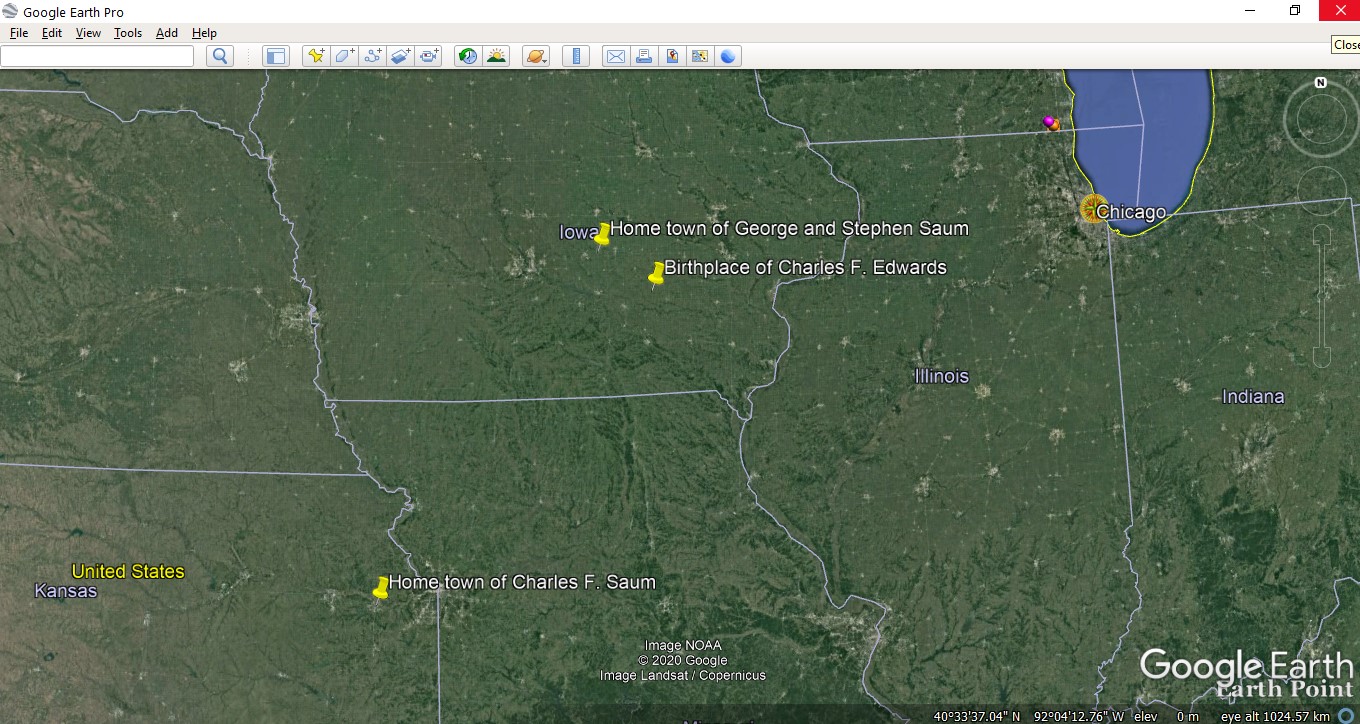
Conducting thorough research on the three possibilities from this family for UF first led me to focus on the third and fourth sons since both spent most of their lives in Iowa, which is likely where Barbara was living when she conceived Charles. A map shows that the distance between Kellogg and What Cheer where Barbara’s parents were living was about 50 miles, not exactly next door but certainly closer than the 280 miles to Lawrence, Kansas where oldest brother Charles lived. These people moved around more than we might think and certainly maintained connections with family members who might not live nearby. As will be seen later, the connection was most likely through Barbara's sister who lived near two of the Saum brothers. 


Google Earth image of Iowa and Kansas showing locations of Barbara’s parents and the Saum brothers


THREE BROTHERS POSSIBLE AS CHARLES'S FATHER

 1.      Charles Frederick Saum (1821-1888)

Charles Frederick Saum was born in Dodsonville, Highland, Ohio in 1821. He had one daughter born in 1844 to his first wife Mary Elizabeth Shawver before her death in 1846. His next marriage was in 1847 to Mary Bardell; the couple had nine children born between 1849 and 1869.

Threatened along with his next-younger brother Jacob N. Saum in a poster in 1861 for being an abolitionist supporter of Abraham Lincoln, he survived when Jacob was shot later that year by neighbors. This provided the impetus for Charles to make a hasty departure to Lawrence, Douglas, Kansas with Lane’s army in 1861. He lived in the area until 1878 when he moved to Mt. Ayr, Osborne, Kansas. He was a farmer, carpenter, and notary public. He wrote several articles for newspapers about farming and about his journey to Mt. Ayr. He was interested in politics and served as a delegate in 1880.

An obituary for his daughter Emma in 1910 contains more information about him as described in another story. 

Of the three brothers, Charles Frederick Saum lived the farthest distance from where widowed Barbara Hoover Edwards was living in the spring of 1868 when she became pregnant (somewhere in Iowa, possibly at What Cheer with her parents which is where she was living at the time of the next census in 1870).  Still, the similarity in his name to Charles Francis Edwards (and the ambiguous DNA match results to be discussed later) keep him well in contention as a potential father.

 2.      George Thompson Saum (1824-1912)

Born in Dodsonville, Highland, Ohio 4 January 1824, George married first wife Sarah Roush in 1847 and, after her death, Marieta Boatright in 1855; she died in 1867. He purchased land and moved to Buena Vista Twp., Jasper County, Iowa about 1854-55. He married his third wife Ella Wilson 2 March 1869. He had a total of 9 children (2 each from first and third marriages and five from the second).

His land in Buena Vista Township, Jasper County Iowa was located at section 1, Twp.79 Rge.18 W5M, and he had nearby land in sections 5 and 6 of Twp.79, Rge.17 W5M in Richland Township. The History of Jasper County gives his landholdings as 1000 acres. This land was just south of Kellogg, Iowa which was also his postal address at the time. Kellogg was a new town in 1865, being laid out in anticipation of the Mississippi and Missouri Railroad being built through the area. The population never exceeded 800 people.

The next township north of Buena Vista is Kellogg Township, which happened to be the home of Barbara Hoover’s sister Susan Anna Hoover Bleakney. The Bleakney land was located just north of the town of Kellogg at section 14, Twp.80 Rge.18 W5M. When Barbara gave birth to her twin daughters Minnie and Grace in 1865 or 1866, she did so at the Bleakney home. One can assume Barbara could have been a regular visitor or perhaps was even living at the Bleakney home at the time she became pregnant in the spring of 1868. She would have been very near the home of the widowed George Thompson Saum at the time. The distance is only about 3 ½ miles. The two would definitely have known each other in this small rural community. However, if George was aware of her pregnancy and the birth of a son Charles at her parents’ home at What Cheer, Iowa, on 22 February 1869, it would seem a real slap in Barbara’s face for him to have married Ella Wilson only about a week later!
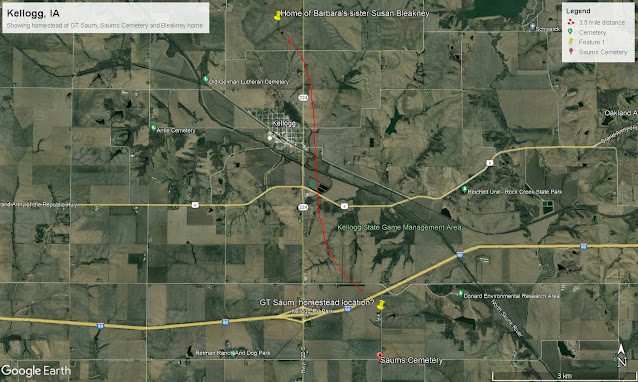
Google Earth map showing locations of George Thompson Saum property, Saums cemetery and the Clark and Susan Anna Bleakney home near Kellogg, Iowa about 3 to 4 miles away

George Thompson Saum died 19 September 1912 when his car was hit by a train while he was driving from Waukee to Des Moines. (His stone is in the Saums Cemetery located on his original section of land as shown above.) 

His obituary indicates that “Mr. Saum was not a church man nor a member of any secret order however he was a man of very pronounced opinions even in politics and the democratic party to which he belonged. He was a careful business man and regarded his word as his best asset and was the kind of a man whose word was as good as his bond.” He does not sound like the sort of man who would abandon a woman pregnant by him to her own devices - assuming, of course, that he ever knew of her situation.

3.      Stephen Adam Saum (1834-1927)

Like the other brothers, he was born in Dodsonville, Highland, Ohio. In 1853 he was living in Knox, Illinois where he married Rachel Ellis 21 December 1856. By 1860 he had joined his older brother George Thompson Saum in Jasper County, Iowa. Like George, Stephen had land in the vicinity of Kellogg and would have been neighbors to Barbara’s sister Susan Anna and her husband Clark Bleakney.

Stephen joined the Union army 3 August 1862 where he served as a Private in Company K of the Iowa 28th Infantry. By 1864 he had been promoted to full 6th corporal. He mustered out 31 July 1865. By the time of the 1870 census he was living in Buena Vista Township, Jasper County, putting him equally well situated as brother George to have had a relationship with Barbara Hoover Edwards in the spring of 1868.

Stephen was a manufacturer of pumps and a businessman in Kellogg Township, often acting as a travelling salesman (presumably on behalf of his company Saum, David & Co.) He died in Florida in 1927.

Stephen and Ella had three children, two of whom did not survive childhood. Stephen’s medical records indicate that he contracted mumps in 1863 during his Civil War service, leading to atrophy of his left testicle. He did not father any additional children with his wife after the Civil War, making him the least likely of the three brothers to have fathered Charles Edwards.

ANALYSIS OF AUTOSOMAL MATCHES TO THE SAUM FAMILY

Several or my family members have had DNA tests done with a variety of the popular testing companies: Familytree DNA, My Heritage and Ancestry DNA. Some of these results have also been uploaded to GEDMATCH. I have tried to take advantage of every clue leading to the family that Charles Edwards’ father came from. The tools on the various sites vary significantly in terms of the information provided and the tools available to narrow down matches.

Except for Ancestry DNA, the testing sites provide chromosome information for where a test taker and a match share DNA on a particular chromosome and the amount of such match expressed in centimorgans (cM). This enabled me to make a spreadsheet for overlap areas on chromosomes where the same DNA was shared by one or more matches, meaning that it was likely inherited from the same ancestor some distance up all their trees.

Portion of Spreadsheet for Elinor’s DNA matches by Chromosome - portion C6

test co.

tester

match


chromosome

start position

end position

cM

FTDNA

ELINOR

Richard

6

88.5

102.3

12.2

MH

ELINOR

Norma

6

88.5

105

15.3

FTDNA

ELINOR

Oneil

6

88.5

106.3

16.7

FTDNA

ELINOR

Rachel

6

88.5

108.5

20

MH

ELINOR

Marvin

6

88.5

109

21

FTDNA

ELINOR

Scott

6

89.1

104.9

13.8

FTDNA

ELINOR

ayla

6

90.4

108.5

17

FTDNA

ELINOR

John Joseph

6

91.7

125.1

28.8

FTDNA

ELINOR

Scott (5)

6

93

109.1

15

FTDNA

ELINOR

Murray

6

98.8

110

12

Ancestry

ELINOR

BL

Gedmatch

6

99.9

125.7

22.4

Ancestry

ELINOR

Norton

Gedmatch

6

107.3

125.7

14.9

FTDNA

ELINOR

Vancil

6

108.1

125.5

13.7

FTDNA

ELINOR

Elizabeth

6

110.9

125.1

11.2

The above section of my spreadsheet shows a portion of my mother’s chromosome #6 and shows several matches in the area from 88.5 to 125.7 (these numbers have been truncated for ease of use.) These people all relate through the Saum family tree. The amount of shared DNA is not large but this is just for one segment of one chromosome, varying from a low of 11.2 for the match called Elizabeth to a high of 28.8 for a match named John Joseph. Not everyone posts a family tree on their DNA sites, but fortunately John Joseph had an extensive tree that enabled me to see that he was indeed a part of the Saum/Henderson family as a descendant of oldest brother Charles Frederick Saum.

The Shared cM Tool is a well-researched and generally accepted tool developed by Blaine Bettinger and accessible on the DNA Painter website. It is used for ascertaining the potential relationships that two test takers could have based on the number of cM of DNA that they share. Using the total 45 cM shared by Elinor and John Joseph over all their chromosomes gives this result:

Blaine T. Bettinger

www.thegeneticgenealogist.com

CC 4.0 Attribution License


YEdwards also matched John Joseph on FTDNA and shared 52 cM with him. Relationship possibilities according to this amount are shown in this chart:


Blaine T. Bettinger

www.thegeneticgenealogist.com

CC 4.0 Attribution License


John Joseph (a descendant of Charles Frederick Saum), Elinor and YEdwards would be either half second cousins once removed (Half 2C1R) (if Charles Frederick Saum is UF) or third cousins (3C) (if one of the other two brothers is UF).

The foregoing analysis is just an example of the methods that can be used. Using a variety of tools enabled me to find dozens of Saum/Henderson matches for various of my family members and to add all these “new” family members to my own tree so that I could determine potential relationships. Consistently, the Shared cM tool indicated that these matches could arise if any of the three Saum brothers was indeed Charles Edwards’ UF.

My Heritage and Ancestry DNA both added tools for suggesting how a tester and a match might share ancestors. For this to work, the tester must have a genealogy family tree associated with their DNA results. Adding a hypothetical UF where you think he might belong in your tree is a necessity. For my trees, I had added Charles Frederick Saum as the hypothetical father for Charles Edwards. 

Having uploaded my mother Elinor’s family tree along with her raw DNA data from FamilytreeDNA to My Heritage enabled me to view their tools called “Theory of Family Relativity” and “Smart Matches”. One of her Saum/Henderson matches found this way on My Heritage was L.P., a descendant of Charles Frederick Saum. L.P. would be either a half 2nd Cousin once removed or a Third Cousin of Elinor’s depending on which of the brothers is the UF of Charles Edwards.  (It might not immediately be obvious, but a half 2nd cousin and a 3rd cousin are equivalent.) Once again, the Shared cM Tool indicates these are quite probable relationships for this amount of shared DNA (40.6cM).  (There are many other DNA matches on My Heritage for Elinor to members of the extended Saum/Henderson family, most often through the two older brothers.)

Turning now to the tools at Ancestry, their “ThruLines” tool is one of the most useful in that it sets out possible trees showing exactly how all the DNA tested cousins relate to a shared ancestor. 

I have access on Ancestry to DNA results for three family members of my own generation plus one for a younger generation and was able to see dozens of Saum/Henderson DNA matches with exactly how we might relate.  But testing an older generation is even better as the relationship to UF is one generation closer and therefore more of UF’s DNA is likely still in evidence. Fortunately, another first cousin of my mother’s, L.M., has granted me access to his DNA on Ancestry. L.M.’s ThruLines to the Saum/Henderson families have proven very useful. To give you an idea of the number of matches that show up for L.M.’s DNA and how certain this makes me that I have found the right family for UF:

·        Of the 8 great grandparents of L.M., hypothetical Charles Frederick Saum has the most DNA matches for L.M. (excluding descendants of Charles Edwards himself) – 87 compared to just 3 for Barbara Hoover who we know to have been Charles Edwards’ mother!

·        Of the sixteen 2nd great grandparents of L.M., the parental couple for the three brothers (George Adam Saum and Susannah Henderson) again have significantly more than the other 2nd great grandparents. This Saum/Henderson couple have a total of 102 DNA matches to L.M. compared to just 16 for Barbara Hoover’s parents (again excluding those of us who descend from Charles Edwards himself).

·        The pattern continues back for the next couple of generations with significant DNA matches for all branches going back from the Saum/Henderson families.

L.M.’s closest matches have shared DNA with him in amounts up to 112 cM that he shares with “Linda”, a descendant of Charles Frederick Saum. She would be either a half second cousin twice removed (half 2C2R) or a third cousin once removed (3C1R) to L.M., again falling well within the range of possible relationships according to Blaine Bettinger’s Shared cM Tool:

Blaine T. Bettinger

www.thegeneticgenealogist.com

CC 4.0 Attribution License

from the DNA Painter Website


"What are the Odds?" Tool

A tool developed by Jonny Perl available on his DNA Painter Website is called “What are the Odds?” (WATO) located at https://dnapainter.com/tools/probability. This tool allows you to upload your family tree and include DNA matches in that tree along with the amount of shared DNA. A question is asked, in my case “Who is the father of Charles Edwards?”, the test taker’s name is added and then hypotheses are posed or suggested by the website. If the odds come back as “0”, the hypothesis is an impossibility. Anything from “1” up is possible, with the highest number being deemed the most likely. Even Jonny Perl will admit that just because one hypothesis is deemed most likely does not necessarily make it the right answer.

So, what happens when I pose various hypotheses for UF based on different test takers’ DNA matches? I will use only the oldest generation of testers available to me – namely Elinor, YEdwards and L.M.

1.      YEdwards as the Tester

-        Charles Frederick Saum most likely

-        George Thompson Saum second most likely

-        Abraham Henderson third (but can be eliminated as not fitting with Y chromosome Saum result)

-        Asa Henderson (a descendant of the other Saum/Henderson marriage mentioned earlier, but also can be eliminated as not fitting with the Y chromosome Saum result)

-        Stephen Adam Saum possible, score of 1, remains a possibility

2.      L.M. as the Tester

-        George Thompson Saum most likely

-        Charles Frederick Saum second most likely

-        Stephen Adam Saum a possibility again with a score of just 1

3.      Elinor as the Tester

-        Charles Frederick Saum most likely

-        George Thompson Saum second most likely

-        Stephen Adam Saum third most likely

The foregoing results are therefore inconclusive but it does seem that both Charles Frederick and George Thompson Saum are the likeliest candidates as father for Charles Edwards but Stephen Adam Saum remains a possibility.


CONCLUSIONS

In my opinion, the least likely father for Charles is youngest brother Stephen Adam Saum because of his damaged testicle after suffering from mumps during the Civil War. As between the two older brothers, it is really a toss-up (George Thompson Saum for his geographic proximity to Barbara’s sister’s Bleakney family or Charles Frederick Saum for the similarity in name and the huge number of DNA matches among his descendants to our family).

One possible way to pinpoint one of the brothers would be by chromosome analysis to determine if any specific DNA segment(s) could have been passed to us by only one of the brothers, but I don't have enough data (nor perhaps enough patience!) to make this a viable option. We may never be able to identify the father with certainty. However, it is certain that the Saum family is our family; we are related to these people.

I welcome any additional information that may come to light working to either prove or disprove my theory. I remain hopeful that as testing increases and additional tools become available, one or other of the brothers may be claimed with certainty.


Reference DNA Sites:

Ancestry: https://www.ancestry.com

DNA Painter website: https://dnapainter.com

My Heritage: https://www.myheritage.com/

Familytree DNA: https://www.familytreedna.com/

GEDMATCH: https://www.gedmatch.com/

(Sources for genealogical data provided for family members can be obtained through the author.)

Labels: