Saturday, 12 July 2025

Wescott and Bullen Cousins (52 Ancestors in 52 Weeks 2025 Week 29 theme: "Cousins")


Wescott - Bullen Cousins photo abt.1893-1894

This photograph shows two sets of sisters who were first cousins, their common grandparents being David Bullen Sr. and  Jane Murdie. The Bullen sisters (on the left) were daughters of David Bullen Jr. (1832-1911) and the Wescott sisters (on the right) were daughters of David's sister Sarah Catherine Bullen (1838-1933). The Bullens were living in Poynette, WI and the Wescotts in Colby, WI., a distance of over 200 miles as the crow flies. 

Pictured are: 

Maude Bullen (married name Branton) upper left

Eva Bullen (married name Wescott) lower left

Idella Wescott (married name Wicker) upper right

Mayme Wescott (married name Edwards) lower right - my maternal great grandmother

The photographer is identified on the back as M. Danks of Colby, Wisconsin. He was registered in business there from 1893-1906 (but had died on 11 February 1905). That limits the timing of this photograph, as does the apparent ages of the young women when compared to other photographs of them.  

I often wonder about the reason for the cousins being together and dressing up with corsages. Perhaps a family wedding? Of the two ring fingers visible in the image, Eva appears to be wearing a wedding ring while Mayme does not; Eva had married her first cousin Harvey Wescott (brother to Idella and Mayme) 14 October 1890 but this would have been prior to Mr. Danks having his photography business in Colby. Mayme married Charles Edwards 1 October 1896 in Great Falls, Montana. There were a couple of family weddings in Colby that occurred in 1894 when Idella Wescott married Frank Wicker and when Idella and Mayme's brother Fred married Josephine Nikodeme. Perhaps the family had gathered for one of those events, but Idella is not dressed in traditional bridal garb if this was at the time of her own wedding. In any event, the gathering of the four of them in Colby was considered worthy of this group photo.

Maude Martha Bullen (1869-1964) was born in Arlington, WI. She married Charles Branton on 16 March 1897. The following is from an undated and unsourced newspaper clipping in the possession of Mrs. A. H. Nelson at the time she and Ruth Dunlop compiled their family history in the 1930s: 

At the Mr. E. Parsonage on Wednesday evening, Nov. 28th, Miss Maude M. Bullen, daughter of Mrs. Hannah Bullen of this city, and Mr. C. H. Branton, also of this place, were joined in holy bonds of matrimony. Following the ceremony the newlyweds started on an auto trip northward to Unity, to spend a few days with the family of the bride's sister, Mrs. Eva Wescott. 

Miss Bullen has spent the major portion of her life in Poynette and was for a number of years a faithful employee of the Poynette Telephone Co. She is held in the highest esteem by her friends. For the past year she has been employed in a hospital in Madison.

Mr. Branton is foreman of a crew of county men, whose business he has successfully conducted for the past eight years; he has been a neighbor to the editor and family for about twenty years, and our associations with each other have been gilt edge. We join in extending congratulations--may they be blessed with health, happiness and prosperity.

This is where the story gets confusing. The good wishes from their wedding announcement did not result in a "happily ever after" story for Maude and Charles. In the 1900 census, just 3 years later, she was a teacher living with her parents under the name Maude Bullen, single. Charles was listed in the same town having been married 3 years to someone named Eliza with two very young children. There is no record of Maude and Charles having any children nor of their marriage having been annulled or ended by divorce. No additional marriage record has been located for Charles and Eliza. Maude is listed as single and a "call girl" with the telephone company in 1920, living with her widowed mother.  From time to time over the years, she used the name Branton. When Charles died in 1959, his obituary lists her as his surviving wife along with the implication that the children, grandchildren and great grandchildren listed were also hers. In fact Eliza had predeceased him but there is no reference to her in his obituary.  

Maude died in 1969 and is buried with her parents in the Bullen section of Hillside Cemetery in Poynette, Wisconsin.

Maude Bullen stone - photo courtesy Findagrave.com member EAK II


Eva Lee Bullen (1868-1939) was the first-born child of David Bullen Jr. and Hannah Hodgson in Arlington, WI.  According to her obituary, she received her education in the public schools of Arlngton, and graduated from the Poynette High School.  She went to Marathon County, WI as a teacher, then on 14 October 1890 married her cousin Harvey Wescott and had a family of  3 sons (Harry, Ross and Glenn) with him. 

At the Wescott Homestead in Wisconsin 1895 (colorized). Harvey Wescott is back row, 2nd from left and his wife Eva is on the far right of the picture with young sons Harry and Ross, standing next to her mother-in-law Sarah Catherine (Bullen) Wescott. (Seated front row are Harvey's sisters Idella and Mayme)

Eva was very active in community and church affairs. She died on 8 March 1939 at Marshfield, WI.

Eva Lee (Bullen) Wescott


Idella Louise Wescott (1869-1963)  was the first of two daughters born to George Garner Wescott and Sarah Catherine Bullen. There were 6 brothers. Idella was in the first high school graduating class of Colby, Wisconsin. Like her cousin Eva, she was a school teacher in her early years. At the age of 24, she married Frank Wicker and went on to have a family of 7 children with him. 

Frank and Idella, unknown year - photo courtesy Dawn Wicker


Frank and Idella's Family Celebrate their 50th wedding anniversary
photo courtesy Dawn Wicker 


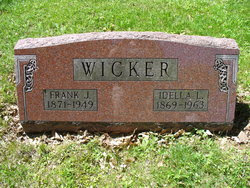
Frank died in 1949 and Idella survived him until 1963. They are buried beside each other at Colby, WI.
Headstone for Frank and Idella in Colby Cemetery, photo courtesy kclem of findagrave.com

Mary Jane "Mayme" Wescott (1871-1926) was the second daughter born to George and Sarah (Bullen) Wescott. 

Daughter Marion (Edwards) Miller describes Mayme as follows: 

My mother, a small quiet spoken lady, blue eyes, dark auburn hair that turned grey when she was in her thirties or forties, always going around the house singing softly, a very particular housekeeper, with hands that were never idle.  She loved to sew, made all of our clothes, even coats when we were young, and when she had all of us fitted out, she made clothes for poor children. . . . When she was a young woman she went on a trip to Montana, probably around 1895, to visit a cousin in Great Falls.  The cousin had a young man boarding with her, 6 ft. tall and handsome, a railroad man who had headquarters there.  His name was Charles Francis Edwards.

For their wedding in Great Falls, Mayme made her own wedding dress, a pale mint green, soft taffeta.

Mayme and Charles Wedding Photo 1896

My grandmother Idella Edwards was the oldest of their 6 children. The family moved around a bit with Charles working on the railroad and trying his hand at mining and farming. It was during their short attempt at homesteading in Saskatchewan that my grandmother started to teach in the Lancer area, fell in love with my young homesteading grandfather and stayed behind to marry when the rest of the family moved back to the United States. Mayme was not happy about leaving her daughter behind but nevertheless hand-stitched this beautiful wool log cabin quilt for the newlyweds.

Portion of the quilt made by Mayme for daughter's wedding - now in possession of the author

Mayme died in 1926 at the age of 54 years after having had a number of teeth extracted in an apparent attempt to improve an unknown long-standing health issue. She was hospitalized in Kelso, WA on a Sunday, died on Tuesday and the funeral was held on Thursday morning in Castle Rock, WA. Her remains were cremated and the ashes are in the Portland Memorial Mausoleum.  Charles lived until 1941; his ashes are beside hers. 

The four young sisters/cousins gazing out with so much promise (and a bit of trepidation perhaps) in that early group photo were women of their time who led somewhat conventional lives that were certainly stamped with their own individuality. 

Some Resources: 

  • Miller, Marion Frances Edwards; My Memories, personal memoir written for her family in January 1978 from her home at 5405 Union Street, Lexington, Michigan, p2
  • Nelson, M. and Dunlop, R., Compilers,  Source Book for the Bullen Family; Privately printed in the 1930s
  • Train, May Phillips, Samuel Bullen and Some of His Descendants, Privately printed 1941
  • Wicker, Frank and Judith, The Wicker-Wescott Heritage, privately printed Milwaukee, Wisconsin. 1998

Labels: , ,

Wednesday, 16 September 2020

Murder in Minneapolis: Frederick Wescott (1867-1912) (52 Ancestors 2020 Week 39) Theme: "Should Have Been a Movie"

Frederick "Fred" Wescott was one of my great grandmother Mary Jane Wescott's older brothers, making him a great granduncle to those in my generation in the family. He was born in Kaukauna, Outagamie, Wisconsin 12 May 1867 a couple of years after his father George Garner Wescott returned home from fighting for the Union in the American Civil War. That may have used up most of Fred's luck; things did not end well for him as this tragic murder mystery will reveal.

Fred Wescott 1895

Place

  • Rising Sun Restaurant, a somewhat seedy establishment at 208 Second Avenue South, Minneapolis, Minnestota

Time

  • 1912, beginning on the evening of Saturday 1 June

Cast of Characters 

  • Frederick Wescott, age 45, cook in the Rising Sun Restaurant, the victim
  • Mrs. Isabelle Getsman, age 35ish, otherwise known as "Scotch Maggie", owner of the Rising Sun Restaurant
  • John Getsman, her husband, age 56, a horse dealer and sometime saloon owner
  • Daniel Moon, clerk in the Grand Central hotel, 110 Second Street South, Milwaukee 
  • Minneapolis Police Chief Mealey, Captain Smith and Detectives Crummy and Johnson
  • Hubert Jacobs, possible witness, age 23, height 5 ft. 3 inches, walks with a slight limp

Synopsis

The headlines shouted out the tragic news on the front page of the Monday 3 June 1912 edition of the Minneapolis Morning Tribune:


Headlines 3 June 1912 Star Tribune, Minneapolis MN, front page
accessed from Newspapers.com 

The lengthy story that followed was conveniently broken into sections since there was so much to report. It continued:

     Fred Wescott, cook in the Rising Sun restaurant, 208 Second avenue south, was murdered Saturday night by being stabbed in the back, either shortly before or immediately after entering the restaurant at about 10 o'clock.

    Mrs. Isabelle Getsman, formerly better known as "Scotch Maggie", her husband, John Getsman, a horse dealer and Daniel Moon, clerk in the Grand Central hotel, 110 Second street south, are being held in Central station pending a further investigation.

    Although Wescott must have been stabbed before 10 o'clock, it was not until after 3 o'clock in tho morning that the police were notified of his death. Then it was said he had died from heart disease, and it was not until detectives and the coroner arrived that the stab wound under his left shoulder blade was discovered.

From there, the article reported how the stories told by Mr. and Mrs. Getsman contradicted one another. First, they reported her version verbatim:

"Wescott has been cooking for me for the last two years. Last night, at about 8 o'clock, he said he was going out to get a shave. I gave him a dollar, asking him to buy some groceries. It was about 10 o'clock when he returned. He hadn't had a shave, nor did he have any groceries. Tho dollar was also gone. 

   "He took off his coat and sat down in the kitchen, cocking his feet on the kitchen table. I noticed there was blood on his vest and asked him about it. He said it didn't amount to anything. 

   "I left him there and went to bed. My husband came in about 11 o'clock and I told him about Fred. He talked to him a moment and then also went to bed. It was some time afterward that I heard Wescott walking about. Shortly after I heard a peculiar gurgling sound and awakened my husband, who went to investigate, and then hurried out to find a policeman."

There were some differences in the versions of husband and wife. He said the door was locked when he got home while his wife had said it not been locked. (The policeman on the beat who had made his rounds between 10 and 11 p.m had found the door locked.) She said that when her husband came home she prepared supper for him and they shared a bottle of beer; he denied eating anything after he got home. Each claimed to be the first to go to bed that night. 


According to Mr. Getsman, when he found Wescott in distress, he went to find a policeman and wandered up and down Washington Avenue both directions but was unable to find one. When he got home, still not having obtained assistance, he found that Wescott was dead.  Finally, Getsman ran to the National Hotel and telephoned police headquarters saying there was a dead man at his place, probably having suffered a heart attack. (The police were, understandably, suspicious that Getsman, who had lived int he city for many years and knew the area well, would have known where police headquarters and the patrol barn were located and would have easily been able to find a policeman had he really wanted to.)

The third person arrested was Daniel Moon, clerk at the nearby Grand Central Hotel. He had been in the Rising Sun Restaurant that evening and was supposedly the last man to have seen Wescott alive and well. Mrs. Getsman tried to focus blame on Moon saying that Moon and Wescott had planned to open a saloon together but must have fallen out; Moon denied all of this. He said he had seen Wescott shortly after 8 o'clock that evening when Wescott had left to go to 28 First Street North to feed the dogs at Getsman's barn. That was the last Moon saw of him.


The Coroner's autopsy found that Fred's death had resulted from internal hemorrhage caused by a sharp object such as a stiletto or double-edged knife; two such knives were found at the scene (nor surprisingly since this was a restaurant). 

Other evidence found by the police included a white cook's apron, covered in blood and rolled up in a ball in the back yard. It was noted that the stab wound had penetrated Fred's shirt and vest but there was no damage to his jacket, leading the police to the conclusion that the stabbing had occurred indoors and not out on the streets as implied by Mrs. Getsman. 

Newspaper stories over the next while often tended to the lurid but do give a sense of what transpired in the investigation. 

It seems that after the confusion of the first night, Daniel Moon was released, as was Mr. Getsman. One witness by name of Hubert Jacobs had been located after a 24 hour search by Detective Crummy. Jacobs stated that he had just been leaving the restaurant on the fateful night after hearing Mrs. Getsman and Wescott arguing about the necessity of  peeling more potatoes. He said he had seen a struggle ensuing, culminating with her stabbing Wescott in the shoulder with a knife. 

Mrs. Getsman remained in jail and remained silent on advice of counsel. When the papers learned of her stage moniker "Scotch Maggie", the opportunity proved irresistible to the reporters.

Star-Tribune, Minneapolis, MN 5 June 1912, p.10
Newspapers.com

Minneapolis Morning Tribune, Tuesday 4 June 1912, page 2


The article was not kind to "Scotch Maggie", describing her and her establishment in very unflattering terms:

 
Seated moodily in the woman's ward last night, the woman, now known as Mrs. lsabelle Getsman, gave little evidence of the girlish charm that had made her name a sort of  power to be reckoned with a score of years ago. She had not only beauty of face and figure then, according to those who knew her, but a voice of remarkable quality as well. It was her voice, in fact, that caused her to be sought for a certain class of entertainments. And always she sang Scotch songs with Scotch dances accompanying. ''Scotch Maggie" they called her and the name clung through the years that became more and more sordid until, as the keeper of a sordid little restaurant in sordid part of the city she is said to have, in the heat of anger, thrust a knife through a man's back.
It got worse when describing the ravages that time and tough living had wrought on poor Maggie:
The woman whom the police came to take away from the restaurant and lock up was an over stout, frously-haired, hard faced woman. For years she had catered to a patronage of rough men in an eating place surrounded by pawn shops and employment agencies. It had taken the light out of her eyes and the color out of her cheeks and made hard lines come about her mouth.

The article then compared this to her enticing beauty of eyes, clothes, and aura of perfume in years gone by. She was said to have laughed at the world in those days.

"The boys used to have some great fights over Maggie," said the old time
detective. "And in those days she had a temper that, was as hot as her face
was beautiful." 
 

But now, the article concluded, she had a sodden brain that might only vaguely remember her days as the belle of her set 20 years previously. Strong drink had robbed her voice of its sweetness and Maggie of her charm. Her establishment, it said, catered to down-and-out strangers who had lost their grip, as had she. The word "sordid" was used numerous times. Was it really as bad as all that or was the paper playing it for all it was worth to boost readership?

It should be pointed out that the 1910 U.S. Census had given Maggie's age as 33; presumably this should be taken with a grain of salt - or life had indeed been very hard on her for her earn the description of an over stout, frously-haired, hard faced, sodden-brained middle-aged woman!


The Rising Sun was, of course, closed immediately. However, two canaries and a parrot were left behind. The parrot was quoted as calling out "Maggie! Where's Maggie?" Mr. Getsman kindly took it to keep her company in prison (although a cynic might think he was just trying to rid himself of the nuisance!)

Star Tribune, Minneapolis, MN 9 June 1912
Newspapers.com


The disappearance of Hubert Jacobs, the only witness, led to the discharge of all charges against Mrs. Getsman. Jacobs was later arrested in Louisville in February of 1913 on a charge of grand larceny and running a sweat box operation. (Internet searches have not enlightened me on exactly what sort of crime this is.) He at one point confessed to the murder of Fred Wescott, but later repudiated that confession. 

Then on 2 April 1913, Mrs. Getsman was rearrested and indicted by the grand jury. A few days later Jacobs was also indicted. It seemed they were both to be tried for the murder in April of 1913.

Star Tribune, Minneapolis, MN 2 April 1913, p. 9
Newspapers.com

But in the end, both were released due to lack of evidence.

13 June 1913 edition of the Minneapolis Star Tribune, p.11
Newspapers.com

This marked the end of the investigation. Was "Scotch Maggie" guilty? We might speculate as to whether there was some sort of conspiracy to confuse matters to the point where no one could be brought to justice. Today, forensics could likely come up with ample incriminating evidence from such a murder scene, but apparently not in 1912.

How did Fred end up in Minneapolis? - Flashback Scenes to Fred's Life in Wisconsin

  • Happier scenes can be found from Fred's childhood in Kaukauna, Wisconsin with his parents George Garner Wescott and Sarah Catherine Bullen and his siblings - 5 brothers and 2 sisters. They were a musical family and played for dances; father George conducted an old-fashioned singing school.
1895 Wescott Family (colorized) - Fred is standing on the left side of the group of siblings

  • On 11 October 1894 at age 27 he married German immigrant Josephine ("Josie") Nikodem and started a family with her. They had 6 children, 3 sons and 3 daughters born between 1895 and 1908. 

Fred Wescott on the right beside wife Josephine with 4 oldest children (in white shirts), estimated date 1903

  • In August of 1904, Fred purchased and operated the Spotted Dan Saloon (located on the road to the asylum in Chippewa Falls) - perhaps providing him with experience that led to his future at the Rising Sun in Minneapolis a few years later. 

  • The plot muddies when we see the newspaper report of Fred and Josephine's  1906 divorce on the basis of his cruelty and violence toward her which says that they weren't married until 10 October 1903.  
Marshfield Times, 26 December 1906, page 6


  • Apparently they had a change of heart just a year later (assuming these two reports relate to our couple; so far no actual records have been located to verify these reported events).
Chippewa Herald-Telegram, Chippewa Falls, WI 
11 January 1908, accessed from Newspapers.com


  • The Chippewa Herald-Telegram newspaper of 7 June 1908 tells how Fred Wescott had been fishing in the river opposite the Central Depot when he found a watch and chain with locket attached; he turned this in to the authorities. In the midst of such a sad tragic life story, it is nice to find evidence of Fred being an essentially honest man who liked to fish in his spare time.

  • The 1910 census for Chippewa Falls, Wisconsin gives some clues that life was not easy for Fred and Josephine; he was supporting his family of 8 by doing odd jobs and they lived in rented property. No mention is made of his ownership or operation of the Spotted Dan Saloon.

  • It isn't difficult to visualize how marital problems could lead later that year to Fred's desertion of his young family for a fresh start in the bigger center of  Minneapolis. It would prove to be a tragic decision.

  • Fred found work as a cook in the Rising Sun Restaurant at 208 2nd Street South in the Bridge District (now called the Gateway District) of downtown Minneapolis. This was right in the hub of all the action near the Mississippi River. Newspaper accounts from the time describe the area as "sordid".  Licenses for establishments at 203 and 205  2nd Street South had been denied by inspectors just the year before; we must assume Fred was not working in a high-end establishment.
John Getzman license denied - Minnesota Star Tribune 3 July 1911, p.7
accessed from Newspapers.com


  • The area, including the Rising Sun Restaurant where Fred was murdered has been  totally demolished and the area modernized since then. 
Google Earth image showing modern Minneapolis
highlighting location of the Rising Sun Restaurant 1912 

Follow-up Information for the People Most Affected:

  • No one has ever been charged for the murder of Fred Wescott. He was buried without fanfare or marker at the Pioneers and Soldiers Memorial Cemetery in Minneapolis. 
  • Mrs. Isabelle Getsman ("Scotch Maggie") disappears from the records after 1913; one might assume the publicity and notoriety caused by the murder destroyed what was left of her life and her marriage.
  • John Getsman later married for a second time and died at the age of 67 on 10 June 1927; he is buried at Crystal Lake Cemetery in Minneapolis. His Find a Grave memorial highlights his connection to the Fred Wescott murder. 
  • Daniel Moon was still a clerk at the Grand Central Hotel in 1916.
  • Hubert Jacobs has proven difficult to find; he had married Florence Northern the year before the murder. There was one divorced man of that name located in the Missouri State Penitentiary at the time of the 1930 U.S. Federal Census, but we cannot know for certain if this is the same man.
  • Fred's widow Josie must have struggled financially for many years; several of her children worked in the shoe factory by 1920. By the time of the 1930 U.S. census she had remarried to a man named Joseph Lavigne and we hope was living a more comfortable life with him. 
  • Earl Wescott, Fred's oldest son, died at age 33, unmarried.
  • Garner Wescott, Fred's son, died at age 39 but had been married and left a widow and young children.
  • Lyda Wescott, Fred's daughter married and had a family; she lived to the age of 92.
  • Margaret Wescott, Fred's daughter, married and had a family; she lived to age 69.
  • Vera Wescott, Fred's daughter, married and had family; she worked most of her life in the Chippewa Shoe Factory and died the day before her 103rd birthday. 
  • Albert ("Manny") Wescott, Fred's youngest son, was injured in a tragic accident while the investigation into his father's death was still ongoing. What a terrible blow this must have been to his poor mother and the extended family! He grew up to get married but, like his brothers, died relatively early at the age of 54.
Chippewa Herald-Telegram, Chippewa Falls, Wisconsin 3 May 1913, p.3
Newspapers.com


Irvin D. Yalom (When Nietzsche Wept) said that "if we climb high enough, we will reach a height from which tragedy ceases to look tragic", but I know of no height that would diminish the tragedy surrounding the seemingly senseless murder of Fred Wescott.


Labels: ,

Friday, 14 August 2020

John Westcott and Amey Clark Family (52 Ancestors 2020 Week 34) Theme: "Chosen Family"

Ever since Wescott cousin Jack Brown suggested that my great grandfather's name was probably meant to be George Gardiner (rather than "Garner") Wescott, I've been wanting to spend a bit more time among the relevant ancestors. The journey takes a bit of a twisting trail, but, in the end, I am convinced that Jack is correct. 

Unusual first or middle names are often found to reflect a lost maternal line surname somewhere back up the family tree. Looking at the siblings of my great grandfather George Garner Wescott, two of his brothers definitely have names that were surnames of earlier female family lines - Barton Wescott and Carver Wescott.

In addition to the Barton and Carver families, there was a Gardiner family line as well. George Garner's 3X great grandfather Josiah Westcott had married Hannah Gardiner on New Year's Day 1701. Hannah was the daughter of George Gardiner (c.1650-1753) and Tabitha Teft and the granddaughter of George Gardiner (1599-1677) and Herodias Long, a couple whose true story rivals any fictional account of infidelity and scandal. (You can read about their tempestuous relationship in a story I wrote five years ago about George Gardiner and Herodias Long, also as part of a "52 Ancestors in 52 Weeks" challenge.)

One of Josiah Westcott and Hannah Gardiner's sons, Caleb, married another Gardiner and they named one of their sons Gardiner Westcott (1774-1808).  In turn, that Gardiner named one of his own sons Gardiner Westcott (1770-1853) who also had a son that he named Gardner (sometimes the "i" was dropped) Wescott (by now the first "t" was also sometimes dropped in some branches of the family more so than in others). The last Gardner Wescott lived from about 1813-1880 but did not seem to name any of his children Gardner. Whew! This Caleb Westcott line is a side branch in my tree, but does serve as an example of how the surname of a female ancestor can survive through the generations as a first or middle name and also of how the same given names were often recycled again and again throughout the family tree.

Gardner Westcott (died 1853) and wife Hannah
Buried Deerfield-Schuyler Cemetery, Deerfield, New York
Photo by Tom Morosco of Find a Grave Website

We descend through Caleb Westcott's younger brother Oliver Westcott (1720-1795). Oliver had a son named John Westcott. John and his wife Amey Clark were probably the first parents in the family to name one of their children George Gardiner Westcott (1784-1815) and their lives will form the basis of this week's story as my "chosen family".  

John Wescott (1745-1831) was my 5X great grandfather. He was the first-born child of Oliver Wescott and Susannah Wilkinson and spent his life at Scituate, Providence County, Rhode Island. On the 21st of October 1770, at age 24, he married 18 year-old Amey Clark and started a family with her. Seven children would eventually join them: Susannah, Christopher, Stephen (my 4X great grandfather), Artemus, Charles, Josiah, and finally the baby of the family (and the only one treated to a middle name) George Gardiner Westcott.

John and Amie's son George Gardiner Westcott born June 11, 1784


Given the lack of a middle name for the father John and the proliferation of Westcotts's descending from our immigrant ancestor Stukely Westcott at Providence, R.I., it is difficult to ascertain which records for John Westcott pertain to our John Westcott. Nevertheless, it seems certain he was a minister (probably Baptist) and is generally called Reverend John Westcott or Elder John Westcott. He was one of the first ministers in Scituate and continued his ministry into his 80s. He performed marriages in Scituate and Foster, R.I.

Although probably not a military person, John assisted in the American Revolutionary War through his work as a Justice in the Civil Service.  Several of his descendants' applications for membership in the National Society of Daughters of the American Revolution ("DAR") have been based on this service. 

Amey died on her husband's birthday on 26 March 1814 at the age of 62. John died the day after Christmas in 1831 at the age of 87. Both are buried at the Westcott-Wilkinson Lot, Scituate, Providence, R.I.

Now, to get back to George Garner (or Gardiner) Wescott's name. When John and Amey's grandson Stephen H. Wescott and his wife Catherine Barton started their own family, it is quite likely that they were harking back to granduncle George Gardner Westcott for a name  for their second son. (They had named their first son "Artimus" in memory of another of the granduncles from the John and Amey Westcott family. Sons Barton and  Carver were named for female ancestral surnames.) It would be easy enough to forget the "d" in Gardiner through the passage of time. Or maybe they knew it should have a "d" or "di" but preferred the sound of the name without it. 

1850 U.S. Census for Farmingham, Washington Co., Wisconsin
Stephen and Catherine Wescott and Children including George


To the best of my knowledge, Garner isn't a common, or even uncommon, name except as a surname. (Jennifer Garner and Ben Affleck have named their son Samuel Garner Affleck, clearly with the intention of retaining the mother's name.) It seems very likely that our George's parents Stephen and Catherine were similarly intending to carry on one of the old family names - Gardiner. 

From the Civil War Pension File for "Garner Westcott"


But all records for George Garner Wescott are spelled without the "d", including his Civil War Pension records in which he used Garner as his first name. I'm not suggesting any amendments are in order, or that the records are wrong, but it does seem very likely that the intention was to honour the old family name of Gardiner.

In the end, although I may have chosen to write about John Westcott and Amey Clark's family as my "chosen family" for this week, it seems the story has really developed a mind of its own - the chosen family was obviously the Gardiners!

Some Resources:


Labels: , ,

Saturday, 6 June 2020

Elinor (Anderson) Bardahl and Love of Sewing (52 Ancestors 2020 Week 24) Theme: "Handed Down"

My mother Elinor (Anderson) Bardahl was a woman of many creative talents. Although not what this story is going to be about, she was perhaps best known for her Norwegian rosemaling folk art pieces sold widely and treasured by family members.

Elinor at one of her numerous art shows of paintings and Norwegian rosemaling


Elinor's Rosemaling

She was also accomplished with needle and thread and sewing machine - and that will form the focus of this week's story. Elinor no doubt got her sewing talent from her mother Idella (Edwards) Anderson. And Grandma Della got it from her mother Mary Jane "Mayme" (Wescott) Edwards. Even Elinor's 3X great grandmother Margaret Vought Barton was a quilter whose estate inventory listed several of her hand-made quilts by pattern name. From one set of hands to another, this skill has quite literally been handed down the line. It is sure to pop up somewhere in each generation in a growing web of women connected by blood and by a shared love of sewing.

"Sewing is in My Genes" mixed media fibre art wall hanging by the author 2016
includes photographs of her female line ancestors printed on organza
 and layered over double helix DNA fabric, painted wheat pasted tablecloth and old sewing notions


Wedding Photo for Mayme Wescott and Charles Edwards - colorized
Mayme made her pale green taffeta wedding gown

Stories about Elinor's grandmother Mayme highlighted her excellent dressmaking skills. Mayme's daughter Marion (Edwards) Miller said of the wedding dress, "I have no memory of her telling us about their wedding, but the lovely clothes were kept in a trunk for many years. Her wedding dress was a pale mint green, soft taffeta which she made so beautifully. I remember it well, because I wore it to a masquerade dance when I was 17 or 18. She had quite a time getting me into it as I was more buxom than she had been." 

Marion went on to say, "She loved to sew, made all of our clothes, even coats when we were young, and when she had all of us fitted out, she made clothes for poor children."  Mayme would outfit them to take the train from Montana to Wisconsin to visit her folks, as described by Marion: "She would have us all dressed up so nice.  I can remember the trip when I was seven.  She had made white coats for Ora and me and we had white embroidered hats."


Mayme (back left) with daughters including Della (back right)
Mayme and daughters likely made all their clothing

Sewing was a necessary skill at a time when most clothing was made at home; some women obviously would have enjoyed this more than others. Mayme was clearly one of those who loved to sew. (These days, it costs far more to make one's own clothing than to purchase ready-made disposable outfits. People who sew today do it primarily for expressing their creativity in unique and higher-quality items.)

Wool log cabin wedding quilt made by Mayme Wescott Edwards
for marriage of her daughter Della to Ingvald Anderson 1919


When Mayme and her husband Charles Edwards tried homesteading in Saskatchewan, their eldest child Idella remained in Great Falls, Montana, to complete her high school before joining her family in Canada. Once there, she taught school and fell in love with a young homesteading farmer named Ingvald Anderson. When the rest of the Edwards family moved back to the United States, Della remained to get married. Apparently her parents were NOT pleased with this, yet Mayme created a beautiful log cabin quilt for the young couple's wedding gift.

My mother, the third of Ingvald and Della's daughters, learned to sew from her mother. I recall Mum telling me how her mother required that she and her sisters practice hemming handkerchiefs by hand until they could do it perfectly before she would permit them to sew on her Singer treadle sewing machine.

Grandma Della's thimbles - one decorative, the other well-used
(there was a third one but it had been completely worn through!)


Sewing Head from my Grandma Della's old Singer
that she handed down to my mother Elinor

Elinor came to the Leinan/Stewart Valley community as a school teacher in a one-room country school north of Swift Current, Saskatchewan, and, like her mother, fell in love with a local farmer and remained to raise her family there. 

She taught me to sew on that same old treadle Singer sewing machine that had been handed down to her by her mother Della. I was probably no more than 5 or 6, but I loved being able to design and create clothes for my dolls using the well-stocked remnants bin that she kept in her closet. It was a big round wooden cheese tub with lid. She always rolled all the leftover bits of fabric and tied them into neat bundles. I wonder if her mother and grandmother did the same with theirs?


Elinor on left c 1955 wearing  one of her dresses; with friend Eileen and Eileen's daughter Colleen


Shopping for fabric and patterns was one of my favourite shopping experiences as a child. When we went to the Co-Op Store on Central Avenue in Swift Current, Saskatchewan, we would generally aim up the stairs to the mezzanine floor circling the perimeter but open to the main floor below. Being children, we would of course need to use the washrooms in the corner (featuring photographs of Princesses Elizabeth and Margaret, as I recall) before moving on to the nearby fabric section. Oh, what delight! The pattern books were on one side and the fabric bolts all stacked in rows along the wall. Everything was neat and tidy and very appealing to my aesthetic senses. 

3 of Elinor's children - Sandy on left, John center and Joanne right
Girls are wearing their 1958 Christmas dresses made by Elinor
(they were green with black flocking)

My mother instilled in me a love of sewing, though we also had a 4-H Homecraft Club where we learned a lot of specific skills. I made much of my own wardrobe during my high school years (and well beyond for my own growing family). When I was in Grade 12, my Grandma Della asked me to sew her a couple of dresses, giving me free rein on fabric selection "so long as it isn't some dull old-lady stuff!" How she loved colour!

My sister and I both recall how we would get an idea midweek for some new outfit for a Friday night dance and barely start it ourselves before calling on Mum to finish it for us while we were in school. And she always did. We always had new outfits for Christmas even if it meant she had to make over an old dress of her own or one of her sister's. And we almost always won the Hallowe'en costume contests with her creations; no idea that we came up with ever stumped her.

Others in the community often had her do special sewing projects for them, including at least one bridal trousseau. She particularly enjoyed sewing her daughter Sandy's wedding dress in 1973.


Sandy walking down the aisle with her Dad Ken Bardahl 1973
Wearing the dress made by Elinor

She always took part in community and church activities where she could share her creativity. One of my earliest recollections is of her doing some kind of crazy patchwork stitched onto full sheets of newspaper (removed before quilting) for a charitable project for the church.

Elinor (second from right) in local ladies' group with their charity quilts

Elinor was always full of ideas for creating events. For our family reunion at Waterton Lakes in 2000, she instigated the wearing of historic costumes - and sewed many of them for her somewhat reluctant kinfolk.

Elinor (centre in black and white) with sister Kathryn, brother Bob,
daughters Sandy and Joanne (holding Morgan), Graham

Sandy and Brett with young Morgan


Elinor was a generous grandmother who would willingly share her treasured (and often expensive!) painting supplies to teach her grandchildren how to paint. She was always  there to lend a hand when it came to any craft or sewing projects that were proposed by her grandchildren, several of whom also became sewers.


Elinor keeping granddaughter Angie company - and probably sharing some advice! - 
while sewing on the deck


Angie  teaching a class in Tanzania, Africa 2019

And the web expands. Granddaughter Angie was able to visit Tanzania to share her love of sewing in February of 2019 and commented: "It was the most thankful and grateful moment in my life. We taught them how to make reusable sanitary napkins."

The next generation finds Elinor's great granddaughter Sasha at the sewing machine. When the pandemic hit, Sasha immediately started sewing masks for family. Where will this web expand next?

Sasha designing and  sewing her first quilt 2012


Some Resources:

Miller, Marion Frances Edwards, My Memories, Lexington, Michigan 1978, copy in possession of the author addressed "To Elinor with love from Aunt Marion, Jan. 7, 1986.

Labels: , , , ,

Friday, 10 April 2020

George Garner Wescott (1836-1916) (52 Ancestors 2020 Week 16) Theme: "Air"

Conjuring an ancestor's photo out of thin air - that's my latest genealogical superpower!

I've written about my great great grandfather George Garner Wescott a couple of times previously: once in relation to the 1890 Population Schedule for Union Veterans of the American Civil War and once regarding his wife Sarah Catherine Bullen and their family photo which was my "favourite photo", both written as part of the 2015 "52 Ancestors" project.

Here's the thing about George Garner Wescott: we in the extended family have not been able to locate a single photograph of him.

In desperation, many family members have added the Civil War photograph of a George Wescott in the hope that he is our man. I do not believe that to be the case. When I first located that photograph online for a Civil War site many many years ago, I am quite sure it was identified with a different middle initial (T.?) and different military unit to that of our George Garner Wescott. (Why didn't I record the source for this and more detail, you well might ask?) Secondly, George didn't enlist as "George" but under his middle name of "Garner". This created all sorts of problems when he and then his widow were making pension applications decades later. Unfortunately, I don't believe this handsome young man to be our George Garner Wescott, but one of the many other Wescotts who served in the Civil War.

George Wescott - probably NOT George Garner Wescott

George lived until 1916, but he does not appear in the following Wescott family photograph taken at his home about 1901. As his wife Sarah does not appear in it either, perhaps they were just intending to record their descendants in this image.

George's children with their families - my grandmother Idella Edwards is far left
in front of her mother Mary Jane Wescott Edwards (holding baby Marion Edwards)
Neither George G. nor Sarah appear in this photograph

In 2015 my favourite photo as part of the "52 Ancestors" project was the one from 1895, shown below.

Wescott Family 1895
 I have looked at this picture so often over the years because the posing in front of the Wescott home intrigues me. We have the 8 children of George and Sarah posed more formally on chairs and standing in the foreground and then standing further back on the right side of the picture is Sarah (the middle woman) surrounded by some of the daughters-in-law and grandchildren. I speculated at the time that George's absence could perhaps be explained if he was an amateur photographer who took the picture. I no longer believe that to have been the case.

While recently going through some photographs that had belonged to my Uncle Bob, I took an extra minute to read what was written on the reverse of his copy of this 1895 picture. I do not know who had identified the people in the picture, but whoever it was had made the notation:  "Captain George Wescott, seated on step far left". SAY WHAT???? Grabbing my magnifying glass, I examined the picture more closely and there he was, almost off the picture at the far left in the background. Trouble is: to the best of my knowledge, George was never a "Captain". I checked my database to see if perhaps there was another George Wescott who might have been a Captain and who might be closely enough related to make an appearance in this immediate family photograph; I could find none. Perhaps the person who identified him as a Captain was giving him an honorific title for his service in the Civil War. I immediately put my theory out to other members of the extended family. No one else had ever noticed the man on the left; in some copies of the photograph, he had been cropped right out of the picture.

One theory had been put forward by a descendant and keen family historian Frank Wicker who had noticed this person. His suggestion was that perhaps he was George Bernard Wescott, a man who indeed had a very distinguished military history. The problem with that idea is that George Bernard was born in 1887 and would have been just a child at the time of this picture. Although the image is not clear, the man in the photograph (see enlarged segment below) is almost certainly not a child!

Enlarged segment of 1895 photo showing the man seated on far left behind George and Sarah's adult children
(Scroll  back up to the full image and you will see him almost falling off the left side of the picture.)

George's description from his Civil War pension file indicates that when he signed up he was 5 feet 5 inches tall, blue eyed, black haired. In the early 1890s his pension application and medical report indicated he weighed just 133 pounds and was suffering from rheumatism and kidney trouble. At the time of the 1895 photograph, he would have been 59 years old. Perhaps it's wishful thinking, but I see a strong similarity between the mystery man on the left and the son appearing in the above picture.

Occam's Razor would have us pick the simplest solution to the puzzle. If one person who SHOULD be in the photograph is otherwise missing, this is most likely that person. I can see how this ailing veteran might wish to be seated for a lengthy photography session. He most likely would not want to be standing with the women and children to the one side and was probably quite happy to find a step to rest on while still being part of the scene. It's just too bad that he almost completely disappears.

George Garner Wescott, I think we've finally found a photo of you!

(Comments are welcome. But I will say this before someone else does: Far from having a superpower of conjuring up a picture out of thin air, one might well say I spent years being just plain unobservant.)


Labels: ,