Saturday, 12 July 2025

Wescott and Bullen Cousins (52 Ancestors in 52 Weeks 2025 Week 29 theme: "Cousins")


Wescott - Bullen Cousins photo abt.1893-1894

This photograph shows two sets of sisters who were first cousins, their common grandparents being David Bullen Sr. and  Jane Murdie. The Bullen sisters (on the left) were daughters of David Bullen Jr. (1832-1911) and the Wescott sisters (on the right) were daughters of David's sister Sarah Catherine Bullen (1838-1933). The Bullens were living in Poynette, WI and the Wescotts in Colby, WI., a distance of over 200 miles as the crow flies. 

Pictured are: 

Maude Bullen (married name Branton) upper left

Eva Bullen (married name Wescott) lower left

Idella Wescott (married name Wicker) upper right

Mayme Wescott (married name Edwards) lower right - my maternal great grandmother

The photographer is identified on the back as M. Danks of Colby, Wisconsin. He was registered in business there from 1893-1906 (but had died on 11 February 1905). That limits the timing of this photograph, as does the apparent ages of the young women when compared to other photographs of them.  

I often wonder about the reason for the cousins being together and dressing up with corsages. Perhaps a family wedding? Of the two ring fingers visible in the image, Eva appears to be wearing a wedding ring while Mayme does not; Eva had married her first cousin Harvey Wescott (brother to Idella and Mayme) 14 October 1890 but this would have been prior to Mr. Danks having his photography business in Colby. Mayme married Charles Edwards 1 October 1896 in Great Falls, Montana. There were a couple of family weddings in Colby that occurred in 1894 when Idella Wescott married Frank Wicker and when Idella and Mayme's brother Fred married Josephine Nikodeme. Perhaps the family had gathered for one of those events, but Idella is not dressed in traditional bridal garb if this was at the time of her own wedding. In any event, the gathering of the four of them in Colby was considered worthy of this group photo.

Maude Martha Bullen (1869-1964) was born in Arlington, WI. She married Charles Branton on 16 March 1897. The following is from an undated and unsourced newspaper clipping in the possession of Mrs. A. H. Nelson at the time she and Ruth Dunlop compiled their family history in the 1930s: 

At the Mr. E. Parsonage on Wednesday evening, Nov. 28th, Miss Maude M. Bullen, daughter of Mrs. Hannah Bullen of this city, and Mr. C. H. Branton, also of this place, were joined in holy bonds of matrimony. Following the ceremony the newlyweds started on an auto trip northward to Unity, to spend a few days with the family of the bride's sister, Mrs. Eva Wescott. 

Miss Bullen has spent the major portion of her life in Poynette and was for a number of years a faithful employee of the Poynette Telephone Co. She is held in the highest esteem by her friends. For the past year she has been employed in a hospital in Madison.

Mr. Branton is foreman of a crew of county men, whose business he has successfully conducted for the past eight years; he has been a neighbor to the editor and family for about twenty years, and our associations with each other have been gilt edge. We join in extending congratulations--may they be blessed with health, happiness and prosperity.

This is where the story gets confusing. The good wishes from their wedding announcement did not result in a "happily ever after" story for Maude and Charles. In the 1900 census, just 3 years later, she was a teacher living with her parents under the name Maude Bullen, single. Charles was listed in the same town having been married 3 years to someone named Eliza with two very young children. There is no record of Maude and Charles having any children nor of their marriage having been annulled or ended by divorce. No additional marriage record has been located for Charles and Eliza. Maude is listed as single and a "call girl" with the telephone company in 1920, living with her widowed mother.  From time to time over the years, she used the name Branton. When Charles died in 1959, his obituary lists her as his surviving wife along with the implication that the children, grandchildren and great grandchildren listed were also hers. In fact Eliza had predeceased him but there is no reference to her in his obituary.  

Maude died in 1969 and is buried with her parents in the Bullen section of Hillside Cemetery in Poynette, Wisconsin.

Maude Bullen stone - photo courtesy Findagrave.com member EAK II


Eva Lee Bullen (1868-1939) was the first-born child of David Bullen Jr. and Hannah Hodgson in Arlington, WI.  According to her obituary, she received her education in the public schools of Arlngton, and graduated from the Poynette High School.  She went to Marathon County, WI as a teacher, then on 14 October 1890 married her cousin Harvey Wescott and had a family of  3 sons (Harry, Ross and Glenn) with him. 

At the Wescott Homestead in Wisconsin 1895 (colorized). Harvey Wescott is back row, 2nd from left and his wife Eva is on the far right of the picture with young sons Harry and Ross, standing next to her mother-in-law Sarah Catherine (Bullen) Wescott. (Seated front row are Harvey's sisters Idella and Mayme)

Eva was very active in community and church affairs. She died on 8 March 1939 at Marshfield, WI.

Eva Lee (Bullen) Wescott


Idella Louise Wescott (1869-1963)  was the first of two daughters born to George Garner Wescott and Sarah Catherine Bullen. There were 6 brothers. Idella was in the first high school graduating class of Colby, Wisconsin. Like her cousin Eva, she was a school teacher in her early years. At the age of 24, she married Frank Wicker and went on to have a family of 7 children with him. 

Frank and Idella, unknown year - photo courtesy Dawn Wicker


Frank and Idella's Family Celebrate their 50th wedding anniversary
photo courtesy Dawn Wicker 


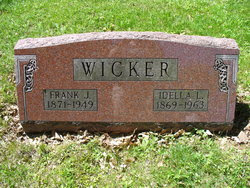
Frank died in 1949 and Idella survived him until 1963. They are buried beside each other at Colby, WI.
Headstone for Frank and Idella in Colby Cemetery, photo courtesy kclem of findagrave.com

Mary Jane "Mayme" Wescott (1871-1926) was the second daughter born to George and Sarah (Bullen) Wescott. 

Daughter Marion (Edwards) Miller describes Mayme as follows: 

My mother, a small quiet spoken lady, blue eyes, dark auburn hair that turned grey when she was in her thirties or forties, always going around the house singing softly, a very particular housekeeper, with hands that were never idle.  She loved to sew, made all of our clothes, even coats when we were young, and when she had all of us fitted out, she made clothes for poor children. . . . When she was a young woman she went on a trip to Montana, probably around 1895, to visit a cousin in Great Falls.  The cousin had a young man boarding with her, 6 ft. tall and handsome, a railroad man who had headquarters there.  His name was Charles Francis Edwards.

For their wedding in Great Falls, Mayme made her own wedding dress, a pale mint green, soft taffeta.

Mayme and Charles Wedding Photo 1896

My grandmother Idella Edwards was the oldest of their 6 children. The family moved around a bit with Charles working on the railroad and trying his hand at mining and farming. It was during their short attempt at homesteading in Saskatchewan that my grandmother started to teach in the Lancer area, fell in love with my young homesteading grandfather and stayed behind to marry when the rest of the family moved back to the United States. Mayme was not happy about leaving her daughter behind but nevertheless hand-stitched this beautiful wool log cabin quilt for the newlyweds.

Portion of the quilt made by Mayme for daughter's wedding - now in possession of the author

Mayme died in 1926 at the age of 54 years after having had a number of teeth extracted in an apparent attempt to improve an unknown long-standing health issue. She was hospitalized in Kelso, WA on a Sunday, died on Tuesday and the funeral was held on Thursday morning in Castle Rock, WA. Her remains were cremated and the ashes are in the Portland Memorial Mausoleum.  Charles lived until 1941; his ashes are beside hers. 

The four young sisters/cousins gazing out with so much promise (and a bit of trepidation perhaps) in that early group photo were women of their time who led somewhat conventional lives that were certainly stamped with their own individuality. 

Some Resources: 

  • Miller, Marion Frances Edwards; My Memories, personal memoir written for her family in January 1978 from her home at 5405 Union Street, Lexington, Michigan, p2
  • Nelson, M. and Dunlop, R., Compilers,  Source Book for the Bullen Family; Privately printed in the 1930s
  • Train, May Phillips, Samuel Bullen and Some of His Descendants, Privately printed 1941
  • Wicker, Frank and Judith, The Wicker-Wescott Heritage, privately printed Milwaukee, Wisconsin. 1998

Labels: , ,

Friday, 11 September 2020

David Bullen (1788-1872) (52 Ancestors 2020 Week 38) Theme: "On the Map"

My 3X great grandfather David Bullen, the son of John Bullen and Mary Whitcomb, was born at Paris Hill near Clinton, Oneida Co., N.Y. in about 1788. His father John Bullen had served in the American Revolution. After the War, John participated in the uprising known as Shay's Rebellion. To avoid capture and prosecution, he fled with his family from Massachusetts to Clinton, N.Y. His pregnant wife Mary gave birth to their seventh child en route, supposedly under a bush. It was about a year after this that David was born in what had to have been much more comfortable circumstances.

1895 Map of the Clinton area of Oneida, New York from the David Rumsey Map Collection,
David Rumsey Map Center, Stanford Libraries
More than a century after David's birth the area has become quite developed

In 1823, at the age of 35, he married Jane Murdie and started a family with her that would eventually include 8 children, the youngest of whom was my great great grandmother Sarah Catherine Bullen. The earliest years of their marriage were spent at Hannibal, Oswego, N.Y.

Google Earth - showing New York locations for David Bullen at Paris Hill and Hannibal

Hannibal's Masonic records tell us that a petition for a Masonic Lodge at Hannibal was signed by John Bullen, David Bullen, and others on 20 July 1824. John Bullen was the first Master and David Bullen was the first Senior Warden. The Charter was later forfeited in 1832 when the Lodge decided to go with the Morgan times (which would be another whole story, no doubt, and would have little to do with putting David "on the map"). This serves, however, as just one example of the usual pecking order between brothers, with David generally playing second fiddle to his older brother John. 

With the multitude of John Bullens in the family, there has at times been confusion between David's brother John Bullen and his brother's son, John Bullen, Jr.

The Bullens were among those interested in exploring the opportunities for establishing new settlements in "the west" fueled by glowing reports of rich fertile soil and bright sunny skies. In December of 1834, a supper meeting was held at the Hannibal home of John Bullen, Jr. To spread out the financial burden, those in attendance expressed an interest in setting up a venture with shares to be sold for $10 each. In February of 1835, "The Western Migration Company" was formed with Reverend Peter Woodin, a respected Baptist minister, as chairman and John Bullen, Jr. as secretary. An exploration committee of three men headed west in March of 1835.

It should be remembered that there were no established transportation routes to the western shores of Lake Michigan at the time. This was the area that was meant by "the west" in the 1830s. When the men from Hannibal set off in search of land for their new settlement, they proceeded from Hannibal by way of Lake Erie to Detroit and then across country to Chicago. This is where they discovered that there was no road north to Milwaukee so they set out by land, mostly following the beach of Lake Michigan, and eventually finding a small sailing vessel that took them to Milwaukee. There they found the property far too expensive for the funds their share sales had generated. They headed back toward the south, eventually choosing an area south of Racine. 

Western Emigration Company General Migration Route to WI 
Google Earth

The exploration committee ran into numerous problems in acquiring lands. John Bullen, Jr. was then made the sole representative of the group to finalize matters.  He is generally regarded as the founder of what is now Kenosha, WI. The area was originally known as Pike Creek, but by 1837 it was called Southport and then in 1850 renamed Kenosha (a Native American word again reflecting the plentiful pike). They had chosen the name of Southport because of its location in the very southern part of Wisconsin on the shores of Lake Michigan. 

John Bullen, Jr. built the first framed building in the new settlement in 1835-36. He was a merchant who focused on providing the necessities in the new community.

Southport Telegraph 1 December 1840
David's nephew John, Jr. opens his new store


David and his brother John Bullen moved to the Kenosha area in 1836 to join John, Jr. Apparently, David made the journey overland in the winter in a covered sleigh. His family followed by boat, "The Michigan", owned by his brother John.  At Milwaukee the boat drifted ashore in a storm.  From there they proceeded south by wagon.  

David is credited with being one of the first settlers of the town of Salem in the Kenosha area in 1636, along with John Dodge, John Bullen and Amos Gratton. David's brother John Bullen located on Bullen's Ridge. He was very active and influential in the community. Fortunately, he was appointed General of the Militia by Governor Dodge and can therefore be differentiated as "General John Bullen".

Early Wisconsin land deeds show us two parcels of land acquired by David Bullen (one in conjunction with one of the John Bullens) in the area west of Southport (now Kenosha) between the new settlements of Bristol and Salem. He owned some 310 acres in sections 6 and 7 of Township 1N, Range 21E pursuant to land grants dated 1840/12/10 and 1843/03/03. (The area has been highlighted on the following map in aqua colour in Range XXI just above the word "Bristol".) 

1845 Morse et al map of Southern Wisconsin from the David Rumsey Map Collection,
David Rumsey Map Center, Stanford Libraries
David Bullen's lands highlighted in aqua colour


David was also said to have had a farm near Paddock Lake just a couple of miles to the west of his Salem land, but a deed has not been located to pinpoint that property.  

By 23 July 1860, David was 70 and a farmer, but Jane had passed away. David's real estate was valued at $1500 and his personal estate at $280; he was living at Farmington in Washington County, WI, north of their previous home near Kenosha. The census tells us the value of his real estate but does not tell us exactly where it was located. Did he retain his lands in the Kenosha area or had he acquired some in the Farmington area? Two of his sons are listed in the same household but I'm not sure who Catherine is. More sleuthing is required here!


When the next US Census was taken ten years later, David was said to be 84 and at that time was living with daughter Jane, her husband Nelson Hull and their 4 children at Fond du Lac, Wisconsin. Several of his sons had moved to the Arlington, Wisconsin area and David lived with their families during his final years.

A letter from daughter Jane Hull in Arlingtonbury dated 5 August 1872  is quoted in the  Nelson Dunlop Papers: 
"Dear Sister and Brother: - It is  with a heavy heart, that I seat myself to write a few lines to you. Our poor father is no more.  He died last Monday afternoon.  He was taken sick the Wednesday before.  Win sent for the doctor.  He came and called it the typhoid fever and said the chance for him was very small.  They done all they could for him but could not keep him.  His work was done. He was called and must go. Gladly would we have kept him, but not our will but His be done.  He has left this world and gone to a better world where he will not have to say any more, "I am sick."  May we all be so happy as to meet him, and her that went before him. Little did we think when Mother died that he would live 14 years.  It was a little over 14 years.  I have forgotten the day of the month that she died.  . . . He died in the afternoon the day before we got here.  All I could see of Father was his cold form.  His funeral was Wednesday at the school house.  . . . I will send you some of father's hair."

David Bullen's stone in Arlington Presbyterian Cemetery, Arlington, WI
Photo Courtesy "Grave Walker" (L Kopet) Findagrave.com


Arlington Cemetery, Arlington, WI
Photo courtesy Steve Seim of Findagrave.com


The final map location where we can place David is at the Arlington Presbyterian Cemetery just a couple of miles west of his sons' Arlington properties. 

Google Earth - David Bullen burial location at Arlington Presbyterian Cemetery -
Not far from lands owned by his sons in the area (circled in red on the old plat overlay) 

Some Resources:

  • The History of Racine and Kenosha Counties, Wisconsin, Chicago: Western Historical Company 1879, 781 pp., accessed online through Google Books
  • Nelson, Myrtle Bullen and Dunlop, Ruth H., Nelson/Dunlop Papers (aka Source Book for the Bullen Family), compiled in the 1930s, privately printed, a photocopy of which is held by the author.
  • David Rumsey Historical Map Collection located at https://www.davidrumsey.com/.

Labels: , ,

Friday, 13 March 2020

Innkeeper: a Popular Occupation (52 Ancestors 2020 Week 12) Theme: "Popular"

Owning and operating an inn was a surprisingly popular occupation among earlier ancestors. Most of ours were in my maternal New England line and one in my paternal Norwegian line. My husband can claim one in his paternal line in England.

My husband's ancestor's tavern in England had a name: "The Butcher's Arms". In New England, taverns were often called "ordinaries". Since these businesses were usually operated out of people's homes, they often had no business name associated with them. In addition to being a popular occupation, no doubt most tavern or innkeepers were popular for providing a place of entertainment in their communities.

Maternal line Innkeepers in Colonial New England:

Links are given above to stories already written about these three men. 

There is an association for descendants of colonial innkeepers called "Flagon and Trencher" which has a lot of useful information on early taverns. John Johnson (below) and Stukely Westcott are both listed as previously approved ancestors for admission, but membership at US$200 seems rather steep for bragging rights to inclusion in this group.

  • John Johnson (1590-1659) (my 10X great grandfather)
John Johnson was born in Hertfordshire, England in about 1590. During the course of his life, he would be married three times. His first wife was Mary Heath; they married 21 September 1613 in Ware, Hertfordshire, England, most likely at St. Mary's Church.

St. Mary's Church, Ware
This image was taken from the Geograph project collection. The copyright on this image is owned by John Salmon
and is licensed for reuse under the 
Creative Commons Attribution-ShareAlike 2.0 license.
Six children were born to the couple in Hertfordshire: Mary, Isaac, Elizabeth, Humphrey (my 9X great grandfather), Sarah and Hannah. Sadly, mother Mary died in 1629. John married his second wife Margery before the family emigrated to America the following year.

The family sailed aboard the Arabella as part of the Winthrop Fleet in 1630. An excellent account of the hardships and realities of the 9 week voyage can be found here.

Replica of the Arabella Produced in 1930 for the 300th anniversary of Salem
Public Domain Image
The ship left Yarmouth, Isle of Wight on 6 April 1630 and landed in Salem, MA on 22 June 1630.

Once there, John was active in the business of the Colony as Juryman, committee man, Surveyor, Deputy to the House of Deputies (some 21 years, almost consecutive) and Surveyor General. He was the First Clerk of the Ancient and Honorable Artillery. He was also one of the founders of Roxbury, MA. 


And  he kept a tavern.


Later in life, he was granted 1000 acres of land in consideration for his service to the Colony. 


  •   General Richard Beers (1607-1675) (my 10X great grandfather)

Richard Beers was born 1 May 1607 in Gravesend, Kent, England to John and Mary (Selby) Beers (sometimes spelled "Beeres" or "Beres").

He emigrated from Gravesend to New England, in 1635, with his orphaned nephews, Anthony and James (sons of his brother James). They settled in Watertown, MA., where he remained. He was made a freeman of Watertown in 1637, was a Selectman in the government there for 31 years and served as a Representative to the General Court for thirteen years. Clearly, Richard was a  respected man of influence in his community.

Richard married a woman named Elizabeth who was probably Elizabeth Furman (1615-1706). She had immigrated to Massachusetts Bay from Nayland, Suffolk, England with her parents in the Winthrop Fleet of 1630. Their oldest child Sarah Beers, my 9X great grandmother, was born in 1639, followed by others between 1642 and 1662.

In 1654, Richard was granted a license to keep an ordinary (inn) in Watertown, which he operated for the rest of his life. (With a surname of  "Beers", this seems a particularly appropriate business for him.)

Paternal line Innkeeper in Norway:

  • Torger Asgrimsen Nystuan (c1624-c1678) (my 8X great grandfather) 

Torger lived and died in Vang, Valdres, Oppland, Norway. He was born on Uvdal (Opdahl) farm to Asgrim Knudsen Opdahl and Gertrude Eriksdatter Hove. 

19th century Vang Kirke sits on the site occupied by a previous stave church located here in Torger's time
Photo by John Erling Blad
Wikimedia Commons

In about 1666, he married Marte Madsdatter Grihammer who had been born in the same area in 1641. The couple lived on Nystuen (Nystøga) farm and had three children: Marit Torgersdatter Nystuen, Ingeborg Torgersdatter Nystuen (my 7X great grandmother) and Asgrim Torgerson Opdahl. It seems he also had a daughter Gertrude Torgersdatter Nystune with Marit Knudsdatter Hermundstad but it isn't clear if or when he ever married her.

In 1664, his occupation in listed as "innkeeper". Unfortunately, we cannot locate any additional details around the type of establishment he would have had in Norway at the time. Did it offer rooms to let? Food? Beverages? Perhaps all of this as well as a place for the locals to socialize.

Barnard Paternal line innkeeper in Gloucestershire, England

  • James Barnard (1833-1879) (my husband's great grandfather)
Born to James and Sarah (Dawes) Barnard in the Forest of Dean, Gloucestershire, James was baptized at Abenhall Church on 22 December 1833. When he grew up he married Emma Matilda Smith and had a family of 11 children with her.

Interior Abenhall Church 2004

James was obviously a very ambitious man who provided well for his large family.  Among other things, he cut rock for houses from the quarries.  He built the first brick house on Plump Hill and many of his homes are still standing.

Detail of one of the homes built by James Barnard

James also kept a butcher shop and a public house. At the time of the 1861 census for England, he is 27, living at the Butchers Arms as an Inn Keeper, with wife Emma M. born West Dean, age 22 and son Jabus age 2 months.  Sister-in-law Ellen Smith, age 15, was staying with them at the time.

#34 James Barnard family at Butcher's Arms, East Dean, Gloucestershire, England 1861


Ten years later, he is listed in the census as an Iron Miner on Plump Hill. A James Barnard took over the Birch Hill Folly gale (regaled) with Reuben Joynes in 1875; this could be our James.  (A gale is a mining claim held by a freeminer and a regaled mine is one that has been transferred from one freeminer to another.  This is a concept unique to the Forest of Dean.)  By 1879, the year he died, James Barnard's name is no longer listed for this gale.

It was said that he was the strongest man in the Forest of Dean and for a wager (perhaps made at his inn!) he carried two sacks of corn, each 120 pounds, up a steep grass hill (perhaps Plump Hill itself ). He ruptured himself so badly that he was never able to lie down again. This may have been the cause of his early death in only his mid 40s. After his death, widow Emma had a shop but there is no evidence that she ever operated the Butcher's Arms as an inn.

Back view of Barnard homes - note steep grade of Plump Hill!

Some Sources: 

  • Genealogy of John Johnson of Roxbury, Massachusetts generations i to xiv accessed online at Ancestry.com.
  • New England, The Great Migration and The Great Migration Begins, 1620-1635. Provo, UT, USA: Ancestry.com Operations, Inc., 2013.
  • George M. Bodge, Soldiers of King Philip's War (Boston, Massachusetts: David Clapp & Son, 1891), 81-87.
  • Valdres Genealogy database located at valdresgenealogy.com person ID I04698, citing information from the Bygdebok: Vang A, author Anders Frohølm, p.36, 54 and from Vang and Slidre, author Tore Ey, p119. 

Labels: , , , , , ,

Saturday, 29 February 2020

Mary Whitcomb (1751-1828) (52 Ancestors 2020 Week 10) Theme: "Strong Woman"

Giving birth under a bush while fleeing with her husband and several young daughters in the aftermath of Shay's Rebellion puts my 4th great grandmother Mary high on my list of strong female ancestors.

Mary Whitcomb was born 23 October 1751 in Warren, Worcester, Massachusetts, the youngest of 10 children born to James and Sarah (Winslow) Whitcomb. Mary's parents had both been married and widowed previously, James to three cousins in succession, none of whom had produced any children, and Sarah to Thomas Lincoln by whom she had three children. Several of Mary's older siblings were a full generation older than she was! Her father died when she was 11 and her mother when Mary was 19.

At the age of  20, Mary married John Bullen in Warren, Worcester, MA. John had been born in Brimfield, MA in 1747 to John and Abigail (Greene) Bullen, but had moved  to Ware by the time of his marriage. Baby girls started arriving within a couple of years and regularly thereafter: Anna (c.1774), Mary Polly (1777), Demia (1778), Ascha (1779). While Mary was busy producing all these daughters, her husband John was operating a tavern at "Bullon's Corners" on the turnpike at Ware. Assuming this was also the location of the family home, it is quite likely that Mary would have assisted with operating the tavern as well.

John enlisted in the American army during the War of Independence. First, he was on the payroll of Captain Breakenridge's Company of Militia in 1777. On 5 June 1780, John Bullen of Ware is among the men raised to reinforce the Continental army for the term of 6 months. They arrived at Springfield 13 July 1780 and marched to camp under command of Captain Thomas Pritchard. He was discharged 8 December 1780  and is credited as serving for 5 months, 3 days.

No children were added to the family between 1779 and 1783, probably a bit of a relief to Mary even though it was while her husband was involved in fighting the Revolutionary War. Finally, Mary and John's girls were joined by a brother, another John (1783) and yet another girl, Irene (c.1785).

Mary's son John Bullen (1783-1850)
(Sadly no photographs are available from the time of his mother Mary's life)
After the end of the Revolutionary War, all was not well in the new country. Economic and cultural injustices led to an unsuccessful attempt to overthrow the new government during Shay's Rebellion (1786-1787). John is said to have served as a captain in the affair and is often thereafter referred to as "Captain John". Life must have been chaotic during those years for both John and Mary and their growing family of young children. After the suppression of the rebellion, 18 men were sentenced to death and escaped into neighbouring states to avoid their fate. John fled with Mary and all their young children to Paris Hills, Clinton (Oneida) N.Y., a distance of some 200 miles.

Escape from Warren, MA to Clinton, NY 

It was during this escape, sometime in 1787, that Mary inconveniently went into labour. She gave birth to daughter Pamela under a bush (or in a bush hut, according to some reports). Both mother and baby daughter survived, attesting to the strength of this family. (A recent DNA match between our family and a descendant of Pamela's adds a more personal connection to this event.)

(There is some confusion over birth order since yet another daughter was said to have born to John and Mary in 1787: Sarah Sally on 4 February 1787. No good source can be located for the place of Sarah Sally's birth - both Brimfield, MA and Clinton, NY are given in various family trees. Pamela's birthplace is generally given as Whitesboro, NY.  Without any good birth records, we can only guess that she must have been born close to the end of that year while the family was making their escape.)

The next child born was my 3X great grandfather David in 1788, followed by daughter Abigail (1790) and a third son Alfred (1793). In all, Jane gave birth to 11 children, all surviving to adulthood to marry and have children of their own. My database indicates 75 grandchildren for Mary and John, one of whom was my 2X great grandmother Sarah Catherine Bullen. Mary was obviously a strong woman made for motherhood in even the toughest of circumstances.

She died 28 February 1828 at the age of 76 years and is buried with her husband at Hannibal, Oswego, New York in the Old Clinton Burying Ground.

Old Clinton Burying Ground where Mary Whitcomb Bullen is buried, along with husband John.
Photo courtesy Jim High of Findagrave.com


Labels: , , , ,

Saturday, 8 February 2020

Grace Fairbanks (1663-1689) (52 Ancestors 2020 Week 7) Theme: "Favourite Discovery"

Exploring family history for the past 23 years has led to many favourite discoveries. For at least a brief moment, each new discovery is my favourite! Recalling those early days of researching my family tree reminds me of the urgent sense of curiosity I had about the name "Grace Fairbank" hand-printed by my Uncle Bob as part of the family tree he had made for the family.

R.W. Anderson 1970s compiled Bullen Family Tree

Although 1997 was early days for the internet, simple searches could yield nuggets of genealogical information. My first searches were for John Bullen and Mary Morse in early New England, but that soon led me to see what I could learn about their children. I was particularly intrigued by the women who seemed to just marry into the family by dropping from the skies with no ancestral backgrounds of their own. Grace was wife to John and Mary (Morse) Bullen's son Ephraim Bullen (1653-1694) and mother to my ancestor John Bullen (1687-1757). She is my 7X great grandmother. 

There were some tantalizing online hints that perhaps our Grace was Grace Fairbanks, part of the family associated with the Fairbanks House. There was a fascinating description of some of the supposed exploits of Jonas Fairbanks who might be Grace's father.


Fairbanks House, Dedham MA
Photographed in 1999
This was before the days where sites like Familysearch and Ancestry provided digitized original source records. There were message boards and one early site called Genserv. As I recall, by providing them with your family tree file for use on the site, you were allowed a specified number of searches each hour or day. Often this was not enough and the results that came back were only as good as the uploaded family trees provided by other users. Frustratingly, many searches came back showing that Jonas Fairbanks and his wife Lydia Prescott did have a daughter named Grace Fairbanks who was born 15 September 1663 in Lancaster, Massachusetts. But there was no information on any marriage or children, where she lived out her life or when she died. My frustration seemed to go on for months, although I'm sure it was probably only a matter of days before enough documentation was found to convince me that our Grace was indeed Grace Fairbanks, daughter of Jonas Fairbanks and granddaughter of immigrants Jonathan and Grace (Smith) Fairbanks who had erected Fairbanks House. 

Grace was just 12 when her father and brother were killed during King Philip's War. Being in the middle of a pack of eight children in the now fatherless family no doubt meant she was called upon to help with her younger siblings. Fortunately, widowed mother Lydia's remarriage within a couple of years provided more security for the family.

Bullen Saward Bullard House
Sherborn Massachusetts
Photo taken 1999
(probably the home built by Ephaim and Grace Bullen)
At 16 Grace married Ephraim Bullen. They built their home on a beautiful hill overlooking rolling meadows and woods on Brush Hill Road at Sherborn, MA. At 17 she gave birth to daughter Mary. Sons Ephraim and John Bullen (my 6X great grandfather) followed over the next few years. Life seemed to be going well for the young family until the birth of her fourth child, a daughter (also named Grace), on 7 August 1689. Complications of childbirth are no doubt the cause of her death just a few days later at only 25 years of age. Baby Grace survived her mother by just 10 days.

At one time it had been reported that her gravestone was preserved in a stone wall in Sherborn, MA and read:  "Here lies Ye Body/ of Grace/ Bullen - Who/ Died August 11th/ 1689 in Ye 26th Year of Her/ Age." When we visited Sherborn in 1999, the local historian said she had been unable to locate this stone, but that it was probably located at the Brush Hill Road property.

The satisfaction of making this early discovery of Grace's family can largely be blamed for my ongoing obsession with family history.


Labels: , , , ,

Wednesday, 1 January 2020

Samuel Morse (1576 or 1585-1654) (52 Ancestors 2020 Week 1) Theme: "Fresh Start"

Five years have passed since I last took part in Amy Johnson Crow's 52 Ancestors in 52 Weeks Challenge. Time for a fresh start!

First up: taking a fresh look at one of the first New England ancestors who started my genealogy obsession over 20 years ago, my 9X great grandfather Samuel Morse. One side benefit of writing these stories is focusing on revisiting the available records for an individual and his family.

In 2015, I wrote about Samuel's father, Reverend Thomas Morse whose story gives a good indication of the sort of unsettled childhood Samuel and his siblings would have had. Their father Thomas was a Puritan religious dissident whose beliefs were constantly undermining his position as a minister in the Church of England.

Parish Church of St. Peter, Boxted

Conflicting dates, almost a decade apart, are given for Samuel's birth (12 June 1576 or 1585). No primary sources can be located, but considering that his marriage to Elizabeth Jasper occurred on 29 June 1602, I believe the earlier date to be the more likely (Samuel would have been 26 rather than barely 17 marrying the 23 year-old Elizabeth). He is said to have been born at Boxted, Suffolk, England while his father was rector there.  He would have been about seven when his family moved to Hinderclay, Suffolk.

St. Mary Church at Hinderclay, Suffolk

Porch at the Hinderclay Church

View from inside Hinderclay Church

List of Rectors of Hinderclay Church
Samuel's father Thomas Morse 1583, deprived 1595 (third from bottom)

It isn't clear whether Samuel moved with the family to Foxearth when his father became rector there in 1595 (after being "deprived" of his benefice at Hinderclay that same year, as shown above). At that time, Samuel would have been nearly 20. 

Location of Hinderclay and Redgrave, Suffolk
Google Earth Image

On 29 June 1602, Samuel married Elizabeth Jasper of nearby Redgrave.  The couple had several children born in Redgrave starting in 1603 and ending in 1620 with the birth of their youngest daughter Mary (my 8X great grandmother). Their children grew up and eldest daughter Elizabeth married in 1629 and started a family of her own. Things were not as settled as they might seem, however. The family's Puritan leanings would have been an ongoing source of concern.

St. Mary's Church at Redgrave, Suffolk

Now for Samuel's "fresh start". He embarked 15 April 1635 on the ship Increase  bound from London to New England, together with wife, son Joseph and granddaughter Elizabeth Daniel.  (Other family members also ended up in America, but it isn't clear whether they were on this or some other ship.) The passenger list for the Increase has husbandman (farmer) Samuel at age 50, Elizabeth 48, Joseph 20 and granddaughter Elizabeth Daniel just 2. (At 50 Samuel was fairly old for such a fresh start, but he may actually have been almost a decade older at 59 and wife Elizabeth possibly about 56.)

According to May Phillips Train in  Samuel Bullen and some of His Descendants, p. 52, Morse's emigration to America was to effect "separation from the corruption of the English Church." Clearly Samuel was in agreement with his father's non-conforming ways, putting our Morse family among the many religious dissidents who moved to America in search of religious freedom.

The Morses came first to Watertown (near Boston), part of the Puritan Massachusetts Bay Colony, where they were accepted as members of the first church.

The following year they were part of the new Utopian Christian settlement at Dedham. On 15 August 1636 Samuel was among the first signatories of the covenant (constitution) for the new settlement.  Sons Daniel, John and Joseph also signed the covenant.  Samuel became a freeman of the town 8 October 1640 and a member of newly organized Dedham church 30 May 1641.  As the son of an English minister, he was probably fairly well educated and a respected man in his community. He frequently served in public office, including as selectman (one of the council of  "seven men" of Dedham) and as surveyor.

Location of Dedham, MA southwest of Boston
Google Earth Image


By 1641, a new town called Medfield was set off from Dedham. Samuel was present at the formation meeting in Medfield in 1644 of the first free school in Massachusetts supported by town tax.

Medfield's Vine Lake Cemetery

When he died in 1654, his will left everything to widow Elizabeth for her lifetime and then equally to his children or their survivors. His earthly estate was valued at just over 124 pounds.


Morse Memorial at Medfield, MA

Samuel died in the absolute belief that he would have one final fresh start with his Father in Heaven.

Portion of the will of Samuel Morse

Resources

Ancestry.com, New England, The Great Migration and The Great Migration Begins, 1620-1635.

Ancestry.com. U.S. and Canada, Passenger and Immigration Lists Index, 1500s-1900s. Provo, UT, USA: Ancestry.com Operations, Inc, 2010.

Massachusetts, Wills and Probate Records, 1635-1991, Suffolk County (Massachusetts) Probate Records, 1636-1899; Author: Massachusetts. Probate Court (Suffolk County); Probate Place: Suffolk, Massachusetts accessed through Ancestry.ca

Roberts, Gary Boyd, English Origins of New England Families, Genealogical Pub. Co, 1984.

Tilden, William S., History of  the Town of Medfield, Massachusetts 1650-1886, Boston: Geo. H. Ellis Publisher, 1887.


Labels: , , ,

Sunday, 19 August 2018

The Thirty-Two: Part D (Ancestors of Idella Edwards Anderson)

My last three postings have been about 24 of my third great grandparents, all Scandinavians. Now for something quite different: my grandmother Della's 8 great grandparents. Until a couple of months ago, I would have been able to report on just 6 of the 8, but thanks to DNA analysis, I can now add the other two with some degree of confidence. Here are my final 8 third great grandparents:

25. George Adam Saum (1797-1836)


DNA analysis (both Y chromosome and autosomal matches for a number of Idella's father's extended family) has led me to the family of George Adam Saum and his wife Susannah Henderson. I have not as yet been able to pinpoint exactly which of three of their sons is the biological father of my grandmother's father Charles Edwards, but it is most likely one of the two who lived conveniently nearby in Iowa at the relevant time - Stephen Adam Saum or older brother George Thompson Saum. Not surprisingly, I have not uncovered a paper trail to confirm this connection, but the DNA evidence is quite persuasive.

Location of Saumsville in the Shenandoah Valley, Virginia
Google Earth Image


George Saum was born in Saumsville, Shenandoah, Virginia on 23 March 1797 to Frederick Saum and Catherine Caley. The Saum(s) male line can likely be traced back to the Rhine Valley of what is now Germany. The Caley family had deep roots in Ballaugh on the Isle of Man. 

George's parents had married in the Shenandoah Valley in 1794 and their first three children were born there. 

By 1809, the family had uprooted and left for Newmarket, Highland County, Ohio. It is not known whether they traveled there on Zane's Trace road, but it is likely. The Ohio River and canals built early in the 19th century added to the transportation network to Ohio as it opened up for new settlers.

On 4 November 1819 George married Susannah Henderson in Highland City, Highland County, Ohio. George can be found in Ohio in the 1820 and 1830 United States Censuses. He and Susannah had a family of seven children, 4 sons and 3 daughters. The eldest son, Charles Frederick, lived out his life in Kansas. Son Jacob died in 1861 (8 years before Charles Edwards was born). Two of the sons, George Thompson and Stephen Adam, moved to Jasper County, Iowa (near where Charles would be born).

 George Adam Saum died in Highland County, Ohio at the young age of 39.


26. Susannah Henderson (1805-1855)


Susannah was born 21 January 1805 in Fairfax, Virginia. Her parents were Nathaniel Henderson and Mary Thompson. Susannah's Henderson and Thompson ancestors had deep roots in Virginia dating back at least to the very early 1700s. 

Susannah's family would no longer be living in Fairfax at the time of the historic Battle of Fairfax Court House in 1861, but the Court House shown in the Wikipedia article would have been a landmark in their day. When she was only about 5 years old, her family moved from Virginia to Ohio. What an adventure that must have seemed to young Susannah!

She wasn't yet 15 when she married George Saum on 4 November 1819. Their first child, son Charles Frederick Saum was born in 1822 and she would go on to give birth to another six children. 

Susannah died on 8 April 1855 at the age of 50 at Clark, Clinton, Ohio. 


27. Christian Hoover (1809-1897)


Christian Hoover was born 6 October 1809 in Armstrong, Pennsylvania, to Christian Hoover and Maria Barbara Harmon. The family had roots in Pennsylvania and perhaps Maryland dating back well into the 1700's.

When he was 23, he married Mary Green in Cowanshannock, Armstrong County, PA and the couple made their home at Plum Creek, Armstrong, PA until 1856 when they moved with family to Illinois, then to Iowa and finally to Kansas.

Christian and Mary had a family of 9 children between about 1834 and 1849. The eldest was daughter Barbara Hoover who was my grandmother Idella's paternal grandmother. The family seemed to be a close one as shown by how often they were living with or near one another in the various census records.

Christian and his wife Mary were both listed as doctors in the medical listings at the time. Both were of the "eclectic" school, meaning they were not formally educated in medicine but were self-taught and simply hung out their shingles, she probably as midwife and he as a general physician. 

There is some evidence that Christian was a staunch abolitionist which may have precipitated his unwise move to sign up in Company C, 11th Illinois Cavalry for the Union at the start of the Civil War. He was 52 at the time, but shaved 10 years off his age when he enrolled. His war career did not last long and he returned home with serious health issues as a result. More details about his war experience can be found in this blog story about my Civil War ancestors.

The agony that he endured for years after his Civil War service eventually resulted in the tragic ending of his life by suicide in 1897 when he was 88.

Christian's Tombstone in Burlingame Cemetery, Kansas
Image courtesy Jean Pinick on Findagrave.com


28. Mary Green (1812-1907) 


Mary was born  4 September 1812 in Muncy Twp., Lycoming Co., Pennsylvania, USA. Her father was Ezekiel Green and she had 8 siblings.

In the 1830 census, father Ezekiel is in Plumcreek, Armstrong, PA.  He is between 40 and 50 and has 2 males living in his household (one under 5 and one between 5-10).  His wife (unfortunately not named) is between 40 and 50 and three females are aged between 15 and 20 and one between 10 and 15. There is a Samuel Hoover family two households away from him on the census form and Christian Hoover is listed next. Proximity led to Christian and Mary marrying on 15 August 1833 at the home of her parents.

Mary's life would not have been an easy one. She raised a large family and often had grandchildren living with her as well. The family moved frequently and no doubt she would have set up home over and over again. She acted as a midwife and is found in the list of Kansas doctors. She was left home when her husband decided to sign up for the Civil War and then she would have had to nurse him through his years of ill health after he returned. In the meantime, she was going blind (I cannot help but wonder if the macular degeneration disease found in so many members of the family is what caused her to lose her sight.) Finally, she lived on in penury after her husband's suicide. Fortunately, her son Professor Samuel Hoover took her in and would have cared for her in her last years. She died at the age of 95.

More details about Mary's life can be found in my blog story about her.

Mary Green Hoover
(so far, the only photograph found for any of my 32 third great grandparents)


29. Stephen Henry Wescott (c1809-1889)


Stephen Henry Wescott was born about 1809 in Butler, Wayne County, New York to parents Stephen Westcott and Elizabeth Carver. The Wes(t)cotts can trace back to immigrant ancestor Stukely Westcott who arrived in Salem, Massachusetts Bay Colony in 1635 and was one of the original founders of Providence, Rhode Island. The Carver line can be traced back to families who had arrived at Plymouth aboard the Mayflower in 1620. Both sides are steeped in  early New England history.

The Wes(t)cotts tended to be quite prolific: Stephen had 12 siblings. On 2 December 1830 he married Catherine ("Katie") Barton. Stephen and Katie went on to have 11 children themselves, including my great great grandfather George Garner Wescott. The first 6 children were born in Butler, Wayne County, New York and the family can be found there in the 1830 and 1840 U.S. censuses.

By the mid 1840's, Stephen moved his growing family to Wisconsin. The first town meeting of the Town of Farmington (renamed from the Town of Clarence) was held at his home 5 April 1848; at the meeting, he was elected as an Assessor and later that year as a Justice. All early town meetings were held at his home.

The 1859 plat map of Farmington Township shows the location of Stephen's land in Section 36, Twp. 12N, Rge 20E. (The David Bullen family lived very nearby in Section 35 so it is not surprising with such proximity that their children George Garner Wescott and Sarah Catherine Bullen would marry and become my second great grandparents.)

Location of Farmington WI
Google Earth Image


Stephen is named in at Farmington, Washington Co., WI in the censuses of 1850, 1855 and 1860 but by 1870 was located at Kaukauna, Outagamie, Wisconsin.

Like so many other American families, the Wescott family participated in the Civil War (1861-1865). On 1 October 1881, Stephen applied for a civil war pension based on son Carver Wescott's Civil War service and death. Son George Garner Wescott had also served in the War; he was in Co. D, 12th Regiment, Wisconsin Volunteer Infantry, and survived (fortunately for those of us descending from his children born after the War!) Another son, Barton had served in Co. K 1st Regiment Cavalry, Wisconsin Volunteers, and happily also survived.

Stephen died in 1889 and was buried in Kelso Cemetery at Kaukauna, Wisconsin.


30. Catherine ("Katie") Barton (1812-1880)

Catherine was born 30 August 1812 in Wayne County, N.Y., to Isaac Barton and Margaret ("Abba") Vought.

Katie's Barton ancestors were found in Westchester County, New York state since the 1600's. Her mother's Voughts were in Peekskill, Westchester County but had originated in Holland (Reusel-de Mierden, Noord-Brabant, Netherlands).

Katie moved along with husband Stephen from New York to Wisconsin and raised their large family of 11 children. With at least 3 sons serving in the Civil War, she must have worried about them and then mourned the loss of son Carver (aged about 19) but rejoiced when sons George and Barton returned home to their families. In 1880 she made application for a mother's Civil War pension resulting from service and loss of son Carver. 

She died 9 October 1880 and is buried with Stephen at Kelso Cemetery, Kaukauna, Wisconsin.

Westcott Memorial in Kelso Cemetery, Kaukauna,  WI
Photo Courtesy Jack Brown


31. David Bullen (1788-1872)


David Bullen, the son of John Bullen and Mary Whitcomb, was born in Clinton, Oneida Co., NY in about 1788. His ancestors were early New England immigrants who came from various parts of England, settling in Massachusetts Bay Colony in the 1630s. His father John Bullen served in the American Revolution. After the War, John participated in the uprising known as Shay's Rebellion. To avoid capture and prosecution, he fled with his family from Massachusetts to Clinton, NY. His pregnant wife Jane gave birth to a daughter en route, supposedly under a bush. It was about a year later that son David was born, no doubt in more comfortable circumstances.

David's first wife died quite young, and 35 year-old David then married Jane Murdie.

An excellent resource for details about David and the extended Bullen family is a collection of stories and letters amassed in the 1930's by descendants Myrtle Bullen Nelson and Ruth Dunlop called "Source Book for the Bullen Family". Some family members alive at the time remembered David and were able to provide such details as the fact that he had "reddish" hair up to old age. We also learn from them that David Bullen moved his family west from New York in 1836.  (However, this is called into question by the appearance of the family in the 1840 census for Oswego, New York.) His brother John Bullen was the instigator of the move by several families to Kenosha, Wisconsin. Apparently, David made the journey overland in the winter in a covered sleigh. His family followed by boat, "The Michigan", owned by brother John Bullen.  At Milwaukee the boat drifted ashore in a storm.  From there they proceeded by wagon.  David also had a farm near Paddock's Lake in southern Wisconsin.  The family moved to Washington County in 1850.

By 23 July 1860, David was 70 and a farmer, but Jane has passed away. David's real estate is valued at 1500 and his personal estate at 280. When the next US Census was done ten years later, David was said to be 84 and living with daughter Jane and her husband Nelson Hull and their 4 children at Fond du Lac, Wisconsin.

A letter from daughter Jane Hull in Arlingtonbury dated 5 August 1872 in the  "Source Book for Bullen Family" to "Dear Sister and Brother: - It is  with a heavy heart, that I seat myself to write a few lines to you. Our poor father is no more.  He died last Monday afternoon.  He was taken sick the Wednesday before.  Win sent for the doctor.  He came and called it the typhoid fever and said the chance for him was very small.  They done all they could for him but could not keep him.  His work was done. He was called and must go. Gladly would we have kept him, but not our will but His be done.  He has left this world and gone to a better world where he will not have to say any more, "I am sick."  May we all be so happy as to meet him, and her that went before him. Little did we think when Mother died that he would live 14 years.  It was a little over 14 years.  I have forgotten the day of the month that she died.  . . . He died in the afternoon the day before we got here.  All I could see of Father was his cold form.  His funeral was Wednesday at the school house.  . . . I will send you some of father's hair."

David Bullen's stone in Arlington Presbyterian Cemetery, Arlington, WI
Photo Courtesy "Grave Walker" (L Kopet) Findagrave.com

31. Jane Murdie (1801-1858)

Mitochondria are the tiny energy-producing bodies located in almost every cell in our bodies. Each contains mitochondrial DNA (mtDNA) which is passed almost unchanged from mothers to all their children. Only daughters pass that same mtDNA on to all their children. As Jane is my direct female-only line, my mtDNA is Jane's mitochondrial DNA. The only mtDNA test done to date was through National Geographic several years ago indicating that the haplogroup inherited from Jane was called H2a1, a group most closely linked to southern Scandinavia and Russia. 

Jane was born 31 January 1801 in New York. She was said to be of Scottish origin, making one wonder if perhaps her female line generations back might have moved across the North Sea from Scandinavia. A more thorough mitochondrial DNA test might be in order!

The "Source Book for the Bullen Family" contained the following reference to Jane's parentage provided in a letter dated 19 October 1935 from Americus Vespucius Brown (son of Mary Bullen and John Brown, a grandson of David and Jane's) to Eva Bullen: "Mother was born in Hannibal, NY.  Her mother was Jane Murdy.  Her grandmother and she who was her mother came west from NY and settled in northern Illinois with their people.  Her grandfather came later as he was a breeder of fine horses -  bringing some blooded stock.  When he got where they were he wanted to see farther west so he hitched up a team and started out.  It was the last seen or heard of him.  It was always supposed he was killed by the Indians for his team."

Notes from the "Source Book for the Bullen Family" in the handwriting of Mrs AH Nelson: "My grandmother's (Jane Murdy) father died and her mother married a Mr Chambers who was the father of Kate and Mary Chambers." I had always, perhaps mistakenly, taken that to mean that Jane's mother married a widower with two daughters, but other family members believe that Kate and Mary Chambers were actually Jane's half sisters. If so, Jane's mother would have been Jane Daviddson, another link back on our mtDNA chain.

In 1823 Jane Murdie married widower David Bullen in Hannibal, Oswego, New York. She was said to be just 16, which would have put her birth at about 1807 instead of 1801. She and David had 8 children, spaced two years apart, between 1824 and 1838, the youngest being my great great grandmother Sarah Catherine Bullen. All of the children were born before the family's move from New York to Wisconsin. You may recall that husband David went ahead first and Jane followed with the children by boat owned by her brother-in-law John Bullen. When that boat drifted ashore in a storm at Milwaukee, Jane must have been terrified for the fate of her children. But all survived the ordeal and carried on by wagon to join David.  

Jane died about 1857 or 1858 in Wisconsin. No record has been found for her burial location.

Here is a link for another story about Jane Murdie.

The Thirty-Two: Conclusion


All 32 of my third great grandparents have been identified. They were born in the period of about 1760-1815. 3/4 were Scandinavian and 1/4 were a mixture of British and western European ancestry.

On my Dad's side, all were born in Norway; it was mainly their children who would become immigrants to the United States. On my mother's paternal side,  my Swedish third great parents were born in Sweden but died in America; the Norwegians were born and died in Norway. It is my mother's maternal line that has been in America the longest, many since the 1600's; as a result, all 8 of those third great grandparents were born and died in the United States.

As with all families, stories of hardships abound. Emigration across the Atlantic Ocean in steerage would have posed many challenges on top of the emotional upheaval of leaving family and friends behind. Life in Scandinavia at the time was not easy either and helps explain the allure of moving to a different place to start a new life. Those already in the United States had challenging tales of the Revolutionary War, Shay's Rebellion and the Civil War. All 16 of the women had few choices in their lives. They were expected to marry and raise families, and this they did, generally producing large families with babies spaced just about two years apart. There were few luxuries and everything had to be created by hand, whether a new home built in the wilderness or clothing for all the family members. Happily, all 32 survived to produce children so that their descendants can count themselves very fortunate to enjoy the lives we have today.

Links to the other 24 can be found here:

John Bardahl Ancestors
Louise Nelson Ancestors
Ingwald Anderson Ancestors


Labels: , , , , ,