Saturday, 2 August 2025

The Andersons at Bawlf, Alberta, Canada (52 Ancestors in 52 Weeks 2025 Week 32 theme: "Wide Open Spaces")

My maternal great great grandfather Israel Anderson (1829-1910) spent a lifetime searching for wide open spaces. Born in 1829  and raised in Laxarby, Västra Götaland, Sweden, 3 miles from the nearest town, he moved to Norway as a young man to work on a farm there. He married farmer's daughter Johanna Gundersdatter Opsahl and moved to America in 1856 with wife and their first child, my great grandfather Anders (Andrew) Anderson. 

Israel and Johanna went on to have the following children: Andrew b 1855, Sophia b. abt. 1856, Ida b. 1858, Gunelius b. 1862, Olava b. 1864, Annetta b. 1868, John b. 1868, Betsy b. abt. 1870 and Carl Gustaf b. 1873. Johanna died in 1900.  

Over the years, the call of its wide open spaces took Israel and family to several newly developing areas on the American frontier. After first settling in Decatur, WI, they moved on to Northwood County, Iowa and then to Grafton, Dakota Territories, traveling by train and covered wagon. In 1901 son Carl Gustaf moved across the border to homestead in Manitoba. In 1902 son Gunelius moved his family to Canada as well, settling in what became the Bawlf area of what was then the North-West Territories.  In 1903 Israel himself emigrated for a third and final time to join Gunelius in the Bawlf area. He was a widower in his mid-70s.

Alberta was not even yet a province when Israel arrived. In 1903 the land was still part of the North-West Territories, and, of course, before that had been part of the truly wide open spaces occupied by the western First Nations peoples. At noon on 1 September 1905 Alberta became a Province of Canada. Israel had been there for a couple of years by this time.

Google Earth view of Bawlf area - showing the present-day checkerboard of fields that were wide open spaces when the Andersons arrived


The Village of Bawlf was established in the vast Canadian prairies in 1905, the same year that Alberta became a province. Named for Nicholas Bawlf, president of the Winnipeg Grain Exchange, the town came into being alongside the new railroad. Farming and shipping grain were its raison d'être.

Son Gunelius "G.I."  had moved there the preceding year with his family. The following is from a letter dated 17 May 1977 from Ernie and Esther Anderson to R.W. "Bob" Anderson, based on their recollections of  comments made by Gunelius's son Lawrence Anderson: 

"G.I. left Edinburg, N.D., where he owned a hotel, in 1902 and moved to Alberta. Andrew and John came up two years later and bought a half section beside the homestead. Lawrence was saved land, proved it up and got it at age 21. The railroad came in 1906. Israel homesteaded near his sons' farms and was required to spend a few months each year on his homestead, so he had a house on skids that he pulled over to the land in summer and then back to the sons in the winter.    Lawrence said they lived in 2 tents when they arrive in Daysland and lived in them until three weeks before Christmas when their house was finally ready for occupancy. It was bitterly cold, he remembers."

The 1906 census of Alberta shows Gunelius at section 8-45-17-W4M, his sons Emil at 10-45-17-W4M and Lawrence at 30-44-16-W4M. Another brother, John Anderson, had homesteaded at Bawlf just east of his father at NE36-44-17 W4M.


Homestead application of Israel Anderson


Sadly, on 7 March 1910, at age 80, Israel died before proving up his homestead application. 

1910 Post Card from Gunelius Anderson advising sister Sophia of Israel's death

Decades ago my uncle Bob Anderson and his son visited the rural Lutheran cemetery near Bawlf  where Israel is buried. A few years after this, while attending a kids' hockey tournament at nearby Daysland, my husband and I also paid Israel's gravesite a visit.

Two of His Male Anderson descendants visit Israel's burial location 

In 1998, in response to my letter to the Village of Bawlf, local resident and historical record-keeper Lil Bohmer sent me a considerable amount of information based on local knowledge of the family. Lil was a member of the same Bawlf Lutheran Church as the Andersons and was the record-keeper for the cemetery. She provided the burial locations for Israel as well as for Gunelius, his wife Sophia, their daughter Gina Reesor (1891-1928), son Emil (1884-1950) and son Alfred (1886-1954).

Lil went on to say: 

I found in the Daysland History book the enclosed information about Kenneth and Aleda Anderson. Also in the book were copies of maps showing land owners in the early 1900s. Another son of Gunelius and Sophia farmed north of Ohaton. He was known as Ike but a gentleman who knew him said he thought his given name was Israel - after his grandfather. The other son Lawrence, who farmed with Alfred later lived in Daysland. I found several people who remembered Gunelius and family but no one is left who would remember Israel. The house that the Andersons built on their farm was considered a beautiful place. Their neighbours and church friends were all there for Open House when it was completed. A few years ago that house was moved into Daysland to be a neat looking place yet. It was a 2 story. The fact that it had a kitchen nook and a dining room had impressed everyone. 

Israel's grandsons Clarence and Ingwald (sons of Andrew) homesteaded in the Lancer area of Saskatchewan, Canada a few years later. The wide open spaces of the Canadian prairies did not suit everyone. Some of the sons or their descendants ended up moving back south of the 49th parallel. The current crop of Andersons inhabiting Canada's wide open spaces primarily descend through the Israel/Andrew/Ingwald line. 

3 of Israel's sons backed by their sons about 1915: lower left my great grandfather Andrew Anderson in front of his son Clarence, lower centre Gunelius in front of his son Emil and lower right John in front of his son Victor. The picture was taken after Victor returned from fighting in World War I


Labels: , , , , , , , , , , , , ,

Friday, 13 March 2020

Innkeeper: a Popular Occupation (52 Ancestors 2020 Week 12) Theme: "Popular"

Owning and operating an inn was a surprisingly popular occupation among earlier ancestors. Most of ours were in my maternal New England line and one in my paternal Norwegian line. My husband can claim one in his paternal line in England.

My husband's ancestor's tavern in England had a name: "The Butcher's Arms". In New England, taverns were often called "ordinaries". Since these businesses were usually operated out of people's homes, they often had no business name associated with them. In addition to being a popular occupation, no doubt most tavern or innkeepers were popular for providing a place of entertainment in their communities.

Maternal line Innkeepers in Colonial New England:

Links are given above to stories already written about these three men. 

There is an association for descendants of colonial innkeepers called "Flagon and Trencher" which has a lot of useful information on early taverns. John Johnson (below) and Stukely Westcott are both listed as previously approved ancestors for admission, but membership at US$200 seems rather steep for bragging rights to inclusion in this group.

  • John Johnson (1590-1659) (my 10X great grandfather)
John Johnson was born in Hertfordshire, England in about 1590. During the course of his life, he would be married three times. His first wife was Mary Heath; they married 21 September 1613 in Ware, Hertfordshire, England, most likely at St. Mary's Church.

St. Mary's Church, Ware
This image was taken from the Geograph project collection. The copyright on this image is owned by John Salmon
and is licensed for reuse under the 
Creative Commons Attribution-ShareAlike 2.0 license.
Six children were born to the couple in Hertfordshire: Mary, Isaac, Elizabeth, Humphrey (my 9X great grandfather), Sarah and Hannah. Sadly, mother Mary died in 1629. John married his second wife Margery before the family emigrated to America the following year.

The family sailed aboard the Arabella as part of the Winthrop Fleet in 1630. An excellent account of the hardships and realities of the 9 week voyage can be found here.

Replica of the Arabella Produced in 1930 for the 300th anniversary of Salem
Public Domain Image
The ship left Yarmouth, Isle of Wight on 6 April 1630 and landed in Salem, MA on 22 June 1630.

Once there, John was active in the business of the Colony as Juryman, committee man, Surveyor, Deputy to the House of Deputies (some 21 years, almost consecutive) and Surveyor General. He was the First Clerk of the Ancient and Honorable Artillery. He was also one of the founders of Roxbury, MA. 


And  he kept a tavern.


Later in life, he was granted 1000 acres of land in consideration for his service to the Colony. 


  •   General Richard Beers (1607-1675) (my 10X great grandfather)

Richard Beers was born 1 May 1607 in Gravesend, Kent, England to John and Mary (Selby) Beers (sometimes spelled "Beeres" or "Beres").

He emigrated from Gravesend to New England, in 1635, with his orphaned nephews, Anthony and James (sons of his brother James). They settled in Watertown, MA., where he remained. He was made a freeman of Watertown in 1637, was a Selectman in the government there for 31 years and served as a Representative to the General Court for thirteen years. Clearly, Richard was a  respected man of influence in his community.

Richard married a woman named Elizabeth who was probably Elizabeth Furman (1615-1706). She had immigrated to Massachusetts Bay from Nayland, Suffolk, England with her parents in the Winthrop Fleet of 1630. Their oldest child Sarah Beers, my 9X great grandmother, was born in 1639, followed by others between 1642 and 1662.

In 1654, Richard was granted a license to keep an ordinary (inn) in Watertown, which he operated for the rest of his life. (With a surname of  "Beers", this seems a particularly appropriate business for him.)

Paternal line Innkeeper in Norway:

  • Torger Asgrimsen Nystuan (c1624-c1678) (my 8X great grandfather) 

Torger lived and died in Vang, Valdres, Oppland, Norway. He was born on Uvdal (Opdahl) farm to Asgrim Knudsen Opdahl and Gertrude Eriksdatter Hove. 

19th century Vang Kirke sits on the site occupied by a previous stave church located here in Torger's time
Photo by John Erling Blad
Wikimedia Commons

In about 1666, he married Marte Madsdatter Grihammer who had been born in the same area in 1641. The couple lived on Nystuen (Nystøga) farm and had three children: Marit Torgersdatter Nystuen, Ingeborg Torgersdatter Nystuen (my 7X great grandmother) and Asgrim Torgerson Opdahl. It seems he also had a daughter Gertrude Torgersdatter Nystune with Marit Knudsdatter Hermundstad but it isn't clear if or when he ever married her.

In 1664, his occupation in listed as "innkeeper". Unfortunately, we cannot locate any additional details around the type of establishment he would have had in Norway at the time. Did it offer rooms to let? Food? Beverages? Perhaps all of this as well as a place for the locals to socialize.

Barnard Paternal line innkeeper in Gloucestershire, England

  • James Barnard (1833-1879) (my husband's great grandfather)
Born to James and Sarah (Dawes) Barnard in the Forest of Dean, Gloucestershire, James was baptized at Abenhall Church on 22 December 1833. When he grew up he married Emma Matilda Smith and had a family of 11 children with her.

Interior Abenhall Church 2004

James was obviously a very ambitious man who provided well for his large family.  Among other things, he cut rock for houses from the quarries.  He built the first brick house on Plump Hill and many of his homes are still standing.

Detail of one of the homes built by James Barnard

James also kept a butcher shop and a public house. At the time of the 1861 census for England, he is 27, living at the Butchers Arms as an Inn Keeper, with wife Emma M. born West Dean, age 22 and son Jabus age 2 months.  Sister-in-law Ellen Smith, age 15, was staying with them at the time.

#34 James Barnard family at Butcher's Arms, East Dean, Gloucestershire, England 1861


Ten years later, he is listed in the census as an Iron Miner on Plump Hill. A James Barnard took over the Birch Hill Folly gale (regaled) with Reuben Joynes in 1875; this could be our James.  (A gale is a mining claim held by a freeminer and a regaled mine is one that has been transferred from one freeminer to another.  This is a concept unique to the Forest of Dean.)  By 1879, the year he died, James Barnard's name is no longer listed for this gale.

It was said that he was the strongest man in the Forest of Dean and for a wager (perhaps made at his inn!) he carried two sacks of corn, each 120 pounds, up a steep grass hill (perhaps Plump Hill itself ). He ruptured himself so badly that he was never able to lie down again. This may have been the cause of his early death in only his mid 40s. After his death, widow Emma had a shop but there is no evidence that she ever operated the Butcher's Arms as an inn.

Back view of Barnard homes - note steep grade of Plump Hill!

Some Sources: 

  • Genealogy of John Johnson of Roxbury, Massachusetts generations i to xiv accessed online at Ancestry.com.
  • New England, The Great Migration and The Great Migration Begins, 1620-1635. Provo, UT, USA: Ancestry.com Operations, Inc., 2013.
  • George M. Bodge, Soldiers of King Philip's War (Boston, Massachusetts: David Clapp & Son, 1891), 81-87.
  • Valdres Genealogy database located at valdresgenealogy.com person ID I04698, citing information from the Bygdebok: Vang A, author Anders Frohølm, p.36, 54 and from Vang and Slidre, author Tore Ey, p119. 

Labels: , , , , , ,

Thursday, 9 May 2019

Emma Matilda Smith Barnard (1838-1908): Importer of a Frozen Sheep

This memorandum found among the Barnard family treasures cannot but pique one's curiosity.


Why would Mrs. Barnard be receiving a frozen sheep sent by steamship and rail all the way from New Zealand in 1885?

Mrs. E Barnard in this document refers to my husband's great grandmother born Emma Matilda Smith in East Dean, Gloucestershire in 1838 to William and Harriet Smith.

First, a bit of background. When she was 19, Emma married James Barnard of Littledean, Gloucestershire and started a family with him that would eventually include 11 children. From census and mining records we know that James was involved in free-mining as co-owner of Birch Hill Gale as well as being a shopkeeper and innkeeper. He was also very active in quarrying and building brick/stone houses in the Forest of Dean, many of which are still in use.


James was obviously an ambitious man and no doubt a good provider for his growing family.


1861 census with Innkeeper James and wife Emma at Butchers Arms, East Dean


James had a reputation as the strongest man in the Forest of Dean, according to information provided by his grandson Arthur Barnard to Richard Barnard who wrote about it in his school project  "My Family History". On a bet, James carried two sacks of corn (each 120 pounds) up a steep grass hill.  He ruptured himself so badly that he was never able to lie down again. In fact, James died at the age of just 46, quite possibly as a result of this ill-advised wager.

Then things fell apart for widowed Emma. They had already lost eldest son Clement in a mining accident when he was killed by falling rock in the Dowlais Company's Edge Hill Mine in 1875. Left on her own to raise the remaining 10 children, she soon learned that life would not be easy.  She had to call upon her young children to help.

From "My Family History" by Richard Barnard: "J.M Barnard started work at the age of 9 picking rocks for 6 pence a day. He and his brother Naboth used to collect laundry from about two miles into the forest, which his mother used to launder for 1 penny a family plus 1 penny carriage.  They grew up in extreme poverty because his mother was too proud to seek help from the Poor Law." It was said that a male relative had come and claimed all James's estate, leaving Emma with no money for supporting her large family. When he was just 10 or 11 son John Mathias Barnard was sent to London to work as an errand boy for an uncle. Earning just 3 shillings 6 pence a week, he managed to send 2 shillings 6 pence home to his mother. Later writings by son John indicate his belief that women were very badly treated in business, no doubt resulting from some bad experiences his mother had had.

Emma did manage to either retain or obtain a shop as indicated by the following entry in the 1881 census just a couple of years after her husband's death:
Emma Barnard, widowed shopkeeper 1881 with son Job and the 5 youngest children at home, Plump Hill, East Dean

Son Job, a gardener and later a miner, married in 1884 and it seems that Emma was basically running the shop on her own with probable assistance from her younger children. Son George Arthur Barnard (aka Arthur George Barnard) had emigrated to New Zealand where he had married in 1885. Perhaps he was instrumental in placing the meat order on his mother's behalf.

Historical information shows that this was brand new technology with the first such shipment having been made by the Gear Meat Preserving Freezing Company just 3 years earlier in 1882. This was the same company that shipped the frozen sheep to Emma, though on a different ship - the newer Steamer Aorangi. From London, the sheep was to be shipped to Emma by rail on one of the fast "perishables" trains on the Great Western Railway and should have arrived on the 4th or 5th of January 1886 to be sold in her shop.

It isn't clear how long she retained her shop. At the time of the 1891 census, she was enumerated as a visitor at the home of her daughter and son-in-law in London. One clue can, however, be found in her youngest son Arthur's service record from 1896 (Short Service Army form B.265) indicating that he had been a grocer's assistant in East Dean parish in Gloucestershire so perhaps she still had the shop up until at least 1896. By the 1901 census, she was living on her own means next door to son Job and family in East Dean. She died there in her 70th year, a strong hard-working woman who had lived to see her children well settled and successful people in their own rights.

Emma Matilda (Smith) Barnard


Labels:

Thursday, 12 January 2017

Visiting England: Locating the Burial Sites for John Mathias Barnard and Florence Hacon

Despite his well-documented life, it proved quite difficult to locate records surrounding the death and burial of my husband Graham's paternal grandfather John Mathias Barnard. Nothing could be located online. No one in the family seemed to possess a copy of his obituary, death certificate or photographs of his tombstone, or any of those for his wife Florence Hacon Barnard.

Contacting local societies and records offices in Suffolk before our visit last summer had not produced any leads. An in-person visit to the Suffolk Record Office in Lowestoft brought results when we visited there with Graham's niece Kate and her husband Mark last August. We knew that John Mathias Barnard had died sometime in January of 1945, but didn't have the specific date. Because he had been Mayor of Lowestoft in the 1920's, we surmised that his death would almost certainly have warranted an obituary, or perhaps even a news item, notwithstanding that the Second World War was still in progress. The local paper in Lowestoft in 1945 was a weekly paper called the "Lowestoft Journal". It was fairly easy to find what we were looking for in the microfilmed edition for Saturday 20 January, 1945: "Death of Former Lowestoft Mayor: Mr. J. M. Barnard". The condition of the record was quite bad with folds or lines throughout, making it very difficult to read. Nevertheless, it was clear that he had died the previous Saturday 13 January 1945 at the home of his daughter Mrs. (Winnie) Smith at Pond Farm, Worlingworth, Suffolk. He was 69.

His business and political life in the town and surrounding area were outlined in his obituary. He had been well known in Lowestoft fishing circles through his ownership of fishing smacks in the firm of Slater & Barnard. He was a representative on the Lowestoft Town Council for several years and served as alderman and then as mayor in 1923-24 and 1924-25. He was appointed a J.P. in 1927. He had moved away from Lowestoft for a number of years by the time of his death, living for some time at Wissett Lodge. His membership in the Halesworth and District Branch of the National Farmers' Union reflected his interest in farming; he was vice-chairman of this organization at the time of his death.

The list of mourners included his widow, son A. J. Barnard and three daughters: Miss F. E. Barnard, Mrs. W. A. Smith and Mrs. B. E. Gethings. His sister Mrs. F. Muir, daughter-in-law (Graham's mother Margaret), two nieces (Mrs. D Bryant and Miss F. Yeoman), a nephew (A. Barnard) and some cousins named Mohan were listed, as was his son-in-law J. Smith. The names of others present at the funeral were also listed. Then came a very lengthy list of all the wreaths given in his memory.

The funeral had been held at St. Margaret's Church, Lowestoft, on Thursday (18 December 1945). Hymns were "Lead Kindly Light" and "Rock of Ages".

St. Margaret's Church, Lowestoft

A visit to St. Margaret's was definitely next on our agenda. After being pointed in the general direction of burial locations from the 1940's, Graham quite quickly spotted the stone for his grandparents.

Kate, Graham and Mark at the grave site


Photo by Mark Churchman


Photo by Graham Barnard

St.Margaret's Church has been the Parish Church in Lowestoft,Suffolk, for over five centuries. The exterior walls are constructed of flint and mortar. The copper spire was new in 1954 so would not have been there at the time of John's or Florence's funerals there. It replaced the original lead on timber spire. The gilded weathercock is the tallest point on any building in the area and is thus a significant landmark. During the Second World War, incendiary bombs fell all around this area. One hit the roof and set fire to the roof timbers, but prompt action saved the church.


The north aisle contains a "Fishermen's Memorial" with the names of local fishermen lost at sea between 1865 and 1923. No doubt many of these men would have been well known to John.

Fishermen's Memorial on wall to right
Photo by Graham Barnard

The brass lecturn is one of very few remaining from pre-Reformation days. It was buried for safety during Puritan times. It was again removed to a place of safety in the crypt during the Second World War, restored to its former position on 19 May 1945, four months after John Barnard's funeral here.


Sources:

  • Pye, Robert, "A Walk Around St. Margaret's", St. Margaret's Parochial Church Council, Hollingsworth Road, Lowestoft, Tyndale Press (Lowestoft)
  • "Death of Former Lowestoft Mayor: Mr. J. M. Barnard" from the "Lowestoft Journal" 20 January 1945 edition accessed on microfilm at the Suffolk Record Office, Lowestoft,Suffolk

Labels: ,

Sunday, 4 September 2016

Visiting England: The Baxter Family in Kettleburgh, Suffolk

On our recent visit to England, Graham and I found ourselves with a free morning before attending the 50th wedding anniversary party for his sister Stephanie and her husband Roger. The party was to be held at Framlingham College in Framlingham, Suffolk. According to my genealogy place list, Graham had ancestors living within a couple of miles of there back in the 1700's. Kettleburgh, here we come!


With the help of GPS and after only a few wrong turns, we found Kettleburgh, but had a bit more difficulty locating its church. Once off the main road that passes through the small village, we travelled down some lanes and (carefully) through a gaggle of tame geese to find a camping field that we took to be the church parking lot. Our first thought was that the church had been abandoned, but closer examination revealed that it was indeed still in use. (There are probably not a lot of church members as the 2011 census had a total population here of just 231.)


Graham's Read family ancestors who were born, baptised, married and buried in the area were mainly Baxters. Mary Baxter moved to Burg, Suffolk when she married William Ashwell on 3 August 1780. Mary and William's daughter Elizabeth Ashwell grew up to marry Bloomfield Read, Graham's 2X great grandfather.

Mary Baxter had family in Kettleburgh dating back to at least 1700. We can trace her lineage to her grandparents as follows:

  • Mary's Parents (Graham's 4th great grandparents): Joseph Baxter (1727-1803) and Mary Sallows (c. 1720-1783)
  • Mary's Grandparents (Graham's 5th great grandparents): Joseph Baxter (c.1700-1773) and Elizabeth Wright (c.1705-1788)
Searching the gravestones at St. Andrew's Church, Kettleburgh was not an easy task. The ground was quite rough and the vegetation had been winning its battle with the mower. We did not find any of the Baxter family stones, but finding any surviving 18th century stones is difficult in the best of situations. Nevertheless, we know that many of Graham's ancestors and extended family are buried here. Mary's grandfather Joseph Baxter was buried here in March of 1773. This same Joseph and his wife Elizabeth had lost their first-born son Benjamin shortly before his third birthday in 1728; young Benjamin is also buried here.


The church provides a very informative "History and Guide: St. Andrew's Church, Kettleburgh, Suffolk" prepared by Robert Warner in June of 1998. According to Warner, a church has stood here since at least Saxon times. The existing church dates mainly from the 1300's with the 51 foot western tower from the Decorated Period, 1350. The windows on the south side (as can be seen above) are irregular and date from a couple of centuries later.

photo courtesy Graham Barnard

The octagonal baptismal font dates from the early 1400's with a Jacobean oak font cover (painted yellow when described in 1712). The font can be seen in the lower part of the picture below.

  
This baptismal font (with the cover no doubt still yellow at this time!) would therefor have been used during the baptisms of many members of the Baxter family including:
  • Benjamin Baxter 4 April 1725
  • David Baxter 30 October 1726
  • Elizabeth Baxter 5 July 1730
  • Benjamin Baxter 30 January 1731
  • Jonathan Baxter 19 March 1733
  • Hannah Baxter 19 September 1736
  • Mary Baxter 19 February 1737
  • Sarah Baxter 13 April 1740
The wedding of Joseph Baxter and Elizabeth Wright occurred here on 16 August 1724. All of the children listed above are theirs. (No record has so far been located for a baptism for their son Joseph born in 1727.)


Because Graham's family were no longer in the area by the late 1800's, we can be reasonably certain it was not a relative of his who caused mayhem in the church in about 1879. A man was charged and fined by the Framlingham magistrates for riotous and indecent behaviour at the church during a Sunday afternoon service in September. Warner describes the situation: "He had seated himself in the gallery, with his dog on his lap and all was well until he urged the dog to 'speak to'em lad', whereupon it broke out into a great commotion of barking. Its master had obviously been drinking, and the Verger and his son had a struggle to eject man and beast, the service meanwhile having been abandoned."

Nor is he likely related to Samuel Hart, listed at Kettleburgh in Whites' Directory of Suffolk, 1844 as "herbalist and poet". His advertisement, again as noted by Warner: "Curer of bunions, Scab heads, Rheumatism, Scrofula and various other complaints incidental to the human frame. Poems and Pieces composed and arranged on any occasion!" Several of the gravestones in Kettleburgh are said to contain verses of his creation, but, sadly, we didn't come upon any of them in our search.


photo courtesy Graham Barnard


Labels: , ,

Monday, 27 April 2015

John Mathias Barnard (1875-1945) (52 Ancestors #17) Theme: "Prosper"

The person who immediately springs to mind in the context of a success story is my grandfather-in-law John Mathias Barnard, my husband's paternal grandfather. When John was just four, the sudden death of his father threw the family from apparent comfort into poverty. His ambition, character, personality, good looks and innate ability enabled him to work his way up in society and to prosper.

1901 wedding photo of John Mathias Barnard and Florence Hacon


John Mathias Barnard and wife Florence Hacon
Probably in front of The Maples, Oulton Broad, Lowestoft

Roots in the Forest of Dean

John also forms a link in the R-L625 [2020 update: revised name is R-L21, subclade R-DF5]
haplogroup Y chromosome chain that has been passed down the generations to my husband and other Barnard men in this family. This Y chromosome haplogroup is often found in Ireland and the western part of England, exactly where the Barnards were found back as far as I have been able to trace: my husband's 3X great grandfather Thomas Barnard (1771-1848) who lived on Plump Hill in the Forest of Dean, Gloucestershire, England. This old forest area is very near Wales and is almost a triangular island, surrounded on two sides by the Severn and Wye Rivers and on the other by Herefordshire.

Plump Hill in the Forest of Dean 2004

The Forest of Dean is unique in many ways, one of the most significant for this story being the system of coal and iron mine ownership and regulation known as freemining. This system has been in place for centuries and exists to the present day. Traditionally, any male over the age of 21 born in the Hundred of St Briavels who worked a mine for a period of one year plus one day would obtain the personal right to mine that claim as a Free Miner. The Dean Forest Mines Act of 1838 confirmed these freeminers' rights, but also allowed them to pass on title to their claims or "gales" to outsiders. Freemining rights can also include quarries - something that was also to prove useful to the Barnards.

The Forest of Dean has its own dialect, sometimes called by the locals "speaking Forest" (and watch for this to pop up again later in this story).

Birth Record for John Mathias Barnard 11 December 1875, Plump, East Dean, Gloucestershire

Death of Father Changes Everything

John Mathias Barnard was born to James Barnard and his wife Emma Smith on 11 December 1875 at East Dean in the Forest of Dean. His parents already had 7 children by the time he arrived: Job born 1861, George 1863, Matilda 1865, Mary Jane 1867, Theophilus 1870, Flora 1872 and Naboth 1873. They had lost eldest son Clement at the age of 16 just the year before John was born. One additional son Arthur would complete the family in 1879, the same year that father James died at the age of 46, leaving Emma widowed at age 41 with 9 children to feed and clothe.  The family story was that James was considered the strongest man in the Forest of Dean and had accepted a wager that had him hauling two 120 pound bags of corn up a very steep grassy hill; he had injured himself so badly that he had never been able to lie down again. This rupture might well have been the cause of his early death.

Another story that has been passed down in the family is that Emma was somehow deprived of most of the assets that James had held, probably including his freemining rights. (It isn't clear whether Emma as a female would simply not have been entitled to retain those rights and her oldest son Job would not have yet attained the required 21 years of age at the time of his father's death. Perhaps James had had a partner or relative whose legal right took priority. Or perhaps there was skulduggery. In any event, based on comments made later by her son John, he clearly felt that women were taken advantage of in business and this undoubtedly came from the bad experience his mother had had as a widow.)

James had probably been a good provider. He kept a butcher shop as well as being a quarry man and builder of houses. He built the first brick house on Plump Hill, called, appropriately enough "Brick House".


Back of Brick House (front has been resurfaced, but this part is original), Plump Hill, Gloucestershire 2004

James was an innkeeper at the "Butcher's Arms" at the time of the 1861 British census and an iron miner at the time of the 1871 British census. In 1875 he had taken over Birch Hill Folly gales with Reuben Joynes and is listed in the 1875 census as being a mine overman (probably because of these freemining rights), but by 1879 there is no evidence of such rights  persisting.

Scraping By

James's unexpected death left Emma destitute. Too proud to allow herself and her children to fall under the Poor Law and end up in a workhouse, Emma turned to shopkeeping and taking in boarders and ironing to make a living.

1881 British census for East dean, Westbury on Severn, page 18

The older boys were also making a contribution to the family's upkeep, but the situation could not have been an easy one. Job at 20 was working as a gardener. By the time Naboth was 10 years old, he was working in a mine as a pit boy. Child labour was common, especially in the mines. There is no indication that John ever worked in the mines but he did contribute to the family's upkeep. At the age of 9, he picked rocks for 6 pence a day. He and brother Naboth collected laundry from families up to 2 miles into the forest for his mother to launder for 1 penny plus 1 penny carriage. At the age of about 10, he was sent to London to be an errand boy for an uncle. He was a page boy in an ice cream stall and an errand boy for a butcher. Earning just 3 shillings 6 pence a week, he still managed to send 2 shillings 6 pence home to his mother.

My husband recalls stories his grandfather John related to him, but it is difficult to pinpoint a date or details for this. Apparently John was falsely accused of stealing a shilling from an uncle and was imprisoned in a cellar of the house from which he made his escape. He also told him of having walked to Lowestoft from London.

By the time he was 15, he was a full-fledged butcher as shown by the 1891 British census:

1891 British Census for Westminster (London)

Domestic Service

He then decided to enter domestic service, working his way up to be head footman for Lord Newton. The role of footman was largely a decorative one to display the prestige of the employer, and tall handsome young John would have fit the bill perfectly. Lord Newton's family seat was at Lyme Park, Derbyshire - the mansion that stood in for "Pemberley" in the BBC production of "Pride and Prejudice". But it was undoubtedly in the Newton household in Belgravia, London, that John met his future wife, Florence Hacon from Lowestoft who was lady's maid to Lady Newton. (Shades of "Downton Abbey"!) John wrote to Florence while she was staying at Lyme Park with the Newtons. (In most letters, he calls her "Florrie" and signs his name "Jack".) Their courtship would seem to have lasted for some 5 years.

His last service post was as head butler in the Hanbury household at Herbert House, Belgrave Square, London. In a letter dated 8 February (probably 1899), John proposed to Florence to clarify his seemingly awkward attempt in person of the previous evening. The Hanburys and their household spent time at Ilham Hall, Ashbourne, Darbyshire from which John wrote many letters on Ilam Hall stationery to his "own dear Florrie". His departure from this position was an unexpected one. In a letter to Florence dated June 7th (or possibly 27th, no year stated), after starting the letter with pleasantries, he says, almost as an afterthought: "I am sorry to tell you that Mrs Hanbury discharged me this morning. I am to leave this day month. I feel it very much to think that I gave my own notice twice and they begged of me to stop with them and directly all the company went this morning she asked to see me and it came like a thunderbolt for only last Wednesday week she promised to do great things for me and asked me to stay until Mr. Hanbury could get me something out of service." Two other servants were discharged at the same time. His parting thought was "I suppose it is all for the best" - he was clearly trying to make a change in their circumstances so that he and Florence could marry. Living amidst wealth and power probably gave him the motivation to prosper himself.

Health Problems

The story is told that one day he was trying to carry a bucket in one hand and salute his master with the other while riding a penny farthing. (The timing of this story isn't clear; it cannot be said with certainty whether this was during his time in the Newton household or in the Hanbury household.) In any event, he fell and was so badly injured that he nearly died. He had a weak heart having suffered several bouts of rheumatic fever. The first part of his convalescence was spent at Royden Hall, Tonbridge, Kent, but then he was ordered to have a full month's complete rest so he went back home to the Forest of Dean.

There is also some correspondence from the Royal National Hospital for Consumption and Diseases of the Chest, Vendun on the Isle of Wight where he was recovering from rheumatic fever just after Christmas one year. (I really wish he would have put the full dates on his letters, but I'm sure he wasn't thinking about snoopy family historians trying to fit together the pieces a century later!)

Setting Up His Own Business and Home

At some point he bought a carrier's business. However, this business seems to have been short-lived since his fiance didn't think that was a suitable job for him.

John was not part of either of the Newton or Hanbury households when the 1901 census was conducted on 31 March 1901. Lord and Lady Newton and their 3 daughters were enumerated, along with some 16 servants including 25 year-old lady's maid Florence. By then, John had moved to Lowestoft and had set himself up with a butchering business; he was a boarder at 11 Factory Street in the home of his future mother-in-law, Elizabeth Hacon. A month after the census, John wrote to Florence advising her that a second butcher shop was for sale on Crown Street and thinking that he should buy it to increase their business; he didn't have the full amount of the payment and asked if she would contribute 30 pounds which she obviously did since his business stationery later had both addresses on it. The couple were married in the summer of 1901.


Prosperity Arrives - and so does War

Business prospered, and he partnered with a man named Jonathan Slater in trawl fishing. They owned at least 24 trawlers including two that remain afloat today - Sunbeam and Deodar. The profits were invested in buildings, farms and marshes. He had gone into house building as well, often incorporating the name "dean" into the house name in honour of his home in the Forest of Dean.

During the First World War, John sent Florence and their children (sons John and Arthur and daughters Florence, Winnifred and Beatrice) to live with his brother Job and family in the Forest of Dean. This was much farther away from the action and felt to be much safer. Florence had been badly frightened by the German zeppelins that had been coming over Suffolk. The letters that he wrote to her during their separation show how deeply he loved her and their children and how much he missed them. Like all his letters to her both before and after their marriage, he never tells her what to do but says she must do what she thinks best. For awhile, he thought he would enlist in the military to do his duty and dull his pain from the separation, notwithstanding his rheumatic heart and his age by now approaching 40.

It is likely during this separation in 1915 that he wrote her a lengthy letter clarifying his wishes "in the event of my death (I think at this crisis every man should be at least ready for the sake of his loved ones and his country)" and providing her with guidance as to "how to deal with our property although I advise you I want you to understand you are perfectly free to act as you think fit." He discouraged her from continuing in the butchering business, saying, "As you know, females can be robbed right and left." Later he says, "I want you to get hold of every possible shilling that belongs to you and ours. If at times I appear to you to have been mean I wish you to know that my whole life one ambition has been to benefit you and ours at this time therefore I trust you will carry out my wish and compel every debtor to pay up. It is only what you and I have worked hard for, and once again I entreat you to look out for the rainy day as I know from my young life how little ones are left in the lurch and done out of their own and I know your generous nature, hence my special appeal to you now and I want you to act while there is time as there are so few that will give you what belongs to you unless you demand it." (These comments obviously result from how his mother had been left destitute after her husband's death.). The properties that he mentions in this letter include 8 Suffolk Road and 39 Crown Street, Oulton Street, Beccles Road and the Carlton Colville marshes.

He closes the 24 July letter with the following: "Warn our dear boys of the dangers that beset them. I know you will do  your part with the dear girls but I ask you to do my part to the boys, teach them of our Love and happiness and of the enormous importance of being Truthful tell them this is Daddy's great wish that they should above all be Truthful as this is the foundation for their future."

Florence and the children did return to Lowestoft for the remainder of the war; John did not enlist. Several of the Slater and Barnard fishing trawlers were destroyed during the war. The Trevone, a 46 ton fishing smack owned by John was sunk by the German U-boat U 55 Wilhem Werner  on 30 January 1917 off the west coast of England 30 miles NW of Trevose Head with two casualties.

Mayor of Lowestoft


From 1923 to 1925 John served as mayor of Lowestoft, Suffolk, England.

John M Barnard, Mayor of Lowestoft in foreground
At the War Memorial, the Plain, Lowestoft 1924

One gets a sense that he regarded this as a civic duty and a position in which he could make a difference. For example, supporting the local hospital was important to him and he sponsored a Christmas variety "Programme of Entertainments supporting the Mayor's Appeal for the Hospital" that included events scheduled over a full week in December of 1924.

Much of the time he was expected to represent Lowestoft at social events. The picture below contains just 4 of the dozens of events he would have attended during his mayoralty.

A few of the invitations for John and Florence as Mayor and Mayoress of Lowestoft

Another time an invitation was sent from Lady Somerleyton to Florence as Mayoress, inviting them to supper at Somerleyton Hall with Prime Minister Baldwin.


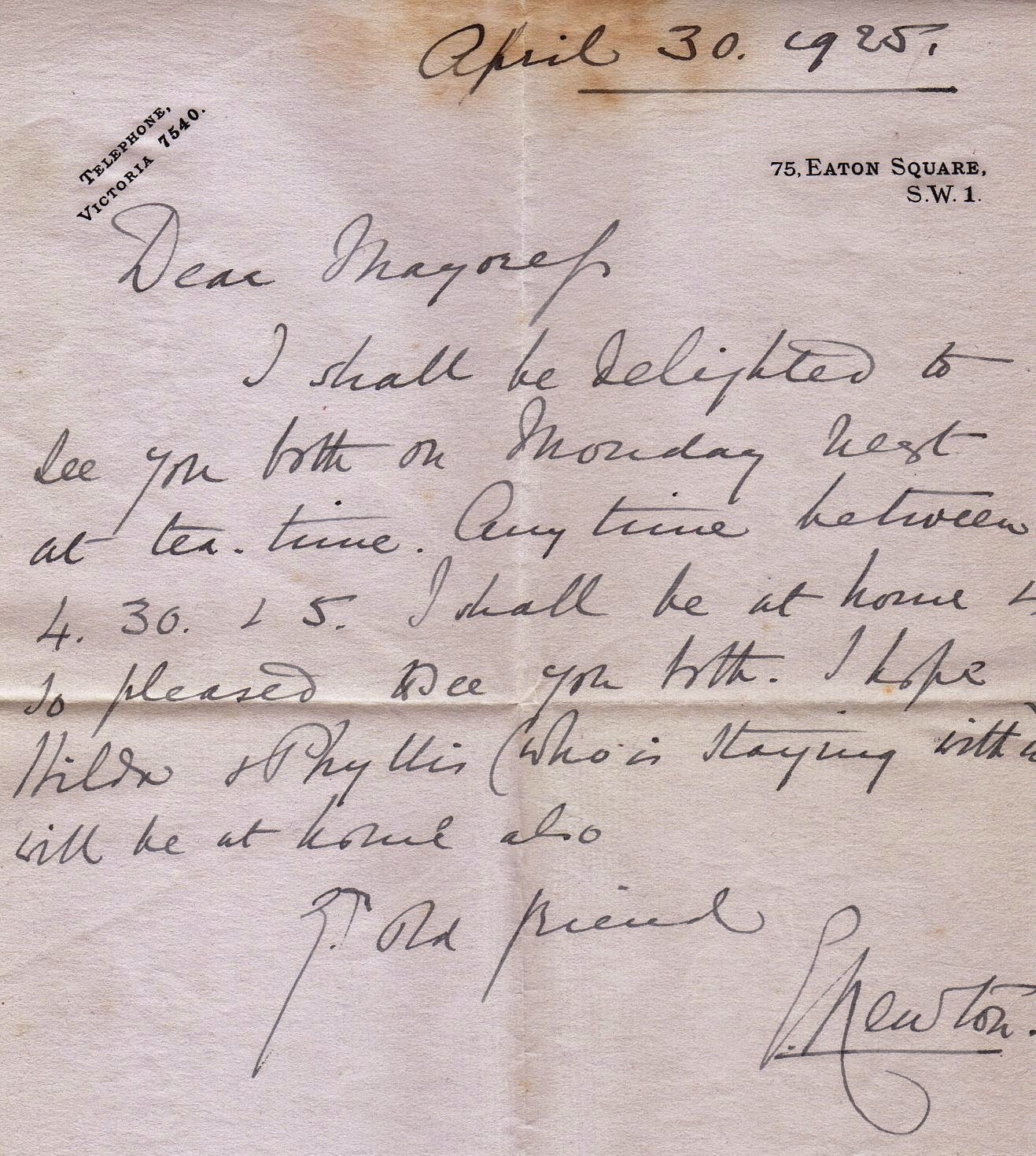
During his term as Mayor, Lady Newton also invited them both to tea when they visited London. In this and other letters, Lady Newton refers to her friendship for Florence who had once been her lady's maid.


He continued to serve as an alderman in Lowestoft for many years after his terms as mayor.

The Good Life - but War Arrives Again

John clearly appreciated the good life that his hard work had produced. He enjoyed boating and picnicking with family and took obvious pleasure in the vehicle and company in this picture. His brother Arthur George Barnard had gone to Australia and prospered greatly there; this picture is believed to be of the two brothers shortly before Arthur George's death.

John second from left and Florence third from left c. 1927
One of his many homes was Wissett Lodge near Halesworth, Suffolk. My husband's father (also John Barnard) had died suddenly of blood poisoning at the age of 35 on 19 December 1943. As if this hadn't created enough tragedy and turmoil for the family, just a couple of nights later a British Lancaster bomber crashed in a field behind Wissett Lodge on a return flight from Germany. Damaged and unable to deploy its bombs on its mission, it created a major impact that blew in the windows in the house. My husband was in the upstairs right-hand bedroom asleep when it happened and he remembers his mother and grandmother Florence coming to rescue him and cutting their feet in the broken glass. To say that this was a hugely stressful time for John would be an understatement.

Wissett Lodge, Halesworth, Suffolk

Final Days

He moved to Saxtead Green, Suffolk, to retire but died just 6 weeks into his retirement in January of 1945 (co-incidentally the same month that my paternal grandfather died half a world away). He and Florence were staying with daughter Winnifred and her husband Joe Smith at Pond Farm, Suffolk, at the time. My husband was a young child living with the Smiths and remembers that day well. There had been a draft through one of the lead-paned windows and John had got up from his death-bed to repair it, much to the surprise and shock of all the adults in the family. Shortly before he died, my husband was most amazed to hear his grandfather speak in a foreign language that he had never heard before - we now think that he was "speaking Forest" harking back to his childhood in the Forest of Dean.

Obituary and Burial

An update to how we located the obituary and grave sites of John and Florence can be located here.

Sources:

  • Barnard, Richard, "My Family History" school genealogy project based on information provided in the 1970's by Arthur Barnard, son of John Matthias Barnard
  • British Censuses for 1841, 1851, 1861, 1881, 1891, 1901
  • National Geographic Genographic Project DNA analysis dated 06 January 2013
  • Personal memories and original handwritten photographs, letters and memorabilia in possession of Graham Barnard
  • uboat.net website for "Ships hit during WWI", Trevone, accessed 26 April 2015

Labels: ,