Friday, 16 October 2020

Kenelm Winslow (1599-1672) (52 Ancestors 2020 Week 43) Theme: "Quite the Character"

Does the name make the man? Call a  man John or Edward and he may grow into the upstanding conventional sort of man those names seem to evince. Call a man Kenelm and it's quite possible he will be just a wee bit eccentric. At least that's my theory about why he among his Winslow brothers is the one who grew up to be quite the character!

Kenelm (my 8X great grandfather), born 30 April 1599, was  the fourth child born to Edward Winslow and Malgdalene Ollyver of Droitwich, England.  The names of his seven siblings were: Edward, John, Eleanor, Gilbert, Elizabeth, Magdalene and Josiah. Kenelm was named for his paternal grandfather, though we don't know whether the grandfather also had proven to be a bit of a character.

The Winslow family was quite well-to-do with father Edward owning a salt production business. The family home called Kerswell is still a magnificent home. My husband had made prior arrangements with the owners who graciously allowed us to have a tour inside the home on our 2004 visit to England. 

The old Winslow family home - Kerswell, photo taken 1998


It felt like such a tangible connection to be able to touch the ancient exposed beams that would have been touched centuries ago by Kenelm and his family. 


Lovely old beams from the time Kenelm grew up here at Kerswell, photos 2004


Of the five Winslow brothers, oldest brother Edward is the best known. He and younger brother Gilbert were both passengers on the Mayflower that arrived in America 400 years ago. (Gilbert returned to England within a few years and little is known of him.) Edward apprenticed as a printer and joined the Separatist religious group in Leiden, Holland, where he was involved in the underground printing activities of the dissident congregation. Once in America, Edward was one of the first signers of the Mayflower Compact, was a well-respected leader in the colony and is renowned for his report about that well-known first Thanksgiving at Plymouth Colony. 

Brother John Winslow (my 10X great grandfather) followed on the ship Fortune in 1621. He was a ship owner and respected businessman and took an active role in civic affairs like his older brother Edward. 

Another brother, Josiah, also arrived in Plymouth Colony in its early years, but he is sadly remembered for making a total shambles of trying to straighten out the financial affairs of the Colony. 

And then there was Kenelm.

He would have been about 30 when he arrived, unmarried, in Plymouth Colony. Unlike older brother Edward, his was not primarily a move for religious reasons. In fact, he sometimes found himself at odds with the church in his new home community, as we shall see. 

In 1634, he married the widowed Ellen (Newton) Adams. At the time of this marriage, Kenelm Winslow put up security to pay James Adams, Ellen's son from her first marriage, 5 pounds when he came of age. Kenelm was a man of his word: this was done and recorded on 26 December 1651. He and Ellen would have four children of their own, the oldest of whom was another Kenelm Winslow, my 7X great grandfather. 

In many ways, Kenelm was, like his brothers, an upstanding man and a major contributor to his new community. Having completed his seven year apprenticeship to Abraham Worthington prior to leaving England, he had been admitted to the Joiners' Company of London, England in about 1624. As a joiner, he would have designed and built much of the furniture needed by the colonists.  Kenelm was also known as the colony's coffin-maker.

Langdon (pp. 28 and 32) describes the significance of joiners to the community:  

The early settlers also made chests for themselves. They had joiners or cabinetmakers as they called them rather than carpenters, who did any work with wood for them that required skill in the mortise and tenon construction from building a house to making a chest or stool.  John Alden and Kenelm Winslow were the "joyners" of Plymouth.  They made chests and chairs and other furniture no doubt for the Pilgrims. . . .  From Plymouth Colony mostly there has come a type of chair, or two similar types of chair which are indeed instinct with dignity and certain formality but not so repellent in their magnificence.  These are the Carver Chair and the Brewster Chair.  It seems reasonable to believe that  John Alden  and Kenelm Winslow made quite a number of these, especially for the older leaders of the Colony.  There are chairs of these types extant ascribed to the ownership of Governor Carver, Elder Brewster, Captain Miles Standish and Edward Winslow.

Examples of Plymouth Colony furniture of the period can be found at the Plymouth Hall Museum website. 

In addition to his contributions to making the necessary furniture and coffins for the colony, Kenelm also took an active role in civic life. In 1635 he was one of the men chosen to assist the governor and council to set rates on goods and wages. In 1638 John and Kenelm Winslow were witnesses against Stephen Hopkins for selling wine at excessive prices. One might assume that they were just doing their rate-setting jobs, but it may equally have presaged Kenelm's propensity to take matters to court.

He was elected the town's highway surveyor where we get an early glimpse of him marching to the beat of his own drum. On 1 December 1640, he was fined 10 shillings for neglecting those surveying duties.

The following year, the Winslow brothers moved their families to Marshfield where Kenelm was living in 1646 when he was jailed for four weeks for for  using "approbrious words" against the church of Marshfield, calling them all a bunch of liars.

Memorial to the Early Settlers of Marshfield
Kenelm Winslow and wife Ellen listed between brothers Edward and Josiah and their wives


While resident in Marshfield, Kenelm was Deputy to the General Court 1642 - 44 and 1649 - 53. On 1 June 1647 he was chosen constable for Marshfield.   He served on juries and committees, but one sometimes gets the sense that he might have been granted these respected positions based in large part on the success and reputation of his older brothers. 

Stratton describes the many instances of Kenelm's litigious nature (pp. 376-77):  

On 4 June 1645 a committee examined his complaint of injustice and found it to be untrue.  He had said that he could not be heard in a case between himself and John Maynard, but the committee found the judge and jury without fault and ordered Kenelm imprisoned and fined 10 pounds.  On his petition the same day in which he acknowledged his offence and sorrow for same, he was released from imprisonment, and his fine was suspended for one year, and then if he showed good behavior, it would be remitted.  

On 5 May 1646 Kenelm was sued by Roger Chandler for detaining his daughter's clothes on pretense that she owed him further service, and the court ordered Kenelm to return her clothes immediately.

On the same day the court ordered Kenelm to find sureties for his good behavior for uttering those approbrious words against the Marshfield Church, having called them all liars. When he refused to do so, he was sentenced to prison, where he remained until the next month's court. 

Perhaps his month in jail taught him a valuable lesson for he seems to have gone quiet for awhile after these episodes. Still, one can imagine him in his workshop laboring over the next piece of furniture while fuming over some perceived slight, but he held things in check, at least for awhile.

Old habits die hard. On 7 March  1653/54 Kenelm complained against John Soule for speaking falsely of his daughter Eleanor by scandalizing her in carrying reports of her and Josias Standish. John Soule's father George requested that the matter be referred to another court to be tried by a jury of twelve of his equals, but  there is no further mention of the matter so perhaps the complaint was simply dropped. And that seemed to mark the end of Kenelm's public complaints.

Kenelm may have been a character who got himself embroiled in controversy, but he was not alone. People then were much like people now, notwithstanding their Puritan reputation. Cullity (p.9) recounted a couple of lawsuits involving my 7X great granduncles Joseph and Nathaniel Turner in nearby Scituate (spelling in the following as in the original): 

Consider the language and behavior reported in the suit brought by Charles Stockbridge and his wife, Abigail against Joseph Turner of Scituate in 1669. The two charged Turner with slander and defamation for reportedly saying that "the said Charles Stockbridge is a coocally rogue, and that Abigail, his wife, is as very strumpet as an in New England, and that the said Abigaill is a brasen faced whore, and that her husband is a coocally raskall, and he would prove him soe." Turner was fined 100 pounds. Another case in the same year involved the same Charles Stockbridge, but on the other end of the stick: "Mr. Joseph Tilden (1657-1712) complained against Charles Stockbridge, of Scituate, in an action of slander and defamation, to the damage of 1000 pound, for saying and reporting that Nathaniel Turner and Joseph Turner could kisse Elizabeth, the wife of the said Tilden, as ofte as they listed, and doe something else too, and that the said Nathaniel Turner knew her, the said Elizabeth Tilden, as well as her owne husband knew her.

Yes, this is of more than prurient interest in connection to today's story. Kenelm's great granddaughter Sarah Winslow would in the course of time marry James Whitcomb, the granddaughter of Nathaniel and Joseph Turner's sister Mary Turner. 

In any event, Kenelm lived another couple of decades, apparently in greater harmony with those around him. His eldest brother Edward died in Jamaica in 1655 while on colony business. Brother John had moved his family to Boston by then. No longer having his more successful brothers in  Marshfield may have put an end to much of his community involvement. 

Kenelm signed his will dated 8 August 1672. He must have had a premonition of his impending death which occurred 12 September while he was visiting his daughter at Salem; he was buried there the following day. His wife Ellen was named sole executrix of his estate which included real estate, money, goods and movables including a Bible and 7 other books. 

Some Resources:

  • Anderson, Robert C., The Great Migration Begins: Immigrants to New England 1620–1633, 3 Volumes (Boston: New England Genealogical Society, 1995–1996), Vol.3  pp. 2033-2036.
  • Cullity, Brian (Chief Curator), A Cubberd, Four Joyne Stools & Other Smalle Thinges: the Material Culture of Plymouth Colony, Printed for the Loan Exhibition May 8 - October 23, 1994, Heritage Plantation of Sandwich.
  • Follansbee, Peter, Connecting a London-Trained Joiner to 1630s Plymouth Colony article accessed online 15 October 2020 at https://www.incollect.com/articles/connecting-a-london-trained-joiner-to-1630s-plymouth-colony
  • Langdon, William Chauncy, Everyday Things in American Life 1607-1776, MacMillan Publishing Co., 1981.
  • Roberts Gary Boyd, Mayflower Source Records: Deaths and Burials from the Early Records of Marshfield, accessed 9 October 2020 on ancestry.com, Baltimore: Genealogical Publishing Co., Inc., 1986.
  • Stratton,  Plymouth Colony: Its History and People 1620-1691, Ancestry Publishing 1986.
  • Williston, George, Saints and Strangers, New York: Reynal and Hitchcock 1945.


Labels: , , , , ,

Thursday, 12 January 2017

Visiting England: Locating the Burial Sites for John Mathias Barnard and Florence Hacon

Despite his well-documented life, it proved quite difficult to locate records surrounding the death and burial of my husband Graham's paternal grandfather John Mathias Barnard. Nothing could be located online. No one in the family seemed to possess a copy of his obituary, death certificate or photographs of his tombstone, or any of those for his wife Florence Hacon Barnard.

Contacting local societies and records offices in Suffolk before our visit last summer had not produced any leads. An in-person visit to the Suffolk Record Office in Lowestoft brought results when we visited there with Graham's niece Kate and her husband Mark last August. We knew that John Mathias Barnard had died sometime in January of 1945, but didn't have the specific date. Because he had been Mayor of Lowestoft in the 1920's, we surmised that his death would almost certainly have warranted an obituary, or perhaps even a news item, notwithstanding that the Second World War was still in progress. The local paper in Lowestoft in 1945 was a weekly paper called the "Lowestoft Journal". It was fairly easy to find what we were looking for in the microfilmed edition for Saturday 20 January, 1945: "Death of Former Lowestoft Mayor: Mr. J. M. Barnard". The condition of the record was quite bad with folds or lines throughout, making it very difficult to read. Nevertheless, it was clear that he had died the previous Saturday 13 January 1945 at the home of his daughter Mrs. (Winnie) Smith at Pond Farm, Worlingworth, Suffolk. He was 69.

His business and political life in the town and surrounding area were outlined in his obituary. He had been well known in Lowestoft fishing circles through his ownership of fishing smacks in the firm of Slater & Barnard. He was a representative on the Lowestoft Town Council for several years and served as alderman and then as mayor in 1923-24 and 1924-25. He was appointed a J.P. in 1927. He had moved away from Lowestoft for a number of years by the time of his death, living for some time at Wissett Lodge. His membership in the Halesworth and District Branch of the National Farmers' Union reflected his interest in farming; he was vice-chairman of this organization at the time of his death.

The list of mourners included his widow, son A. J. Barnard and three daughters: Miss F. E. Barnard, Mrs. W. A. Smith and Mrs. B. E. Gethings. His sister Mrs. F. Muir, daughter-in-law (Graham's mother Margaret), two nieces (Mrs. D Bryant and Miss F. Yeoman), a nephew (A. Barnard) and some cousins named Mohan were listed, as was his son-in-law J. Smith. The names of others present at the funeral were also listed. Then came a very lengthy list of all the wreaths given in his memory.

The funeral had been held at St. Margaret's Church, Lowestoft, on Thursday (18 December 1945). Hymns were "Lead Kindly Light" and "Rock of Ages".

St. Margaret's Church, Lowestoft

A visit to St. Margaret's was definitely next on our agenda. After being pointed in the general direction of burial locations from the 1940's, Graham quite quickly spotted the stone for his grandparents.

Kate, Graham and Mark at the grave site


Photo by Mark Churchman


Photo by Graham Barnard

St.Margaret's Church has been the Parish Church in Lowestoft,Suffolk, for over five centuries. The exterior walls are constructed of flint and mortar. The copper spire was new in 1954 so would not have been there at the time of John's or Florence's funerals there. It replaced the original lead on timber spire. The gilded weathercock is the tallest point on any building in the area and is thus a significant landmark. During the Second World War, incendiary bombs fell all around this area. One hit the roof and set fire to the roof timbers, but prompt action saved the church.


The north aisle contains a "Fishermen's Memorial" with the names of local fishermen lost at sea between 1865 and 1923. No doubt many of these men would have been well known to John.

Fishermen's Memorial on wall to right
Photo by Graham Barnard

The brass lecturn is one of very few remaining from pre-Reformation days. It was buried for safety during Puritan times. It was again removed to a place of safety in the crypt during the Second World War, restored to its former position on 19 May 1945, four months after John Barnard's funeral here.


Sources:

  • Pye, Robert, "A Walk Around St. Margaret's", St. Margaret's Parochial Church Council, Hollingsworth Road, Lowestoft, Tyndale Press (Lowestoft)
  • "Death of Former Lowestoft Mayor: Mr. J. M. Barnard" from the "Lowestoft Journal" 20 January 1945 edition accessed on microfilm at the Suffolk Record Office, Lowestoft,Suffolk

Labels: ,

Tuesday, 25 October 2016

Visiting England: Yeovil,Somerset

My 9th great grandparents Stukely Westcott and Julianna Marchant were married in St. John's Church in Yeovil, Somerset on 5 October 1619. Stukely was from Ilminster, a town a few miles away, but the bride's Marchant family had deep roots in Yeovil. Family connections provided a perfect excuse for a visit to the town when we were in England this past summer.


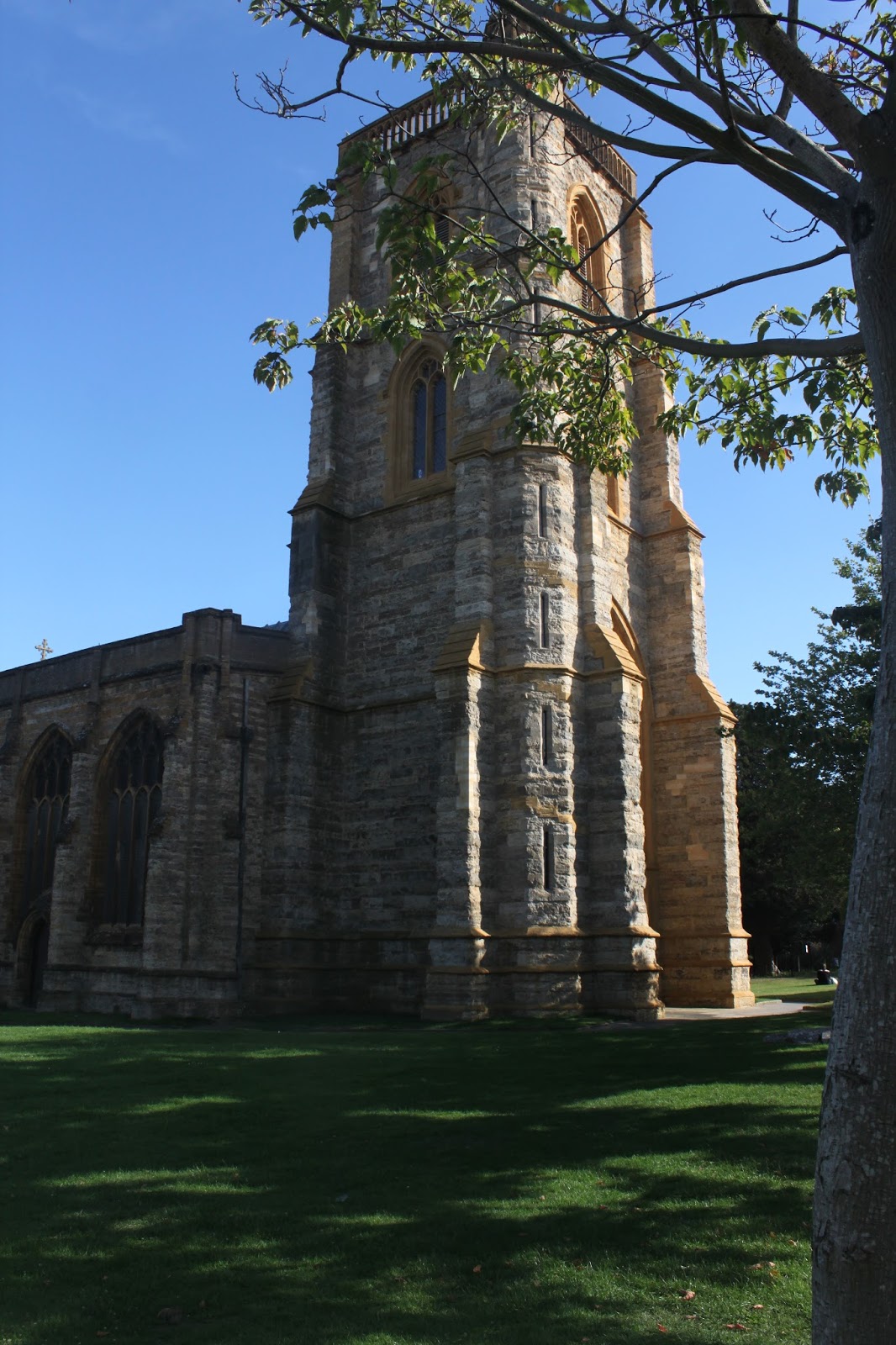
St. John's Church, Yeovil
St.John's Church dates from 1380 and is built from  local limestone thought to have been quarried just north of the building. St.John's is famous for its large windows that give it a sense of light and space. It does not take much imagination to picture Stukely and Juliana, both in their late 20's, taking their vows here.

Interior of St. John's Church, Yeovil

Stukely and Juliana soon became parents to a growing family: Robert, Damaris, Samuel, Amos, Mercy and Jeremiah were all born in England and were probably all baptised here between 1619 and 1635. The baptismal font is as old as the church and would have been used in their baptisms.


Baptismal Font in St. John's Church


An early King James Bible (pictured below) in a case in the chancel was given to the church in 1617, some half dozen years after this version was first published. This Bible would have been in the church by the time of Stukely and Julianna's wedding and the baptisms of their children.

Early King James Bible

Stukely and Julianna did not live out their lives in Yeovil. On 1 May 1635, they and their 6 children boarded a ship to move to America, settling first in Salem and then moving to Providence, Rhode Island where they were among the founding families. It would seem that, notwithstanding their ties to the beautiful and traditional St. John's Church in Yeovil, they were among the legions of dissatisfied English folk heading to New England in search of a different form of religious expression. In the case of Stukely and Julianna, their connection with Roger Williams in Providence is clear evidence that they were ardent Baptists.

But the family connection to Yeovil did not end or begin with Stukely. Julianna's family had ties running even deeper in Yeovil. Her grandfather Captain John Marchant and his wife Eva Cominge had also been married in St. Johns. Their marriage was celebrated here on 18 July 1568.


The church tower rises 90 feet and contains 14 bells, some dating from the 15th century. One wonders if the bells would have pealed for their wedding. Or for that of Julianna's parents John Marchant Jr. and Joan Cotington; no date has yet been found for their wedding, but it was probably held here as well.


In addition to marriages, many family baptisms occurred here over the centuries, as well as funerals and burials. Community gardens have replaced much of what might once have been burying grounds. Not surprisingly there were no signs of any Westcott, Marchant, Cominge or Cottington tombstones here.


Community Gardens in the Church Grounds at St. John's Yeovil


Labels: ,

Tuesday, 27 September 2016

Visiting England: Plymouth

When the Mayflower departed Plymouth harbour for the New World in September of 1620, a baker's dozen of my ancestors were on board, bound for religious freedom and the promise of a new life in America. Having visited their destinations in Plymouth Colony of what is now Massachusetts, I had always hoped to visit their port of embarkation. This summer we had an opportunity to do just that.

Plymouth, England

I had no great expectations of finding any trace of my ancestors ever having been here. Nearly 400 years had passed! Nevertheless, the harbour itself would be largely unchanged and very evocative of their last view of their homeland.


We were surprised, however, to discover a surprising number of references to the Mayflower such as this plaque listing the passengers, including my Mayflower ancestors.


A conspicuous tourist area supposedly marks the steps that the Pilgrims would have descended to get aboard the Mayflower, but it is highly unlikely that these steps were actually used by any of my ancestors to get aboard. It is thought that the actual boarding area was a few blocks away.


There is also a Mayflower Museum associated with the Visitors'  Centre, but we were short of time and had been advised by the locals that it wasn't a particularly good museum for documenting actual Mayflower history. We chose instead to spend our time taking in the other things that Plymouth had to offer. While enjoying a delicious dinner at The Barbican Kitchen, we discovered that it was situated in the Plymouth Gin distillery.


We also learned that this building is thought to have been where the Pilgrim fathers spent their last night in England. They would have been sheltered under this very ceiling. (No, it was not a gin distillery lounge at that time!)


Over the centuries, many other historic events occurred in Plymouth. Commemorative stones are scattered throughout the walls and sidewalks of the Royal Citadel and the Barbican areas.


This is a charming town with many quaint cobbled streets that have probably been here for hundreds of years. I kept asking myself: Did my ancestors walk here?


The Hoe is a flat area of grassland and commemorative monuments situated just above the harbour. There are stunning panoramic views across Plymouth Sound. Smeaton's Tower lighthouse is a distinct landmark.


Another genealogical bonus was awaiting us. While on The Hoe, we were reminded that Plymouth was the home town of Sir Francis Drake and that he supposedly played bowls here before sailing off to defeat the Spanish Armada. Aha! We had an ancestor, John Marchant,  who sailed with Sir Francis. My imagination took flight with images of men like Captain John and Sir Francis strutting around the streets of Plymouth prior to setting off in their grand sailing vessels from this very harbour.


Armada Memorial, Plymouth


Labels: ,

Sunday, 4 September 2016

Visiting England: The Baxter Family in Kettleburgh, Suffolk

On our recent visit to England, Graham and I found ourselves with a free morning before attending the 50th wedding anniversary party for his sister Stephanie and her husband Roger. The party was to be held at Framlingham College in Framlingham, Suffolk. According to my genealogy place list, Graham had ancestors living within a couple of miles of there back in the 1700's. Kettleburgh, here we come!


With the help of GPS and after only a few wrong turns, we found Kettleburgh, but had a bit more difficulty locating its church. Once off the main road that passes through the small village, we travelled down some lanes and (carefully) through a gaggle of tame geese to find a camping field that we took to be the church parking lot. Our first thought was that the church had been abandoned, but closer examination revealed that it was indeed still in use. (There are probably not a lot of church members as the 2011 census had a total population here of just 231.)


Graham's Read family ancestors who were born, baptised, married and buried in the area were mainly Baxters. Mary Baxter moved to Burg, Suffolk when she married William Ashwell on 3 August 1780. Mary and William's daughter Elizabeth Ashwell grew up to marry Bloomfield Read, Graham's 2X great grandfather.

Mary Baxter had family in Kettleburgh dating back to at least 1700. We can trace her lineage to her grandparents as follows:

  • Mary's Parents (Graham's 4th great grandparents): Joseph Baxter (1727-1803) and Mary Sallows (c. 1720-1783)
  • Mary's Grandparents (Graham's 5th great grandparents): Joseph Baxter (c.1700-1773) and Elizabeth Wright (c.1705-1788)
Searching the gravestones at St. Andrew's Church, Kettleburgh was not an easy task. The ground was quite rough and the vegetation had been winning its battle with the mower. We did not find any of the Baxter family stones, but finding any surviving 18th century stones is difficult in the best of situations. Nevertheless, we know that many of Graham's ancestors and extended family are buried here. Mary's grandfather Joseph Baxter was buried here in March of 1773. This same Joseph and his wife Elizabeth had lost their first-born son Benjamin shortly before his third birthday in 1728; young Benjamin is also buried here.


The church provides a very informative "History and Guide: St. Andrew's Church, Kettleburgh, Suffolk" prepared by Robert Warner in June of 1998. According to Warner, a church has stood here since at least Saxon times. The existing church dates mainly from the 1300's with the 51 foot western tower from the Decorated Period, 1350. The windows on the south side (as can be seen above) are irregular and date from a couple of centuries later.

photo courtesy Graham Barnard

The octagonal baptismal font dates from the early 1400's with a Jacobean oak font cover (painted yellow when described in 1712). The font can be seen in the lower part of the picture below.

  
This baptismal font (with the cover no doubt still yellow at this time!) would therefor have been used during the baptisms of many members of the Baxter family including:
  • Benjamin Baxter 4 April 1725
  • David Baxter 30 October 1726
  • Elizabeth Baxter 5 July 1730
  • Benjamin Baxter 30 January 1731
  • Jonathan Baxter 19 March 1733
  • Hannah Baxter 19 September 1736
  • Mary Baxter 19 February 1737
  • Sarah Baxter 13 April 1740
The wedding of Joseph Baxter and Elizabeth Wright occurred here on 16 August 1724. All of the children listed above are theirs. (No record has so far been located for a baptism for their son Joseph born in 1727.)


Because Graham's family were no longer in the area by the late 1800's, we can be reasonably certain it was not a relative of his who caused mayhem in the church in about 1879. A man was charged and fined by the Framlingham magistrates for riotous and indecent behaviour at the church during a Sunday afternoon service in September. Warner describes the situation: "He had seated himself in the gallery, with his dog on his lap and all was well until he urged the dog to 'speak to'em lad', whereupon it broke out into a great commotion of barking. Its master had obviously been drinking, and the Verger and his son had a struggle to eject man and beast, the service meanwhile having been abandoned."

Nor is he likely related to Samuel Hart, listed at Kettleburgh in Whites' Directory of Suffolk, 1844 as "herbalist and poet". His advertisement, again as noted by Warner: "Curer of bunions, Scab heads, Rheumatism, Scrofula and various other complaints incidental to the human frame. Poems and Pieces composed and arranged on any occasion!" Several of the gravestones in Kettleburgh are said to contain verses of his creation, but, sadly, we didn't come upon any of them in our search.


photo courtesy Graham Barnard


Labels: , ,