Thursday, 5 August 2021

Leigh Hovland (1890-1903) 52 Ancestors in 52 Weeks 2021 Week 33 - "The Chicago Iroquois Theater Tragedy"

from the funeral program of Leigh Nicea Hovland 3 January1904

When my third great grandfather Erik Anderson Elton immigrated to America from Norway in 1854, he was accompanied by his 24 year-old sister Sigrid Elton. 

Tragically, Erik died the following year at age 38 when he was hit by a falling tree. One might speculate that Erik's sister Sigrid would have offered support to Erik's widow Sarah Knutsdatter Holien and her two young daughters. 

Sigrid Elton would marry another Norwegian immigrant, Anders Lien, in 1857 and go on to have a family of 8 children with him. The oldest daughter in the Lien family was Anna born in 1860.
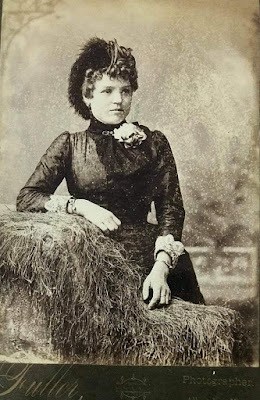
Anna Lien (1st cousin to my Dad's grandma Anna Elton)

When Anna was 21, she married another man of Norwegian heritage, John P. Hovland. 

Anna Lien and John P. Hovland
married 14 March 1881
Albert Lea, Minnesota


Anna and John had two daughters born in Albert Lea, Minnesota: Edna born in 1887 and Leigh in 1890.

Leigh (left) and Edna (right) about 1893
(Leigh and Edna were 2nd cousins to my grandfather John Bardahl)

Sometime before the 1900 U.S. census, the family moved from Albert Lea, Minnesota to Chicago, Illinois.  John was a successful businessman with a chain of clothing shops and a partnership in a silk importing business in Chicago. He was well able to provide his family with many of the fine things that life in Chicago could provide at the turn of the last century. 

One of those fine things was the wherewithal to attend live theater performances in the burgeoning theater district of Chicago. On 30 December 1903, with school out for Christmas vacation, the two Hovland daughters had tickets for the matinee performance of the popular musical comedy "Mr. Blue Beard" at the recently opened Iroquois Theater near the corner of Dearborn and Randolf Streets.


Advertisement from the Kansas City Times, 31 December 1903, page 4
The Iroquois was casting its net for audience members far and wide.


Location of Iroquois Theater Dearborn and Randolf (later the home of the Nederlander)

The elegant new theater was packed that afternoon with over 1700 people dressed in their holiday finery.  No doubt the teenagers Edna and Leigh Hovland were dressed in their nicest dresses and had been anticipating this outing to the theater in downtown Chicago. They were accompanied that afternoon by their 21 year-old cousin Clyde Thompson, a student at Wisconsin University. Clyde had been a holiday houseguest at the Hovlands' home at 33 Humboldt Boulevard. He is sometimes referred to as Leigh's "fiance" and it is possible that marriage was their long-term goal, notwithstanding their close kinship and her young age which make this sound unlikely to our modern ears. 

According to a newspaper article from the following day, it seems there were 16 people attending from a two-block stretch of Humboldt Boulevard, including 13 year-old Josephine Pilat with her mother and younger sister of 34 Humboldt. It is not much of a stretch to assume the Hovland girls and their cousin were with neighborhood friends.  The majority of the audience members for this midweek matinee were, not surprisingly, women and children. The first act went just fine, but a few minutes into the second act, a spark from a  stage light caught on some of the stage material and soon engulfed the building in flames. An asbestos curtain that should have prevented the spread of the flames jammed uselessly.

Tragically, it seems that many corners had been cut in an all-out effort to have the theater completed in time to take advantage of the busy theater season. Bribes may have enabled bypassing crucial inspections and safety equipment. Far from being "absolutely fireproof" as advertised, the Iroquois Theater was actually a firetrap. Exit doors had been locked; those that worked opened inward such that the crush of people trying to escape made it impossible to get the doors open. Younger children were trampled. Fire escapes led nowhere. Some doors also led nowhere. No exit signs had been lit since it was thought they would distract the audience from the performance. Family members easily became separated from one another in the mayhem that ensued.  

The Chicago Tribune 31 December 1903


602 people died that afternoon, including 13 year-olds Leigh Hovland, her cousin Clyde Thompson and her neighbor Josephine Pilat. Leigh's older sister had managed to escape, as had Josephine's mother and younger sister.

The Inter Ocean (Chicago, Illinois) · 31 Dec 1903, Thu · Page 5 

It took some time for all the bodies to be identified and returned to their families for burial. Although classified as "missing" the day after the fire, Leigh's obituary was printed just 3 days later. 


Chicago Tribune (Chicago, Illinois) · 3 Jan 1904, Sun · Page 7

Leigh was buried at Mount Olive Cemetery which had been started by the Scandinavian-American community of Chicago in 1889. The cemetery contains a tower with a bell which is rung each time a funeral procession enters through the limestone arch at the entrance. Presumably it was rung for Leigh on the afternoon of Sunday 3 January 1904. A photograph of her headstone can be seen on this Find a Grave memorial page for her.

An excellent series of photographs from the time showing the elegant new theater before the fire and then the terrible aftermath can be found on a video at this link

Leigh Hovland was my second cousin twice removed. She didn't have the opportunity to grow up to have a family of her own so as to leave direct  descendants to remember her. (Her sister Edna did marry and have a family and lived to the age of 82.)

The Iroquois Theater fire of 1903 has the sad distinction of appearing as the 5th most deadly fire/explosion in American history. Surprisingly, it is not nearly so famous as the less deadly Great Chicago Fire of 1871. In the aftermath, a series of investigations pointed to many faults and rampant wrongdoing, from the Mayor on down, but no one was ever held accountable.

The legacy of the terrible tragedy that took Leigh's life along with that of her cousin and 600 other people is that safety measures are now the expected norm. New standards were established in Chicago and most other jurisdictions with respect to aisles, exits, lit exit signs, fire alarms and other equipment. Exit doors must open outward (with "panic bars" or "push bars") so that they can open if there is a crush of folks trying to escape a burning building.

Although I live a long way from Chicago, I have twice had the opportunity to attend live performances at theaters there, most recently "Hamilton" in 2019. Located just blocks from where the Iroquois Theater fire had taken the life of Leigh Hovland, our enjoyment of the performance was not marred by concerns for our safety.


The author and her husband attending "Hamilton" at the CIBC Theater 27 February 2019


Some Resources:

  • Beatty, Jill, whose father was Leigh's first cousin, for sharing many of the family photographs and memorabilia shown above.
  • Everett, Marshall; The Great Chicago Theater Disaster: The Complete Story Told by the Survivors; c. 1904 D.B. McCurdy, Publishers Union of America, 389 pp., available online at http://livinghistoryofillinois.com/pdf_files/Great%20Chicago%20Theater%20Disaster,%20The%20Complete%20Story%20Told%20by%20the%20Survivors,%20by%20Marshall%20Everett%201904.pdf 
  • Podcast: Stuff you Missed in History Class, "The Iroquois Theater Fire" episode of 8 December 2014 accessible here: https://podcasts.google.com/feed/aHR0cHM6Ly9mZWVkcy5tZWdhcGhvbmUuZm0vc3R1ZmZ5b3VtaXNzZWRpbmhpc3RvcnljbGFzcw/episode/aHR0cHM6Ly9wb2RjYXN0cy5ob3dzdHVmZndvcmtzLmNvbS9oc3cvcG9kY2FzdHMvc3ltaGMvMjAxNC0xMi0wOC1zeW1oYy1pcm9xdWlvcy10aGVhdGVyLWZpcmUubXAz?hl=en-CA&ved=2ahUKEwjRl7Ok99bxAhXUrJ4KHZZ6CNoQjrkEegQIAhAF&ep=6
  • Uenuma, Francine; "The Iroquois Theater Disaster" article from the Smithsonian Magazine 12 June 2018 accessible here: https:www.smithsonianmag.com/history/how-theater-blaze-killed-hundreds-forever-changed-way-we-approach-fire-safety-180969315/

Labels: , ,

Thursday, 18 June 2020

Tora Iversdatter Kjerstein (1794-1861) (52 Ancestors 2020 Week 26) Theme: "Middle"

This week's theme had me stumped until I decided to see which ancestor lived closest to the middle of North America since all recent generations of my family have been widely scattered throughout the United States and Canada. There seems to be a bit of disagreement as to exactly where that is, but it is generally accepted as being in North Dakota. I did have ancestors in North Dakota, as it turns out, and other distant relatives living there now, including a second cousin once removed who farms near the area thought to be the "middle". Although we'd only met them previously one time at a family reunion in 2000, we had a most enjoyable visit on our road trip to view the solar eclipse in the summer of 2017.

That got me thinking about the other highlight of our trip through North Dakota: the Arne Brekke Collection in the Chester Fritz Library at the University of North Dakota in Grand Forks. For decades, the pinnacle of my wish list of resources for review was the Norwegian bygdebøker for the regions in Norway where many of my ancestors originated. These books were put together over one hundred years ago by respected Norwegian historians to detail farm and family life; they contain a wealth of genealogical information about individual families and, along with census and church book records, form the backbone for Norwegian family history research. Having tried unsuccessfully to obtain any of these treasured books on inter-library loan, and not having any repositories near my home on the west coast of Canada, I had almost despaired of ever getting my hands on any of these.

Our proposed route to Grand Island, Nebraska for viewing of the solar eclipse provided an ideal opportunity for a day at the Chester Fritz Library, one of the best homes for a vast collection of bygebøker.  I knew that one single day would not really be enough but thought that my husband could easily find ways to entertain himself for a day and that, with careful planning, I could make significant inroads with my wish list. 

The website for the Chester Fritz Library makes it easy to plan a visit. They provide details of the farm books they have in their collection enabling a visitor to make note of call numbers and relevant farm names. I prepared a binder with details of the books I hoped to find, the farms, the relevant ancestral names and dates. I also communicated with the librarian in advance to be sure they were open during the summer and to let them know which day I would be there. I did bring along my laptop with my genealogical database in case it was needed, but I found my binder of material to be quite adequate for my purposes. I also brought along memory sticks for anything I was able to scan and save from the books.

University of North Dakota - Chester Fritz Library

17 August 2017 dawned bright and clear, an auspicious sign. My husband dropped me off at the university just after its 8 A.M. opening. The librarians were most helpful in getting me oriented with the library layout and their user-friendly and efficient scanning equipment. As the only member of the public visiting the library that day, I had full run of the stacks and scanner. 

Inside the Chester Fritz Library Arne Brekke Collection

It was very easy to find the books, but more difficult to ensure I was finding all the relevant farms for my families. (My father's came from Nordland, Oppland and Buskerud counties and my mother's from Buskerud and Telemark. Within each county there were many relevant farms and families. We are not talking about a single family here, but dozens!) I could see the route ahead of me: it was going to be a full marathon.


In the middle of the fun - stacks of bygdebøker and some of my prepared family tree background

The day flew past in a flurry of books being swept off the shelves, examined and pages flagged for trips to the scanner. I barely stopped long enough to find the cafeteria for a quick lunch. In the end, I did get through my lengthy list. I'm not sure when I've ever had a more satisfying and exhilarating day! 

My husband captured this shot of the happy researcher when he picked me up at closing time

Were there farms and families that I missed? Yes, absolutely. I continue to make discoveries that would have entailed scanning other pages. But I have a lot of material to show for my one day well spent. 

Of course the books are in Norwegian and, although I've learned the basics, I do not have the depth of linguistic skill to understand the complexities without resorting to dictionaries and online translators with their often rather bizarre results. Part of the problem is the changes to the Norwegian language over the years since the records were created. Here are a couple of examples of results I've obtained for other Norwegian ancestors with Google Translate: "In 1746 Kristoffer made an agreement with Trond Hamre about the change of power, but Trond had the right to renegotiate because they were drowning when they made an agreement in a bar of beer at Hamre." And another: "Knut carried the storage team in 1591. In 1599 he got into the place of the fox for a butcher's sauce. Marit, who used to be in 1612, might have liked Knut, and Herbrand might be the son." Sometimes one can hazard a guess, but at other times it's just plain bewildering!

Trying to pinpoint a "middle" of Norway for selecting a particular ancestor for this week's story is a bit tricky because of Norway's shape. I randomly selected an area from the interior of the southern bulb of Norway: Vang in Oppland.


Google Earth Image - Vang is marked with the red pin

The bygedbok for Valdres, Oppland included my Dad's paternal grandmother Anna Ericksdatter Elton's family in Vang. Surely something could be found relating to a "middle" in this family! Anna Elton's farmor (the Norwegian name for the grandmother who is the father's mother - as opposed to a mormor who is the mother's mother; such a useful distinction!) was a woman named Tora Iversdatter Kjerstein. Already we are talking about 2 farm books here: Elton (Eltun) and Kjerstein. (You can see how this multiplied into a full marathon, can't you?) 

According to the bygedbok, Tora (my 3X great grandmother) was the middle child of the 11 born to Ivar Torsteinsson Kjerstein and Anne Kristoffersdatter Leirol (yet another farm name to look up!). Just 3 of the 11 survived childhood; fortunately for those of us who descend from her, Tora was one of the survivors, still remaining in the middle. 

One must go from the general genealogy found in the bygdebok to the official kirkebøker for the actual records. Tora was probably born in July 1794 on the Kjerstein farm since she was baptized 20 July of that year at Vang, Valdres, Oppland.  

Baptism record in the Vang kirkebøker for 1794, p. 427


Tora was confirmed into the state Lutheran church in 1809 and married Andris Erikson Elton (often spelled Eltun) on 6 July 1815 at Øye Kirke. The church was about a mile from the Eltun farm land. She was 21 and her groom 29.


Øye Kirke i Vang
Photo courtesy John Erling Blad Wikimedia Commons


Andris "gjorde soldatteneste" according to page 269 of the Valdres bygdebok; Google translates this as "did the soldier thing"!  He had been running the Nordigarden farm at Eltun since 1806 and was probably well set up to start his own family. 

6 July 1815 marriage record of Andris and Tora from the Vang kirkebøker, p.194


Tora and Andris, like her parents, had a family of 11 children, many of whom died in childhood. Their oldest was Erick Anderson Elton, my 2X great grandfather. In 1838, his father turned over Elton farm to Erick, who ran it until 1853 when he sold to emigrate to America,

Tora predeceased Andris by about 8 years; she died 31 March 1861 and was buried 9 April at Vang, Oppland, Norway.

Death and burial records for Tora Iversdatter at age 67, Vang kirkebøker for 1861, p.172

The bygdebok listing for Tora's family enabled finding the records that give us a bit of a picture of her life. It would be nice to know more about her, of course. What were her skills? What did she love doing? Did she have any eccentricities? What sort of woman was she, this middle daughter who survived?

Resources:

  • Valdres Bygedbok I, Del A, Skriftstyrar Ivar Aars, Gardar og Slekter i Vang av Anders Frøhom, Valdres Bygdeboks Forlag
  • Vang, Oppland Kirkebok, LDS microfilm 125645 and available online through the Norwegian Digital Archives.
  • Valdres Samband Genealogical Database (available to Valdres Samband members online) is another resource for the bygdebok for Vang.


Labels: , , ,

Saturday, 22 February 2020

Ingeborg Eriksdatter Elton (1794-1849) (52 Ancestors 2020 Week 9) Theme: "Disaster"

At the time this story is being written, news reports center on coronavirus COVID-19 causing self-imposed and officially imposed quarantines on shore and on cruise ships. Travel and business are being damaged as alarm is spreading around the world along with the virus. Although COVID-19 is a new virus, similar communicable diseases are not new; they have been around since time began and most certainly impacted the lives of our ancestors.

Cholera is one such disease. There have been a series of pandemics/epidemics over the centuries. The third wave of cholera in the 19th century was ongoing during 1849-1850 when members of my extended family succumbed to it.

Ingeborg Eriksdatter Elton was my third great grandaunt on my father's side, younger sister to my 3X great grandfather Andris Erikson Elton. She was born on the Elton farm in the Vang, Valdres area of Oppland, Norway and baptised 2 March 1794 in the Vang Church.

Vang Kirke Photo by John Erling Blad
Wikimedia Commons

When Ingeborg grew up she married Ole Knudson Stende on 18 October 1818 in the Vang Kirke and went to live with him on his nearby farm. The couple would have 3 children: Ingeborg Olsdatter Stende, Gunvor Olsdatter Stende and Knut (or Newton Andrew) Olson Stende. (There seems to have been a huge unexplained gap between the birth of first child in December of 1818 and the next apparently not until fourteen years later in 1832.)

By the middle of the 19th century, hordes of Norwegians were emigrating to America. Ingeborg and Ole were among them. The Vang church record for out-migrations shows the couple, each age 55 and the two younger children, Gunvor 17 and Knut 14 1/2 leaving for America in 1849.

Udflyttede record for 1849 (9 March) from the Vang church records

The passenger list  for the newly constructed Norwegian Brig Concordia shows Ole and Ingeborg and the two children making the voyage in steerage, leaving Bergen, Norway on 12 May 1849 and arriving in New York City almost two months later on 10 July. No doubt their experience was a far cry from the comforts experienced by ocean-going passengers today. After arriving in New York, they proceeded (again largely by boat) to Wisconsin, the most popular area for Norwegian settlers at that time.

Then tragedy struck! Both parents fell victim to the cholera epidemic sweeping the country. Within two days (24-26 July 1849) the two teen-aged children were left orphaned in a new land. Fortunately they were taken in by extended family members who had already immigrated to the area.

Peter Harstad (see Resource List below) discusses the history of the cholera epidemics in Wisconsin in the 1830s and in 1849-50. At the time, it was thought that impure air ("miasma") was the cause of the disease. Sometimes, more fatalistically, it was simply blamed on "Providence". Because of this lack of scientific understanding, it was mistakenly believed for awhile that the disease was not contagious. Treatments included bleeding or administering medicines such as mercury, laudanum (opium), morphine, turpentine and sulphur. Quarantines were sometimes attempted.

Although not necessarily fatal, the disease was very fast-acting with terrible symptoms of dehydration and diarrhea that often resulted in a quick death, seemingly within hours of the onset of any symptoms. Terrified of catching cholera, people often fled from one area to another, carrying the disease with them and making matters worse through close proximity on boats, trains and stage coaches and often sharing a common contaminated source of water or food. The middle of the 19th century was also the time of mass migrations during the Crimean War, the California Gold Rush and the Irish potato famine. People were on the move; cholera moved right along with them.

Business owners were terrified of potential economic damage caused by fear of the plague. The Milwaukee media shamed doctors and the Board of Health for trying to provide honest information to the public. Eventually the Board of Health doctors were replaced by lay citizens, generally businessmen who greatly underestimated the severity of the disease. This makes it difficult to get accurate statistics on the number who died in the epidemic.

Then, as now, immigrants were often made scapegoats. Irish immigrants fleeing the potato famine were frequently blamed for importing the disease into America. (Given the timing, it is probable that our family did not bring cholera with them from Norway and instead contracted the disease once they were in America.)

Matters were made worse just a week or two after the deaths of Ingeborg and her husband. President Taylor set aside the first Friday of August as a day for prayer, humiliation and fasting. Thousands flocked to congregate at church services, thereby spreading the disease even further. It was difficult to keep up with all the burials required. In some cases, if a whole family died, their house was simply burned to the ground with their bodies still inside. Presumably this didn't happen to Ingeborg and her husband since they had not been in the country long enough to establish a home.

***

Another of my relatives, John Bullen, my third great granduncle on my mother's side, also died of cholera in Wisconsin during this same epidemic. Born in 1783, he had been instrumental in starting the new settlement of Kenosha north of Chicago on Lake Michigan. He died there of cholera on 15 August 1850. No one else in his family seems to have succumbed, but he had been a particularly active man and would have been out and about in the community making him perhaps more vulnerable.

John Bullen (1783-1850)
A couple of weeks after John's death, Michael  Frank (Poormaster and Chief of Board of Health) recorded the Kenosha cholera fatalities in his diary of 26 August 1850, indicating that the epidemic appeared to have run its course with the number of fatalities that season being 32.

Four years later, a physician in London, England named John Snow discovered that cholera was being spread through contaminated drinking water. After this, improvements were made in hygiene and in water and sewage systems around the world such that cholera has largely been eliminated in developed countries.

Cholera continues to be a problem in war-torn, poor or devastated areas such as occurred in Haiti after the earthquake there resulted in contamination of their water supply. It is estimated by Phelps et al. (see Resource List below) that there are still 2-3 million cases worldwide resulting in over 100,000 deaths each year. Let us hope that medical practitioners, scientists, politicians and the public at large can successfully work together to contain COVID-19 so that it does not exact such an ongoing toll.


Resource List: 


Labels: , ,

Wednesday, 24 January 2018

Bardahl Sisters Lost their Lives in the 1918 Flu Pandemic


At the beginning of November 1918, my grandfather John Bardahl had four healthy sisters. By the end of the month, he had but two. As we remember the millions lost one hundred years ago in the 1918 "Spanish" Flu pandemic, it is fitting to pay homage to my two great aunts who were cut down in the prime of their lives. Susan and Hannah, this is for you.

Norwegian immigrants Hans Bardahl and Anna Elton  had a family of seven - sons Steve (Ostenson), John and Ole Bardahl and daughters Sarah, Susan, Hannah and Ella, all born between the years of 1868 and 1890 in Renville County, Minnesota.

Hans and Anna Bardahl Family c.1898 - Back left to right: Hannah, Ole, John, Susan
Front row: Sarah, Hans, Ella and Anna

In the census of 1900, the youngest five children are living with Hans and Anna in Elk Lake, Grant County, Minnesota.


Susan ("Susie") was also known by her Norwegian name Synnova. She was born 22 January 1886, making her 14 years old at the time of the 1900 census. On 31 May 1905, when she was 19, she married her cousin Carl E. Estergren.  Newspaper records give the bride's name as Susie Barlow.  Attendants at her wedding were Miss Louise Nelson (who would marry Susan's brother John a few months later), Jennie Nygren (perhaps a friend?) and Hannah Barlow (Susan's sister Hannah Bardahl).  A reception was given at the home of the bride's parents, Hans and Anna. 

Susan Bardahl Estergren

At the time of the 1910 census, Carl and Susie were living next to another Estergren family (probably Carl's brother) and Susie's parents lived on the second farm away.  At this time, Susie was 24 and Carl 27.  Susie had given birth to 2 children of which one remained alive -  Carl Vernon, just under 2. Living with them was Carl's mother (age 67) also named Susie Estergren (and, to add to the confusion, she was also Susie's aunt, being a sister to Anna). They owned their farm, which was mortgaged at that time. (It should be noted that sometimes parts of the family spelled the name as Estergreen with an extra "e".)

Carl and Susie had another son, Arnold, born in 1912. 

Carl and Susie's lives were probably going along well in their predominantly Norwegian farming community. They were active members of the Immanuel Lutheran Church near Barrett, MN. Little is known of any specific details or stories of their lives in those years. We don't know exactly how Susie contracted the infamous Spanish flu, but it was highly contagious. We do know that she came down with the flu on 4 November and died on 9 November 1918 at the age of 32, leaving a widowed husband and two young sons aged 6 and 10.

Stone for Susie Bardahl Estergren courtesy T Burt of Findagrave.com

She was buried the following day at Immanuel Lutheran cemetery near Barrett, Minnesota.

Immanuel Lutheran Church photo by Elinor Bardahl

It was fortunate that Carl's mother was living with them as she no doubt took over the household duties and helped Carl to raise his young sons.  The 1920 census shows the household with widowed Carl who now owns his home outright, sons Carl V.D. age 11, Arnold age 7 and widowed mother Susie age 78.


Still in shock from the death of one young daughter, Hans and Anna and the extended family were in for more bad news. Nine days after Susie's death, her spinster sister Hannah also succumbed to the flu. Hannah was just 30, having been born 26 November 1887. Had she perhaps gone to look after her sister and sister's family when Susie was ill? She was just 8 days shy of her 31st birthday. Reverend Ivar Sandberg conducted funeral services at the Bardahl house and interment was also in Immanuel cemetery. (Hans and Anna would ultimately also be laid to rest in this same cemetery.)

Hannah Amelia Bardahl


Bardahl stone courtesy T Burt of Findagrave.com


Hanna's stone courtesy T Burt of Findagrave.com
Immanuel Lutheran Church death records 1918 -
Susie and Hannah (#6 and #7) among just a handful (all far too young) who succumbed to the flu

The obituary for Hannah gives a sense of the horrible tragedy to the family: "He who spares neither age nor sex in the relentless toll of death has again entered a happy home and called away another dear daughter, sister and friend. Hannah Amalia, daughter of Mr. and Mrs. Hans Bardahl of Lien, answered the final summons Monday, Nov. 18th, after a four day illness of influenza-pneumonia.  She was a sweet winsome young lady, and held a warm place in the hearts of all she met on life's pathway. She was earnestly interested in the church and all its activities, and will be greatly missed by all. Her sister, Mrs. Ed. Estergren, passed away Nov. 9th. Death has indeed laid its hand heavily upon this family, and the bereaved ones have the heartfelt sympathy of the whole community in their sad hour of affliction."

Labels: ,

Saturday, 3 October 2015

Erick Anderson Elton (1817-1855) (Week 40) Theme: "October"

The theme this week is "October - What ancestor has a birthday or anniversary in October?"

Vang Kirke in Valdres, Oppland, Norway
Photo Courtesy John Erling Blad Wikimedia Commons

My great great grandfather Erick Anderson Elton married Sigri (Sarah) Knudsdatter Holien on 28 October 1844 in Vang, Valdres, Oppland, Norway. They would have just ten (or perhaps eleven) opportunities to celebrate their October wedding anniversary. But during that decade, they were a very busy couple and made a major decision that would change their lives and that of their descendants for all time.


Vang Church Marriage Records for 1844 showing
Erick and Sigri's 28 October wedding (detail shown above, highlighted in pink)
The marriage record shows that Erick was 28 at the time of his marriage and that his father's name was Anders Erickson. Erick's birth record in the Norwegian church records has him born 12 January 1817 and baptised 26 January 1817 at Øye i Vang.

Øye i Vang in Valdres, Oppland, Norway
Photo courtesy John Erling Blad, Wikimedia Commons

When Erick married Sarah, he became step-father to her 3 year-old son Hans Asbjornson Holien. (Sarah had given birth to a second son before their marriage, a boy named Henry Evenson, but he had either died or was being raised by someone else.) They soon added to their family before their first wedding anniversary when their daughter Synner (Susan) Holien was born 12 July 1845 and then another daughter Annie (my great grandmother) was born 14 March 1849. One final daughter Sigrid was born in 1852 but died within the year. Her death may have provided the final impetus for Erick and Sarah to do some soul-searching and make a major change in their lives.

The 1850's were times of great change in Norway. Every spring, shiploads of settlers from all over Norway headed across the Atlantic Ocean. The Vang area emptied out to the point where in 1920 its population was fewer than 2000 people. Tens of thousands of Norwegians were leaving for opportunities in America and Erick and Sarah soon joined that exodus.  The "utflyttede" (moving out) portion of the church records details the departure of the family for America on 10 April 1854: Erich Andersen age 38, Sigrid Knudsdtr age 39, Sannava age 11, Anne age 5, Plar Aslynsen age 13, and Sigrid Anderstr age 24. Although the names are a bit "off", presumably the children are Susan, Anne and Hans. Sigrid Andersdtr was Erick's younger sister who moved with them to America.

Location of Vang, Oppland, Norway marked with red pin
Image from Google Earth


Before leaving for America, Erick sold the Eltun farm to Trond Iversson Eltun who was married to another of Erick's sisters, Anne. After Trond's death, Anne continued to run the farm. The same farm exists to this day, now called Teigen.

By the time the Eltons sailed to America, their port of arrival most likely would have been Quebec even though the desired destination was the American Midwest. To reach this destination, Erick and the two women and three children probably would have gone by boat down the Saint Lawrence River from Quebec to Montreal and then taken a canal boat on the Welland Canal (completed just a few years earlier) to Lake Ontario, across Lake Ontario to Buffalo and then sailed the Great Lakes to the Midwest. (A railroad connecting Quebec and Detroit wasn't in operation until the year after their immigration.)

Points in the likely journey taken by Erick and Family in 1854
Image from Google Earth

The family first located in Iowa where Erick and Sarah would have celebrated their 10th wedding anniversary during their first October in America. They then moved to Goodhue County, Minnesota. Although we don't know their specific Iowa location, Goodhue County had many Norwegian settlers who moved there from Washington Prairie, Iowa, in 1855.

It would appear that Erick was either lumbering or clearing the Minnesota land for farming when he met his death by being crushed under a tree. This accident was a tragedy for the entire family who were left without brother, husband and father. It isn't clear how the family made ends meet since Sarah never did remarry. Sadly, she and Erick had celebrated so few 28 October wedding anniversaries.

Erick is buried in a small rural cemetery, now abandoned, near Kenyon, Minnesota. His plain marker indicates simply that he died in the Fall of 1855.

Gravesite of Erik Anderson Eltun who died Fall 1855
Photo courtesy Dave Vangsness from Find a Grave website

Old Hauge Cemetery, now abandoned, near Kenyon, Minnesota
Photo Courtesy Dave Vangsness from Find a Grave website

Sources:

  • Norwegian kirkebøker (church records) for Vang, Oppland, Norway accessed online at digitalarkiverket
  • Bygdebøk for Elton Farm at Vang, Valdres - information provided by Anstein.Haugen@adm.aho.no
  • LDS microfilms 125645, 125646
  • "Eltun-manuskriptet" provided by Mona Dolen to Astrid Jorgenson of Swift Current, Saskatchewan in 1996 (copy held by author)
  • Family History Library, Salt Lake City, "Research Outline - Norway" 
  • "The Valdris Book", 1920 accessed online on 1 October 2015 through this link


Labels: , , , ,