Thursday, 5 August 2021

Leigh Hovland (1890-1903) 52 Ancestors in 52 Weeks 2021 Week 33 - "The Chicago Iroquois Theater Tragedy"

from the funeral program of Leigh Nicea Hovland 3 January1904

When my third great grandfather Erik Anderson Elton immigrated to America from Norway in 1854, he was accompanied by his 24 year-old sister Sigrid Elton. 

Tragically, Erik died the following year at age 38 when he was hit by a falling tree. One might speculate that Erik's sister Sigrid would have offered support to Erik's widow Sarah Knutsdatter Holien and her two young daughters. 

Sigrid Elton would marry another Norwegian immigrant, Anders Lien, in 1857 and go on to have a family of 8 children with him. The oldest daughter in the Lien family was Anna born in 1860.
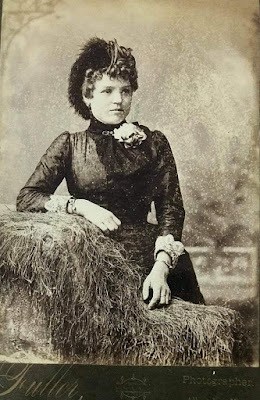
Anna Lien (1st cousin to my Dad's grandma Anna Elton)

When Anna was 21, she married another man of Norwegian heritage, John P. Hovland. 

Anna Lien and John P. Hovland
married 14 March 1881
Albert Lea, Minnesota


Anna and John had two daughters born in Albert Lea, Minnesota: Edna born in 1887 and Leigh in 1890.

Leigh (left) and Edna (right) about 1893
(Leigh and Edna were 2nd cousins to my grandfather John Bardahl)

Sometime before the 1900 U.S. census, the family moved from Albert Lea, Minnesota to Chicago, Illinois.  John was a successful businessman with a chain of clothing shops and a partnership in a silk importing business in Chicago. He was well able to provide his family with many of the fine things that life in Chicago could provide at the turn of the last century. 

One of those fine things was the wherewithal to attend live theater performances in the burgeoning theater district of Chicago. On 30 December 1903, with school out for Christmas vacation, the two Hovland daughters had tickets for the matinee performance of the popular musical comedy "Mr. Blue Beard" at the recently opened Iroquois Theater near the corner of Dearborn and Randolf Streets.


Advertisement from the Kansas City Times, 31 December 1903, page 4
The Iroquois was casting its net for audience members far and wide.


Location of Iroquois Theater Dearborn and Randolf (later the home of the Nederlander)

The elegant new theater was packed that afternoon with over 1700 people dressed in their holiday finery.  No doubt the teenagers Edna and Leigh Hovland were dressed in their nicest dresses and had been anticipating this outing to the theater in downtown Chicago. They were accompanied that afternoon by their 21 year-old cousin Clyde Thompson, a student at Wisconsin University. Clyde had been a holiday houseguest at the Hovlands' home at 33 Humboldt Boulevard. He is sometimes referred to as Leigh's "fiance" and it is possible that marriage was their long-term goal, notwithstanding their close kinship and her young age which make this sound unlikely to our modern ears. 

According to a newspaper article from the following day, it seems there were 16 people attending from a two-block stretch of Humboldt Boulevard, including 13 year-old Josephine Pilat with her mother and younger sister of 34 Humboldt. It is not much of a stretch to assume the Hovland girls and their cousin were with neighborhood friends.  The majority of the audience members for this midweek matinee were, not surprisingly, women and children. The first act went just fine, but a few minutes into the second act, a spark from a  stage light caught on some of the stage material and soon engulfed the building in flames. An asbestos curtain that should have prevented the spread of the flames jammed uselessly.

Tragically, it seems that many corners had been cut in an all-out effort to have the theater completed in time to take advantage of the busy theater season. Bribes may have enabled bypassing crucial inspections and safety equipment. Far from being "absolutely fireproof" as advertised, the Iroquois Theater was actually a firetrap. Exit doors had been locked; those that worked opened inward such that the crush of people trying to escape made it impossible to get the doors open. Younger children were trampled. Fire escapes led nowhere. Some doors also led nowhere. No exit signs had been lit since it was thought they would distract the audience from the performance. Family members easily became separated from one another in the mayhem that ensued.  

The Chicago Tribune 31 December 1903


602 people died that afternoon, including 13 year-olds Leigh Hovland, her cousin Clyde Thompson and her neighbor Josephine Pilat. Leigh's older sister had managed to escape, as had Josephine's mother and younger sister.

The Inter Ocean (Chicago, Illinois) · 31 Dec 1903, Thu · Page 5 

It took some time for all the bodies to be identified and returned to their families for burial. Although classified as "missing" the day after the fire, Leigh's obituary was printed just 3 days later. 


Chicago Tribune (Chicago, Illinois) · 3 Jan 1904, Sun · Page 7

Leigh was buried at Mount Olive Cemetery which had been started by the Scandinavian-American community of Chicago in 1889. The cemetery contains a tower with a bell which is rung each time a funeral procession enters through the limestone arch at the entrance. Presumably it was rung for Leigh on the afternoon of Sunday 3 January 1904. A photograph of her headstone can be seen on this Find a Grave memorial page for her.

An excellent series of photographs from the time showing the elegant new theater before the fire and then the terrible aftermath can be found on a video at this link

Leigh Hovland was my second cousin twice removed. She didn't have the opportunity to grow up to have a family of her own so as to leave direct  descendants to remember her. (Her sister Edna did marry and have a family and lived to the age of 82.)

The Iroquois Theater fire of 1903 has the sad distinction of appearing as the 5th most deadly fire/explosion in American history. Surprisingly, it is not nearly so famous as the less deadly Great Chicago Fire of 1871. In the aftermath, a series of investigations pointed to many faults and rampant wrongdoing, from the Mayor on down, but no one was ever held accountable.

The legacy of the terrible tragedy that took Leigh's life along with that of her cousin and 600 other people is that safety measures are now the expected norm. New standards were established in Chicago and most other jurisdictions with respect to aisles, exits, lit exit signs, fire alarms and other equipment. Exit doors must open outward (with "panic bars" or "push bars") so that they can open if there is a crush of folks trying to escape a burning building.

Although I live a long way from Chicago, I have twice had the opportunity to attend live performances at theaters there, most recently "Hamilton" in 2019. Located just blocks from where the Iroquois Theater fire had taken the life of Leigh Hovland, our enjoyment of the performance was not marred by concerns for our safety.


The author and her husband attending "Hamilton" at the CIBC Theater 27 February 2019


Some Resources:

  • Beatty, Jill, whose father was Leigh's first cousin, for sharing many of the family photographs and memorabilia shown above.
  • Everett, Marshall; The Great Chicago Theater Disaster: The Complete Story Told by the Survivors; c. 1904 D.B. McCurdy, Publishers Union of America, 389 pp., available online at http://livinghistoryofillinois.com/pdf_files/Great%20Chicago%20Theater%20Disaster,%20The%20Complete%20Story%20Told%20by%20the%20Survivors,%20by%20Marshall%20Everett%201904.pdf 
  • Podcast: Stuff you Missed in History Class, "The Iroquois Theater Fire" episode of 8 December 2014 accessible here: https://podcasts.google.com/feed/aHR0cHM6Ly9mZWVkcy5tZWdhcGhvbmUuZm0vc3R1ZmZ5b3VtaXNzZWRpbmhpc3RvcnljbGFzcw/episode/aHR0cHM6Ly9wb2RjYXN0cy5ob3dzdHVmZndvcmtzLmNvbS9oc3cvcG9kY2FzdHMvc3ltaGMvMjAxNC0xMi0wOC1zeW1oYy1pcm9xdWlvcy10aGVhdGVyLWZpcmUubXAz?hl=en-CA&ved=2ahUKEwjRl7Ok99bxAhXUrJ4KHZZ6CNoQjrkEegQIAhAF&ep=6
  • Uenuma, Francine; "The Iroquois Theater Disaster" article from the Smithsonian Magazine 12 June 2018 accessible here: https:www.smithsonianmag.com/history/how-theater-blaze-killed-hundreds-forever-changed-way-we-approach-fire-safety-180969315/

Labels: , ,

Saturday, 17 October 2015

Karen Marie Nilsdatter (1842-1915) (Week 42) Theme: "Proud"

This week's suggested theme is "Proud: Which ancestor did something that made you proud?" Like so many other "ordinary" immigrant women, my great grandmother Karen Marie Nilsdatter lived a life of courage and determination in starting over in a new land. No, she did nothing particularly heroic that would have garnered her any medals. Although no history books are likely to ever celebrate her achievements, she quietly went about doing what was required of her, leaving a trail of strength, goodness and love in her wake.

Karen was born in Norderhov, Ringerike, Buskerud, Norway on 23 December 1842 to Nils Torgersen and Olia Sorensdatter. No doubt because of the winter season, she was not baptised until 17 April 1843.


Church Record of 1842 birth and 1843 baptism of Karen Marie Nilsdatter

At the age of 15 she was confirmed in the local Norderhov Lutheran Church.


Karen's daughter Louise Nelson Bardahl's
comments and photograph of the Lucken, Honnefoss Church, 1969
Other images of this church (including its beautiful interior) and a description of the church, which was built in 1170, can be found through this link.

On the third of July in 1866, Karen married Carl Johan Nelson in the church pictured above. Their daughter Gunhild was born 23 August and baptised there on 15 September. Newlyweds Karen and Carl and baby Gunhild soon packed up and headed to America. The church records in Norway kept track of people who moved out of the parish in their "Uttflyttede" records such as this 1867 record for the departure of Karen, Carl and Gunhild to Wisconsin, America, recorded in January of 1867. One must admire women like Karen who could take a young baby on this courageous voyage across the Atlantic to an unknown life in America, knowing that she would probably never again see close friends, family, and the community that had formed her entire life to that point.

1867 moving out record for Carl, Karen and Gunhild (#6,7 and 8)
Carl's half brother Engebret Nilsen and his family (#2,3,4 and 5) moved with them
The story passed down in the family to my cousin Karen regarding her namesake great grandmother is one that makes me proud to descend from this woman. Apparently, at one time she and Carl experienced a difficult situation and Carl was about to throw up his hands in despair, asking how they were expected to move a lot of heavy sacks of grain across a road without a horse. Karen's response was to hoist up a load herself and say, "Like this." No doubt this is just one small example of this woman's strength of purpose. She was not just along for the ride but was a contributing partner to their success in establishing their family in this new land with new language and new culture.

They were in Wisconsin for only about 3 months before moving to Minnesota, first to Douglas County and later to Erdahl, Grant County, where they would remain for the rest of their lives. Census records show Carl and Karen and their growing family of 7 daughters and one son. Their youngest daughter, Louise, was my paternal grandmother.


Carl and Karen with their family identified in Carl's handwriting in which he uses the
Norwegian patronymic naming system showing my grandmother
Louise Nelson as "Louise Carlsdatter, born 5th of August 1881"
Above photos taken in 1890 - Karen would have been 48 years old in these pictures

In my grandmother Louise's "Fodselsdagbog" (day book) she recorded for 9 April (unknown year) "Mrs C.J. Nelson operated on for tumor". Both Carl and Karen were to ultimately die of stomach cancer. Carl went first, dying 4 December 1911. Karen survived him by nearly four years, dying 27 October 1915 in Erdahl, Grant County, Minnesota.

Her obituary was published in the Grant County Herald on 4 November 1915, page 5, part of which reads as follows:
"The death of Mrs. Carl Nelson at her home south of Erdahl Wednesday, October 27, after a lingering illness of about a year, marks the passing of one of Grant county's pioneers, and a woman loved and respected by all who knew her. 
Mrs. Nelson shared with her husband all the hardships and trials of pioneer days, as well as the happiness of contentment and achievement.
The funeral was held Friday, October 29 from the home, and later at the Synod Church in Erdahl, of which the deceased was a member. Interment was made in the Pomme de Terre Lake Cemetery." 
Headstone for Carl and Karen Nelsen
Erdahl Lutheran Cemetery (aka Pomme de Terre Lake Cemetery)
Grandson Kenneth Bardahl and his wife Elinor visited the area in 1992 

 Sources:

  • Website regarding Norway Parishes
  • Norwegian church records for Norderhov, Buskerud, available on Norway's Digital Archives
  • Minnesota Death certificates for Carl Nelson and Karen Nelson
  • Ancestry.com, U.S., Evangelical Lutheran Church of America, Records, 1875-1940
  • Fodelsdagbog of Louise Nelson Bardahl in possession of author
  • Ancestry.com, Minnesota Wills and Probate Records, 1801-1925


Labels: , ,

Saturday, 3 October 2015

Erick Anderson Elton (1817-1855) (Week 40) Theme: "October"

The theme this week is "October - What ancestor has a birthday or anniversary in October?"

Vang Kirke in Valdres, Oppland, Norway
Photo Courtesy John Erling Blad Wikimedia Commons

My great great grandfather Erick Anderson Elton married Sigri (Sarah) Knudsdatter Holien on 28 October 1844 in Vang, Valdres, Oppland, Norway. They would have just ten (or perhaps eleven) opportunities to celebrate their October wedding anniversary. But during that decade, they were a very busy couple and made a major decision that would change their lives and that of their descendants for all time.


Vang Church Marriage Records for 1844 showing
Erick and Sigri's 28 October wedding (detail shown above, highlighted in pink)
The marriage record shows that Erick was 28 at the time of his marriage and that his father's name was Anders Erickson. Erick's birth record in the Norwegian church records has him born 12 January 1817 and baptised 26 January 1817 at Øye i Vang.

Øye i Vang in Valdres, Oppland, Norway
Photo courtesy John Erling Blad, Wikimedia Commons

When Erick married Sarah, he became step-father to her 3 year-old son Hans Asbjornson Holien. (Sarah had given birth to a second son before their marriage, a boy named Henry Evenson, but he had either died or was being raised by someone else.) They soon added to their family before their first wedding anniversary when their daughter Synner (Susan) Holien was born 12 July 1845 and then another daughter Annie (my great grandmother) was born 14 March 1849. One final daughter Sigrid was born in 1852 but died within the year. Her death may have provided the final impetus for Erick and Sarah to do some soul-searching and make a major change in their lives.

The 1850's were times of great change in Norway. Every spring, shiploads of settlers from all over Norway headed across the Atlantic Ocean. The Vang area emptied out to the point where in 1920 its population was fewer than 2000 people. Tens of thousands of Norwegians were leaving for opportunities in America and Erick and Sarah soon joined that exodus.  The "utflyttede" (moving out) portion of the church records details the departure of the family for America on 10 April 1854: Erich Andersen age 38, Sigrid Knudsdtr age 39, Sannava age 11, Anne age 5, Plar Aslynsen age 13, and Sigrid Anderstr age 24. Although the names are a bit "off", presumably the children are Susan, Anne and Hans. Sigrid Andersdtr was Erick's younger sister who moved with them to America.

Location of Vang, Oppland, Norway marked with red pin
Image from Google Earth


Before leaving for America, Erick sold the Eltun farm to Trond Iversson Eltun who was married to another of Erick's sisters, Anne. After Trond's death, Anne continued to run the farm. The same farm exists to this day, now called Teigen.

By the time the Eltons sailed to America, their port of arrival most likely would have been Quebec even though the desired destination was the American Midwest. To reach this destination, Erick and the two women and three children probably would have gone by boat down the Saint Lawrence River from Quebec to Montreal and then taken a canal boat on the Welland Canal (completed just a few years earlier) to Lake Ontario, across Lake Ontario to Buffalo and then sailed the Great Lakes to the Midwest. (A railroad connecting Quebec and Detroit wasn't in operation until the year after their immigration.)

Points in the likely journey taken by Erick and Family in 1854
Image from Google Earth

The family first located in Iowa where Erick and Sarah would have celebrated their 10th wedding anniversary during their first October in America. They then moved to Goodhue County, Minnesota. Although we don't know their specific Iowa location, Goodhue County had many Norwegian settlers who moved there from Washington Prairie, Iowa, in 1855.

It would appear that Erick was either lumbering or clearing the Minnesota land for farming when he met his death by being crushed under a tree. This accident was a tragedy for the entire family who were left without brother, husband and father. It isn't clear how the family made ends meet since Sarah never did remarry. Sadly, she and Erick had celebrated so few 28 October wedding anniversaries.

Erick is buried in a small rural cemetery, now abandoned, near Kenyon, Minnesota. His plain marker indicates simply that he died in the Fall of 1855.

Gravesite of Erik Anderson Eltun who died Fall 1855
Photo courtesy Dave Vangsness from Find a Grave website

Old Hauge Cemetery, now abandoned, near Kenyon, Minnesota
Photo Courtesy Dave Vangsness from Find a Grave website

Sources:

  • Norwegian kirkebøker (church records) for Vang, Oppland, Norway accessed online at digitalarkiverket
  • Bygdebøk for Elton Farm at Vang, Valdres - information provided by Anstein.Haugen@adm.aho.no
  • LDS microfilms 125645, 125646
  • "Eltun-manuskriptet" provided by Mona Dolen to Astrid Jorgenson of Swift Current, Saskatchewan in 1996 (copy held by author)
  • Family History Library, Salt Lake City, "Research Outline - Norway" 
  • "The Valdris Book", 1920 accessed online on 1 October 2015 through this link


Labels: , , , ,

Tuesday, 28 July 2015

Sigrid (Sarah) Knudsdatter Holien (1815-1891) (52 Ancestors Week 30) Theme: "Challenging"

My great great grandmother was born Sigrid Knudsdatter Holien to Knud Endressen Holien (or Haalien) and Synnev Haagensdtr and baptised on 14 July 1815 at Holien, Vang, Valdres, Oppland, Norway. Whew! It's easy to see why she often went by a simpler "Sarah Holien" after she emigrated to the United States! Her name isn't the only challenging thing about Sigrid. It has been a bit of a challenge sorting out her children.

Using DNA matches, I have recently located two third cousins 1X removed who also descend from Sigrid. One of them has provided me with this image of Sigrid taken later on in her life.

Sigrid (Sarah) Holien

Sigrid married Erick Andersen Elton of Vang, Valdres, Oppland on 28 October 1844 when she was 29 years old and he was 27. This was a bit older than usual for a Norwegian bride at the time. But Sigrid had not simply been sitting around the house quietly becoming an old maid while doing traditional Norwegian embroidery, not by any means. She had produced two sons out of wedlock prior to her marriage - Hans born 26 April 1841 (father was Asbjorn Asbjornsen) and Evan/Henry born 30 June 1843 (father was Evan Evansen). Conveniently for family historians, the Norwegian church records indicate if a child is born to married or unmarried parents and list both mother and father, having a separate final column for naming who reports the illegitimate child - its mother or a friend or church member. Here are the two records for Sigrid's two sons:


Birth of Hans Asbjornsen Holien 1841


Birth of Even Evensen Holien 1843

The Vang stave church where the boys were baptized was the subject of much controversy in the 1840's. For over a decade, the church had been considered too small and in such poor repair that plans were afoot for its demolition. A new log church holding over 200 people was eventually constructed. Norwegian artist Johan Christian Dahl was determined to save the old stave church, but ran into ongoing cavils from the locals. Finally he arranged for an acquaintance, the Prussian Crown Prince, to take it over with plans to move it to Potsdam. In 1842 it was painstakingly taken apart, catalogued, pieces carefully organized, loaded onto a barge and taken to Berlin and finally re-erected at Bruckenberg in Germany, now Karpacz in the mountains of Poland. (The full story can be found at this Wikipedia entry.)  This entire saga occurred during the time that Sigrid was giving birth to babies and shortly before she got married. It would no doubt have been the talk of the parish. One might hope that it gave people something to gossip about other than Sigrid and her two sons born out of wedlock.

An interesting if somewhat surreal view of the ancient Vang Stave church where it is now located in Poland was recently filmed from a drone.

Sigrid went on to produce two daughters after she married Erich. Their daughter Synnev was baptised at Vang on 12 July 1845. A second daughter Anne (my great grandmother, also known as Anna or Annie) was born 14 March 1849 at Vang, Valdres, Oppland. (Anne would marry my great grandfather Hans Bardahl and become the mother of my grandfather John Bardahl. One of the witnesses at the wedding was Anne's half-brother Hans Holien. Until I discovered that he had been Sigrid's son born from an earlier relationship, I had often wondered if he might be related since he used the same farm name.)

Birth/baptism of Synnev (Susan) Ericksdtr Elton 1845

Birth/Baptism of Anne Ericksdtr Elton 1849

Erick sold the Elton farm to his sister Anne Andersdtr Elton and her husband Trond Ivarsson Eltun in the autumn of 1853 and he and Sigrid moved to America in 1854, leaving Bergen on 15 April. The church records (kirkebøker) list their departure for "Amerika" on 10 April as follows: Erich Andersen age 38, Sigrid Knudsdr age 39, Sanneva age 11, Anne age 5, Par Asylynsen age 13 (probably Hans Asbjornsen) and Sigrid Anderstr (Erich's sister) age 24. No mention is made of the other son Evan. There are pages and pages of departures for America in these church records throughout the 1850's - it is clearly a time of mass emigration.

On arriving in America, they often used the farm name as their surname Elton (sometimes given as Eltun, Elson, Ellent and other variations), Sigrid sometimes became Sarah but sometimes still retained her Norwegian surname of Holien and daughter Synova became Susan. The Eltons first settled in Iowa but soon moved to Goodhue County, Minnesota, an area populated by a massive number of Norwegian immigrants.

Erick met his death tragically in 1855 by being crushed under a falling tree and is buried at the Old Hauge Cemetery. He was just 38 or 39 years of age and it must have been a devastating loss to Sigrid and the family. No record of another marriage for her has come to light.

By the time of the 1880 US census, Sigrid Holien is listed as the 65 year-old head of the household at Warsaw, Goodhue County, Minnesota. Living with her are 39 year-old son Hans Holien, daughter-in-law Synner Holien (28), granddaughter Dinah (6), nephew Hulbrand Holien (20), grandson Almer Holien (2), nephew Gulbrand Holien (20), Andrew K Anderson (36), Andreas Overby (16) and grandson Endre Holien (10). Only the three youngest Holien grandchildren had been born in Minnesota and all others had been born in Norway.

Sigrid lived to the age of 75 , dying on 28 March 1891. She is buried at the Vang Lutheran Cemetery at Dennison, Goodhue County, Minnesota.


All 3 of the above images from the Vang Lutheran Cemetery, Dennison, Goodhue County, MN
provided courtesy Find A Grave photographer Dave Vangsness

Sources:

  • Norwegian church records for Vang, Oppland, Norway accessed online at digitalarkiverket
  • Bygdebøk for Elton Farm at Vang, Valdres information provided by Anstein.Haugen@adm.aho.no
  • LDS microfilms 125645, 125646, 307321
  • "Eltun-manuskriptet" provided by Mona Dolen to Astrid Jorgenson of Swift Current, Saskatchewan in 1996 (copy held by author)
  • 1880 US census for Warsaw, Goodhue, Minnesota, United States, Sheet number 259A

Labels: , , ,